




In 2007–08, a journey from Patna to Tajpur or even to Samastipur was nothing short of an ordeal. It took five to six hours on average, and if you were caught in the Gandhi Setu traffic jam, it could easily stretch to ten to twelve hours. That single bridge linking South Bihar with North Bihar was the only route available, and even that was in a deplorable state. The situation reflected not just the condition of the roads, but also the inefficiency of governance in the fifteen years of Lalu Prasad Yadav’s Rashtriya Janata Dal (RJD) rule. But today, the same journey takes just about two and a half hours
Even the Raghopur constituency near the capital city and the bastion of Lalu’s family faced decades of ignorance. People of the constituency have no option but to cross the Ganga by boat or through a peepa pool (pontoon bridge). But things have changed for the people of Raghopur. The newly inaugurated Kacchi Dargah-Bidupur six-lane JP Setu by Nitish Kumar is transforming the lives of lakhs of people by providing year-round, all-weather road connectivity to the capital Patna and other regions. Raghopur, once considered the impregnable fort of the Lalu family, now stands as a symbol of Bihar’s transition. “It was chaos every day, but things are smooth now. In just half an hour, we reached Patna from Raghopur without any difficulty,” recalls Rahul Paswan, a local from Raghopur.
This contrast, this single example, shows the changing destiny of Bihar. The roads are wider, villages are better lit, and conversations are less about survival and more about aspirations. There’s criticism, of course, no democracy breathes without it, but beneath that, there is trust.
Outsiders, who visited the State during the 1990s and early 2000s, can easily notice the difference. The smooth highways and newly constructed bridges have improved connectivity across Bihar. The question this election asks is not merely about change in infrastructure and in other fields, but it’s about continuity of ‘Trust’ versus return of ‘Ghosts.’
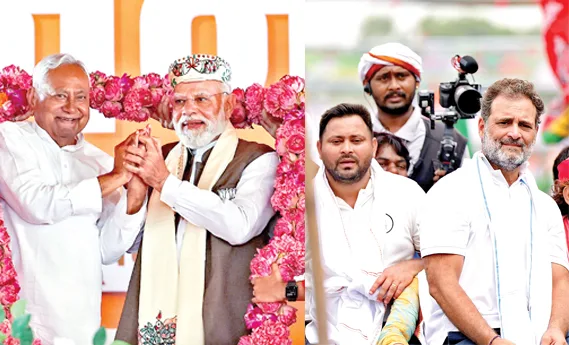
On one side stands Nitish Kumar, the longest-serving Chief Minister in Bihar’s history, now once again aligned with the NDA, powered by Prime Minister Narendra Modi’s national image. On the other side stands Tejashwi Yadav, young and determined to shed the shadow of his father’s “Jungle Raj.” Between these two poles lies the pulse of Bihar – cautious, watchful, and deeply political.
During my weeks-long journey across the State, I encountered two Bihars – one that has built trust over twenty years of governance, and another that is still haunted by the ghosts of its past.
Are these two Bihars, or the same Bihar? The people who trust Nitish are haunted by the Jungle Raj of Lalu. Two striking psychological factors that are defining the mood of the voters – trust about development and delivery, and the ghost of Jungle Raj reminding them of corruption and crime.
Jungle Raj vs Delivery
“Nature and signature never change,” said Shobha Devi, a woman in her late 50s, roaming on Patna’s Marine Drive with her husband and daughter around 11 pm. “We don’t want an RJD Government. We only want the BJP and Nitish Kumar. Tejashwi is young, yes, but no, no – character doesn’t change. A father’s nature shows through. That’s why we don’t want Tejashwi. Not at all. For now, for girls and for women, the BJP and Nitish Kumar are the best. No other Government is good. And Modi ji, especially, is doing very good work for the country.”
Her remark, sharp yet reflective, captures the core of Bihar’s “ghost” politics – the memory of Jungle Raj still haunts the State’s collective psyche.
The 1990s in Bihar remain etched in public memory as the era of “Jungle Raj”, when fear, caste warfare, and kidnappings replaced governance. During Lalu Prasad Yadav’s 15-year rule (1990–2005), the State witnessed an unprecedented collapse of law and order. Political protection emboldened criminals, and entire districts were held hostage by gang lords and caste militias.
In Bathe Bathi (Bhagalpur district, 1996), 22 members of the Koeri community were slaughtered by the CPI(ML)-backed militia. The Senari massacre (1999) followed, where Maoist groups lined up and executed 34 men in front of the village temple as revenge for earlier killings.
Meanwhile, kidnapping became a full-fledged industry. Businessmen, doctors, engineers, and even schoolchildren were abducted for ransom with alarming frequency. Newspapers of that period chronicled almost daily incidents of abduction, often involving relatives of legislators or local strongmen. A Patna-based trader recalled, “In those days, if you drove a white Ambassador car after sunset, you were almost inviting trouble.”
The numbers tell the story: over 32,000 murders, 12 large massacres, and hundreds of kidnappings were recorded between 1990 and 2005. Police morale collapsed, courts stagnated, and citizens fled to Delhi or Kolkata for safety. Villages lived under the rule of muscle and money, not law.
That legacy of anarchy still shapes Bihar’s political vocabulary. For Nitish Kumar and the NDA, “ending Jungle Raj” became not just a slogan but a psychological assurance. Every new road, streetlight, and police outpost today stands as a quiet reminder of the state’s long, painful journey from fear to stability.
In recent years, Tejashwi has consciously tried to reshape the RJD from a party synonymous with caste politics and chaos into one promising jobs, development, and governance, but he is still battling his father’s ghost. Lalu Prasad Yadav’s conviction in the fodder scam, his infamous legacy of patronage, and the collapse of law and order in the 1990s continue to hang over the RJD brand.
Even RJD’s three-time MLA leaders admit that the party is not using Lalu ji’s big image on posters because “his face revives old memories.” Tejashwi is trying to project a modern Bihar – one that talks of “one job per family” but the emotional residue of the past remains heavy.
In Bihar’s politics, memory is a vote. And ghosts vote silently. Whereas for NDA, the trust factor delivery has become the final nail in the coffin for Jungle Raj.
Multiple schemes with proper implementation like the Har Ghar Bijli, Mukhya Mantri Awas, Jal Jeevan Hariyali, Cycle Yojana, Poshak Yojana, and Pension for the Elderly, have created a tangible infrastructure of governance.
Even opposition supporters admit that governance is more structured. As one retired teacher told me, “Bihar no longer wakes up to fear; it wakes up to aspiration.”
The ‘M’ Factor
In village after village, one phrase echoed – “Nitish ji ne mahilaon ko samman diya, sambal banaya.” Women form the strongest emotional bond in Nitish Kumar’s political base, a constituency not merely of gender but of gratitude.
Just before the polls, nearly 1.21 crore Jeevika Didi across Bihar received the initial instalment of Rs 10,000 each under the Mukhyamantri Mahila Rozgar Yojana, a flagship initiative aimed at empowering women through financial inclusion. This money has been a game-changer for many women across Bihar.
At Kalyan Bigha, Rameshwari Devi showed me her goat, while talking about the Rs 10,000 she received under Mukhyamantri Mahila Rozgar Yojana – her symbol of empowerment.
“Haa humko 10000 rupaya mila hai,” she said proudly. “5000 se bakri khareede hai, baki 5000 se batidari pe khet lenge (land on loan). Nitish ji humein hamare pairo par khade kardiye hai, sab to kariye die hain.”
Nearby, Hemlata Devi, who hadn’t even received the Rs 10,000 due to Aadhaar issues, still said she would vote for Nitish: “I haven’t got the money yet, but I will still vote for him. My daughter studies, roads are built, and medicine is free. We live because of his work. Paisa milega to hum apne sabzi ka kaam aur badhaenge”
These voices tell a larger story. Bihar has 3.5 crore women voters, almost half of its electorate, and Nitish’s social policies, from Jeevika to liquor prohibition, have directly empowered them. And that is NDA’s ‘M’ factor.
The prohibition, often mocked for not being implemented properly but has transformed rural homes: incidents of domestic violence and alcohol-related spending fell sharply.
A 2016–2024 study showed that women in prohibition zones were 4–12 per cent less likely to face physical violence and 7 per cent less likely to face emotional abuse. Regular drinking dropped by nearly 70 per cent.
In a State long caricatured for lawlessness, these women have quietly turned policy into power. They are not just beneficiaries; they are Nitish’s most disciplined campaigners.
However, for INDI Alliance’s ‘‘M’ factor is Muslim votes that haunts them because of its overdependence For decades, the “MY” (Muslim-Yadav) coalition powered the RJD. But in 2020, this also got dented because of Asaduddin Owaisi’s All India Majlis-e-Ittehadul Muslimeen (AIMIM) and in 2025, this arithmetic is under strain.
In Seemanchal, Bihar’s eastern belt comprising Kishanganj, Araria, Katihar, and Purnia, the party has made deep inroads. In the 2020 Bihar Assembly elections, AIMIM made a surprising breakthrough by winning five seats, which include districts like Kishanganj, Araria, and Purnia. The party’s success was seen as a reflection of growing dissatisfaction within Muslims with both the RJD and Congress. Even though four of AIMIM’s five MLAs defected to the RJD, it shows that complete Muslim consolidation is unlikely this time too.
In fact, just before the first phase of polling, Tejashwi Yadav went on to call Owaisi an extremist, further hurting the ‘M’ factor. AIMIM is contesting 64 out of 243 seats under its GDA alliance, challenging RJD’s monopoly over the Muslim electorate. This fragmentation hurts the INDI Alliance far more than the NDA, which thrives on polarised or split voting
From Collapse to Construction
Development in Bihar is no longer an abstract slogan. Every village I passed by had a visible sign of governance – proper roads, a school with a boundary wall and proper infrastructure, a panchayat building, a power line and whatnot.
Yet, the same progress has cracks, sometimes literal ones.
The Sultanganj–Aguwani Ghat bridge, which collapsed twice into the Ganga, became a metaphor for Bihar’s engineering contradictions – massive investment, weak supervision. Over a dozen bridges collapsed across the state between 2024 and 2025, from Madhubani to Araria. Even Nalanda wasn’t spared, where a road overbridge caved in near the Chief Minister’s own district.
But what I sensed on the ground wasn’t rage; it was realism. “Pul gir gaya to kya hua, road to bana,” one villager, in fact, Bhagalpur, asked. “Kitna pul bana bhi toh hai, aap dekhe nahi kya?”
Deputy Chief Minister Samrat Choudhary emphasised the same thing when we had a conversation on development. He said, “We only talk about development. Because people must understand the difference between darkness and light. The joy that comes with the first ray of the sun – Bihar saw that dawn in 2005. And today, it is broad daylight; the State is growing steadily and will grow faster. Where Bihar once had barely 10,000 kilometres of roads, today it has 1.5 lakh kilometres. Villages have roads, power and good governance. Women can travel safely even at midnight. That is the change – this is the new Bihar. One must see both the darkness of ‘Jungle Raj’ and the light of ‘Sushasan’ to understand the transformation.”
There’s fatigue with corruption, yes, but not rejection of the idea of progress. The average Bihari recognises that development is a work in progress, and Nitish Kumar, despite his switches, is still seen as the man who began it.
On the other hand, for all his talk of jobs and industry, Tejashwi Yadav still struggles to show a credible governance record. Bihar’s education transformation stands as another example in favour of Nitish. Former IAS officer and JD(U) national secretary Manish Kumar Verma told me: “When Nitish ji came, there were no teachers, no schools, only Rs 4,000 crore for education. Today, it’s Rs 80,000 crore. Girls ride bicycles to school, and they get Rs 25,000 for Class 12, Rs 50,000 for graduation. He changed Bihar’s mindset.”
Jan Suraaj’s candidate from Kumhrar and mathematician KC Sinha added: “We give Nitish ji’s Government a first division, but Bihar can be a topper…”
Even critics like Sinha admit that Nitish delivered quantity, if not yet quality. That’s a more persuasive defence than Tejashwi’s untested claims.
The bridges that fall may make headlines, but the bridges that stand tell another story. Bihar’s road network, irrigation, and urban expansion are unrecognisable compared to the early 2000s.
In education, the progress is undeniable but incomplete. Enrollment is universal; quality remains the challenge. As Manish Verma said, “Education in Bihar is now about dignity.” As KC Sinha added, “Quality must now follow quantity.”
The Synergy of Coalitions
If politics is arithmetic, the NDA seems to have solved the equation. The alliance now represents a grand social coalition, Kushwahas, Majhis, EBCs, and women, alongside upper castes and Dalits. The BJP brings ideological clarity, while the JDU brings local credibility. Allies like the Lok Janshakti Party (Chirag Paswan), HAM (Jitan Ram Manjhi), and the Rashtriya Lok Morcha (Upendra Kushwaha) bring caste depth.
The NDA leaders campaign jointly; their messaging is coherent – “double-engine government, double development.” This synergy contrasts sharply with the INDI Alliance’s confusion of convenience. The INDI Alliance’s “Vote Adhikar Yatra,” launched with fanfare by Rahul Gandhi and Tejashwi, fizzled amid seat-sharing squabbles. From delayed seat-sharing to clashing candidates, the alliance looks like a coalition forced together by circumstance, not conviction.
There are over 10 constituencies where allies are contesting against each other. RJD vs Congress in Vaishali and Narkatiaganj, Congress vs CPI in Bachhwara, and RJD vs VIP in Chainpur. Even Vikassheel Insaan Party (VIP) chief Mukesh Sahni’s brother’s withdrawal in Gaura Bauram symbolised the chaos. By the time Tejashwi asked voters to support him, the candidate had already quit.
Such optics only reinforce the NDA’s pitch of broken opposition. If ghosts had shape, the INDI Alliance would be in disunity.
Pappu Yadav, who recently joined the Congress party, did not shy away from admitting that he doesn’t know his future in the INDI Alliance or Congress, if they win the polls. Not directly, but he subtly put that his criticism of outing only Tejashwi’s face on election posters is not going down well with the Mahagathbandhan. This is what he told me: “If, let’s say, if the Mahagathbandhan wins, I will be the first one to be thrown out. I know that. That’s how politics works – those who speak the truth are always the first to be sacrificed.”
Though even today, jobs remain Bihar’s most stubborn question – the issue that transcends caste, religion, and age. Both alliances have made grand promises. The NDA manifesto pledges 1 crore Government and other jobs, a Skill Census, Mega Skill Centres in every district, and a Mission Crorepati to turn Lakhpati Didis into entrepreneurs.
Tejashwi’s INDI Alliance manifesto counters with 2.5 crore Government jobs; it means “One government job per family.” But on the ground, the debate isn’t about numbers – it’s about credibility. On multiple occasions, Tejashwi failed to answer the question on how he will manage to get these many jobs in the State. I asked this question to Mathematician KC Sinha, who did the maths for us, “Bihar has around 3 crore families, but only about 25 lakh Government jobs exist and not everyone retires at once. How can you give one job to every family when the total number of jobs itself is far less than that? To create 3 crore jobs, the money required would exceed Bihar’s entire annual budget. Such promises sound good in speeches, but they collapse when tested by arithmetic.”
Politics of Perception: No Strong Anti-Incumbency
Between 2005 and 2025, the Nitish-led governments claim to have generated nearly 39 lakh employment opportunities, including 10 lakh in the government sector. Even if one discounts inflated numbers, the perception is clear – he did something. That’s the ultimate mark of delivery – the transition from chaos to bureaucracy.
Beyond trust and ghost, there is another factor – no strong anti-incumbency. Unlike 2020, there is no visible anti-incumbency, wave. It was evident when I was travelling across the state during the 2020 Assembly Polls. Nitish’s multiple side-switches have been internalised as political pragmatism rather than betrayal.The opposition has failed to create a single emotional narrative. In 2020, anger against Nitish was raw – pandemic distress, migration, and floods. In 2025, people seem to say, “He’s not perfect, but better than the rest.”
This subtle shift from resentment to resigned respect may prove decisive. The election of 2025 is not a clash of manifestos; it’s a battle of many things. Experts says that this election result will decide the coming 20 years of politics of Bihar.The NDA’s five trust factors, women’s empowerment, development, leadership, social synergy, and delivery, resonate with lived experiences. The INDI Alliance’s five ghosts, fear of past lawlessness, glorified poverty, communal overreach, credibility gap, and lack of unity, haunt its narrative. As I end my journey in Nalanda, the home district of both Nitish Kumar and ancient knowledge, I meet a group of schoolgirls cycling to their school. They wave as they pass, giggling, unaware that they are, in a way, Nitish Kumar’s real legacy.
Twenty years ago, girls like them weren’t on the road. Today, they are leading the way. Elections will come and go, alliances will form and fracture, bridges will rise and fall, but these girls represent a Bihar that has already crossed the bridge between past and future. The 2025 election, therefore, is not just about who wins; it’s about which Bihar prevails. The Bihar of trust that believes in its own progress. Or the Bihar of ghosts that keeps looking back in fear.















Comments