





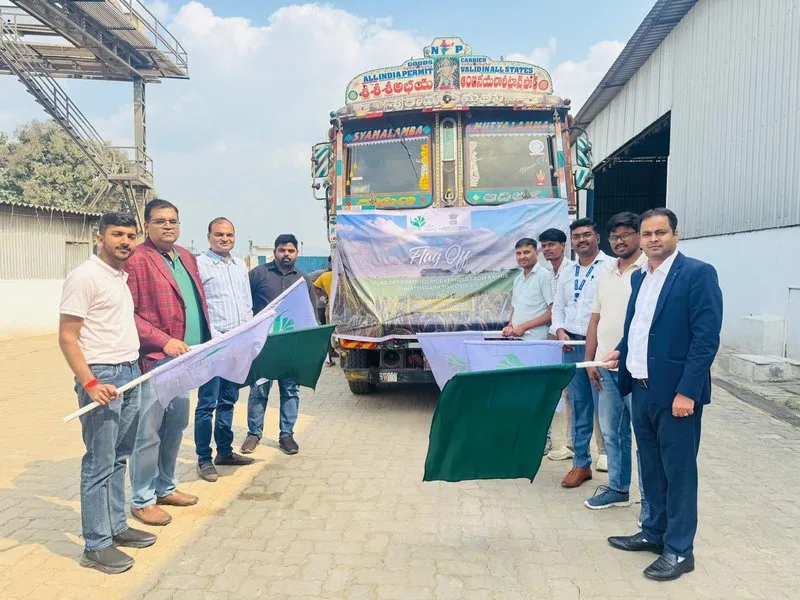
The Agricultural and Processed Food Products Export Development Authority (APEDA), functioning under the Ministry of Commerce and Industry, has enabled the successful shipment of 20 metric tonnes of fortified rice from Chhattisgarh to Papua New Guinea (PNG).
This export not only reinforces India’s position as a reliable supplier of fortified and value-added food products but also reflects the nation’s growing commitment to innovation-led agriculture, ensuring global food and nutritional security.
The consignment symbolises the steady rise of Chhattisgarh’s export capabilities and APEDA’s ongoing mission to expand India’s presence in high-value global markets. It also reflects India’s confidence in science-based agriculture, aligning with the government’s focus on “Make in India for the World.”
Chhattisgarh: Emerging hub for fortified food exports
Over the past few years, Chhattisgarh has steadily evolved from a traditional rice-producing state into a significant player in agricultural exports. The government’s initiatives to promote rice milling, quality testing, and export facilitation have empowered local farmers and entrepreneurs to access international markets.
The export of fortified rice represents the state’s leap into nutrition-oriented trade, with farmers, millers, and traders gaining both global recognition and economic benefits. This achievement, realised through a coordinated effort by APEDA, the Government of Chhattisgarh, and the private sector, highlights how state-level initiatives can integrate seamlessly with national export strategies.
According to officials, the shipment to Papua New Guinea also aligns with India’s broader goal of building a nutrition-focused food supply chain that serves global demand while promoting sustainable agricultural growth within the country.
At the heart of this achievement lies APEDA’s proactive role in supporting and strengthening India’s agricultural export infrastructure.
APEDA Chairman Abhishek Dev congratulated M/s Sponge Enterprises Pvt. Ltd., Raipur, the exporter of the consignment, and lauded the collective efforts of stakeholders who made the shipment possible.
“The export of fortified rice from Chhattisgarh exemplifies India’s growing competence in delivering premium-quality, science-based, and nutrition-oriented food solutions to global consumers,” said Dev.
He further reaffirmed APEDA’s dedication to providing capacity-building programmes, quality assurance systems, value-chain development, and market access facilitation. Through such comprehensive measures, APEDA aims to make India a leader in sustainable agri-trade and value-added exports.
The agency has played a pivotal role in establishing India as a trusted exporter of rice, processed foods, fruits, and organic produce, ensuring that farmers benefit from direct integration with global markets.
Industry welcomes government’s support
The export community of Chhattisgarh hailed this milestone as a turning point for local agri-industries.
Mukesh Jain, President of The Rice Exporters Association of Chhattisgarh (TREA-CG), expressed deep appreciation for APEDA’s guidance and logistical support.
“The export of fortified rice from Chhattisgarh is poised to open new global markets, reflecting the confidence of international buyers in India’s product quality and reliability,” said Jain.
He highlighted how consistent policy support, timely facilitation, and APEDA’s quality certification process have given exporters a competitive edge in global trade. Jain further noted that fortified rice exports are expected to expand into new regions across Asia and Africa, strengthening India’s role in global nutritional trade.
Fortified rice is created by blending rice flour with vital micronutrients, notably iron, folic acid, and vitamin B12, before extrusion into grain-like kernels. These fortified kernels are then mixed with natural rice to improve the nutritional profile of the staple.
India has emerged as one of the leading nations in food fortification technology, integrating science with traditional food systems. This innovation addresses key challenges of malnutrition, anaemia, and micronutrient deficiencies, particularly in developing countries.
Through fortified rice exports, India is not only tapping into a promising international market but also contributing to the United Nations’ Sustainable Development Goals (SDGs) related to zero hunger and good health.
The Government of India’s Poshan Abhiyan (National Nutrition Mission) has also been instrumental in promoting food fortification domestically, ensuring synergy between internal welfare schemes and global trade initiatives.
India’s expanding agricultural export portfolio
India’s agricultural export landscape is witnessing rapid diversification, moving from raw produce to processed, fortified, and organic food categories.
According to APEDA’s latest export data, fortified and processed food exports have seen double-digit growth in the past three years. Demand from Asia-Pacific, Africa, and the Middle East has positioned India as a key global supplier of nutrition-rich staples.
The fortified rice consignment from Chhattisgarh to Papua New Guinea marks a strategic addition to India’s export portfolio, showcasing its ability to meet stringent international quality standards and serve health-driven markets.
This growth also strengthens India’s aspiration to reach the USD 100 billion agri-export target, envisioned under the government’s Atmanirbhar Bharat and Viksit Bharat missions.
The success of the fortified rice export is rooted in the collaborative model between government agencies and private enterprises. APEDA’s support for export-oriented rice clusters, combined with the Chhattisgarh government’s focus on farmer training and infrastructure, has created an enabling environment for international trade.
Private companies, including M/s Sponge Enterprises Pvt. Ltd., have invested in modern processing facilities, testing labs, and quality control mechanisms to meet export standards. This ecosystem exemplifies how policy synergy and entrepreneurial initiative can transform local agriculture into a globally competitive industry.
Moreover, APEDA’s emphasis on traceability, certification, and sustainability ensures that Indian exports align with global expectations for ethical and responsible food sourcing.
Fortified Rice Exports
Many believe that India’s success in fortified rice exports could set the tone for broader diversification into fortified wheat, millet-based products, and nutritional snacks. With rising international awareness about food fortification as a public health measure, India is well-placed to capture a major share of the global fortified food market.
The Papua New Guinea consignment is expected to open trade discussions with other Pacific and African nations facing nutritional challenges, paving the way for long-term partnerships in food security.
By leveraging its agricultural expertise and manufacturing capacity, India can emerge as the “nutrition provider of the Global South”, fulfilling both commercial and humanitarian objectives.
The export of 20 metric tonnes of fortified rice from Chhattisgarh to Papua New Guinea stands as a symbol of India’s evolving agri-export vision, one that blends technology, nutrition, and sustainability.
Backed by the government’s proactive policy environment and APEDA’s facilitation, India is transitioning from a bulk commodity exporter to a global leader in value-added, health-oriented food trade.
This achievement not only enhances India’s global credibility but also empowers farmers, small entrepreneurs, and state economies. With fortified rice at the forefront of its nutrition diplomacy, India continues to strengthen its mission of feeding the world responsibly, one grain at a time.
















Comments