





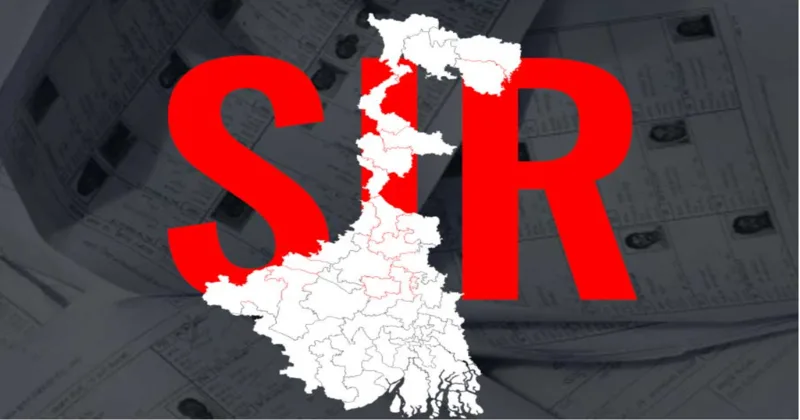
In recent weeks, West Bengal’s political discourse has been set ablaze by a three-letter acronym, SIR. While the term itself stands for Systematic Identification and Re-verification of voters, it has been turned into a lightning rod of misinformation and political rhetoric. What is essentially a constitutional and administrative exercise aimed at ensuring fair elections is now being portrayed quite deliberately as a sinister attempt to disenfranchise millions of voters.
Recently, Chief Minister Mamata Banerjee, leading a protest rally against SIR, declared dramatically, “Two crore voters will be removed from the list and sent to Bangladesh.” The remark immediately went viral, spreading panic and confusion among ordinary citizens. But the question naturally arises on what basis did she make such an alarming claim? Did she receive any official figure from the Election Commission? Or is this yet another instance of politically motivated fear mongering aimed at consolidating a vote bank through manufactured victimhood?
To begin with, there is nothing new or extraordinary about the SIR process. The Systematic Identification and Re-verification of the electoral roll is a routine part of election management in every democratic nation, including India. The Election Commission of India (ECI) has been constitutionally empowered under Article 324 to ensure free and fair elections, which includes maintaining a clean, updated, and accurate voter list. The ‘Representation of the People Act’, 1950, specifically ‘Section 21’, provides for the “preparation and revision of electoral rolls”. The purpose is simple: to include every eligible Indian citizen and to ensure that no ineligible or foreign individual appears on the list. The exercise thus aims both to prevent disenfranchisement and to stop electoral manipulation through fake or duplicate voters. Therefore, to portray SIR as a weapon against any particular community or political group is both misleading and dangerous. It undermines not only the credibility of the Election Commission but also the very spirit of democracy, where elections must reflect the genuine will of Indian citizens and not be distorted by inaccuracies in the electoral rolls.
In any democracy, the integrity of the electoral roll is the foundation of a free and fair election. Even a small percentage of fake or duplicate voters can tilt results, particularly in closely contested constituencies. West Bengal, with its complex demographic structure and long history of border infiltration, presents a unique challenge.
For decades, reports of illegal immigration from Bangladesh into West Bengal have been an open secret. Political leaders across parties, including the current Chief Minister herself, have acknowledged this fact in the past. In fact, Mamata Banerjee, while serving as a Member of Parliament, raised the issue in the Lok Sabha on August 4, 2005, stating: “The infiltration in Bengal has become a disaster now. I have both the Bangladeshi and the Indian voters list. This is a very serious matter. I would like to know when would it be discussed in the House?”
Those were her own words, not quoted by political opponents but recorded in the official parliamentary proceedings. What, then, explains the sudden transformation — from demanding action against illegal infiltrators to calling a voter re-verification drive an “anti-people conspiracy”?
The answer, unfortunately, lies in political expediency. Over time, sections of the political establishment have learned to convert illegal infiltration into a vote bank, turning demographic realities into electoral opportunities. In such a context, any attempt to purify the voter list naturally threatens entrenched political interests. Much of the current panic has been deliberately fuelled by conflating SIR with citizenship determination exercises such as NRC (National Register of Citizens) or CAA (Citizenship Amendment Act). It is essential to clarify that SIR has no connection whatsoever with citizenship.
SIR is conducted under the Election Commission, not the Ministry of Home Affairs. Its purpose is strictly administrative, to verify whether the names on the voter list correspond to living, eligible Indian citizens above 18 years of age. No one’s citizenship is questioned, revoked, or determined through SIR. To claim otherwise is a calculated attempt to mislead the masses. Equating a voter list verification with deportation proceedings is not only inaccurate but also socially irresponsible. Such fear-based politics damages trust in institutions and erodes public confidence in democratic processes. The Indian Constitution envisages the Election Commission as an independent constitutional authority, insulated from political interference. Article 324 entrusts it with the “superintendence, direction, and control” of elections to Parliament and State Legislatures. One of the Commission’s foremost duties is to ensure that every eligible Indian can vote, and no ineligible person can. This dual responsibility means the Commission must continuously update and revise electoral rolls; adding new voters, deleting deceased ones, correcting addresses, and removing duplications or fraudulent entries.
In essence, Special intensive Revision or SIR is a constitutional necessity. Without it, the authenticity of electoral outcomes would always remain in doubt. To question SIR, therefore, is to question the very legitimacy of India’s democratic framework. Ironically, those who take to the streets “with the Constitution in hand” to oppose SIR are, in fact, protesting against a process mandated by that very Constitution.
In West Bengal, the Election Commission initiated the SIR process to prepare for the 2026 Assembly elections. The objective was to ensure that the updated voter roll reflects only genuine and eligible Indian citizens. The Commission issued instructions for field verification, not to harass anyone, but to ensure that no individual is wrongly included or excluded. However, the political narrative has shifted dramatically. What should have been a technical, administrative process is now being framed as a political conspiracy. Misinformation is being spread that SIR will “send people to detention camps” or “cancel citizenship.” Local leaders of the ruling state party are warning citizens not to cooperate with election officials, alleging that “documents will be misused.” The result? Fear, mistrust, and confusion; especially among economically weaker and marginalized sections of society, who are most vulnerable to political manipulation. Instead of helping citizens understand their rights and responsibilities, the state’s political leadership seems intent on exploiting their anxieties for short-term electoral gain.
What makes the current situation truly ironic is that the same leaders opposing SIR today once championed the cause of identifying illegal voters. The change in stance appears to have less to do with principles and more with political arithmetic. At a time when the rest of the country is moving toward greater electoral transparency from electronic voting machines (EVMs) to VVPAT verification and digital voter ID initiatives, West Bengal’s political establishment seems to be resisting even basic verification of voter rolls. Such resistance not only undermines the Election Commission’s authority but also weakens the credibility of the entire electoral process. The strength of a democracy lies not merely in holding elections, but in ensuring that those elections are genuine, transparent, and trustworthy.
Instead of politicizing SIR, what the state urgently needs is public awareness and cooperation. Voter verification is not a punishment; it is a protection. Protection of your right to vote and protection of the democratic process from fraud and manipulation. Citizens should view SIR as an opportunity to correct errors in their voter IDs, update addresses, or ensure that deceased relatives’ names are respectfully removed. It is a step toward cleaner governance, not toward exclusion or discrimination. The Election Commission, for its part, must also ensure that the process remains transparent, fair, and humane, that genuine citizens are not inconvenienced, and every claim or objection is handled efficiently.
The uproar over SIR in West Bengal reveals a deeper malaise in our political culture, a readiness to trade truth for emotion, and constitutional reasoning for populist drama. Instead of helping citizens understand democratic processes, leaders are using them as tools of fear and division. SIR, in reality, is neither a threat nor a weapon. It is a constitutional mechanism designed to safeguard democracy. Its success depends not only on administrative efficiency but also on public trust and political honesty. By turning it into a political flashpoint, the ruling leadership risks damaging the very foundations of electoral integrity. In the long run, this serves no one. Not the voters, not the parties, and certainly not democracy itself. For a state that once led India in political consciousness and reform, West Bengal deserves better than politics of paranoia. It deserves clarity, truth, and a commitment to democratic purity, the very ideals that SIR seeks to uphold.















Comments