





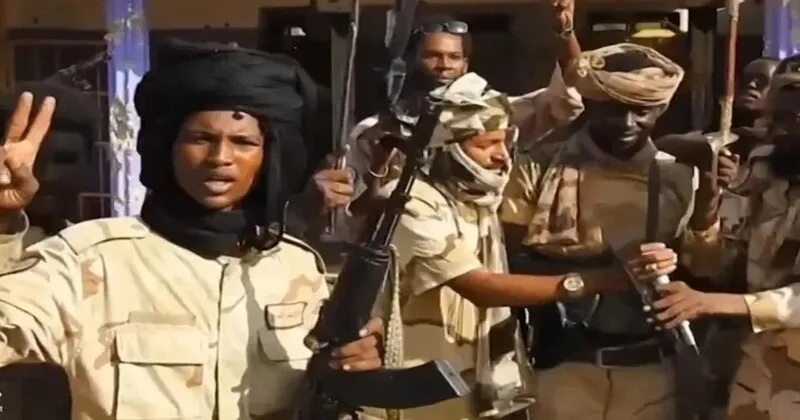
Thousands of people, including women and children, have reportedly been killed in a brutal massacre carried out by the Rapid Support Forces (RSF) in Sudan, where the genocide of the Non-Islamic communities continues to escalate. The atrocities are said to have begun after RSF rebels recently captured the town of El Shafir, with minorities and perceived opponents targeted in systematic killings. The UN has warned that the situation is “extremely serious,” as disturbing videos circulating online appear to show RSF fighters executing people lined up on the ground. Initial reports indicate that over 2,000 people were killed within just two days of violence. Although Sudan’s population is predominantly of Sudanese Arab origin, the RSF is specifically targeted minority groups, including Christians and members of local non-Arab tribes, each accounting for roughly 10% of the population.
The ongoing insecurity stems from a violent power struggle between Sudan’s military and the RSF that has persisted for more than a year. Following the historic 2019 ouster of long-time dictator Omar al-Bashir, tensions grew between General Abdel Fattah al-Burhan, head of the Sudanese Armed Forces (SAF), and RSF commander General Mohammed Hamdan Dagalo, widely known as Hemedti. Their rivalry has since plunged the country into full-scale civil war. According to current estimates, around 150,000 people have been killed since the conflict began. More than 12 million others have been displaced from their homes, forced to flee in search of safety. The international community’s limited response to these grave human rights violations and mass killings has raised serious concerns about accountability and civilian protection. Islamic nations such as the United Arab Emirates (UAE), Libya and Chad are reportedly providing the RSF with money and weapons, with arms being smuggled through Chad. Sudan’s official army, meanwhile, is backed by Egypt, Turkey and Iran, all Muslim-majority states as well. Regardless of who wins this war, the future of Christians and other non-Muslim minorities in Sudan appears bleak, with death looming sooner or later. The campaign unfolding in Sudan is seen as part of the broader push for Islamization across the African continent.
The RSF killed everyone here! It was soo bad, blood could be seen via satellite imagery . #FufuaICC#Sudanpic.twitter.com/tLDvyl1gPw
— Jacob Juma (@WhatEHappened) October 29, 2025
Hospitals become “Slaughterhouses”
As the conflict intensifies, hospitals in Sudan are increasingly becoming battlegrounds. The RSF recently captured the city of El Fasher, the main army stronghold in the Darfur region, leading to a surge in violence against civilians. In one of the most horrifying incidents, around 460 people were reportedly massacred inside the city’s principal healthcare facility, Saudi Maternity Hospital, considered the last fully functional hospital in the region. This assault came shortly after more than 2,000 civilians were killed by armed groups the previous day. According to the World Health Organization (WHO), last Sunday marked the fourth attack on the hospital within a single month. A nurse was killed and three other medical workers were injured in the latest strike. Photographs from the scene showed bodies lying across the hospital floor, alongside shattered medical equipment, a grim picture of the violence inflicted.
Media report say that surgeons were forced to flee mid-operation as heavy mortar fire struck the facility. She recounted that a patient undergoing surgery suffered severe open wounds when an explosion hit the operating theatre, and chaos erupted as staff attempted to escape bombardment. The Sudan Doctors Network (SDN) has condemned these attacks, saying hospitals have effectively turned into “slaughterhouses.” The group further alleged that RSF forces abducted six healthcare workers, including four doctors. A ransom of US$150,000 has been demanded for their release. Since the conflict began in April 2023, the RSF and allied militias have repeatedly been accused of engaging in ethnically targeted attacks, particularly against non-Arab communities. With El Fasher now under full RSF control, more than 250,000 people, many belonging to minority tribes, are believed to be trapped inside the city, with communication networks deliberately disrupted to block reporting and emergency outreach. Currently, Darfur and Kordofan regions are largely under RSF control, while the Sudanese Armed Forces maintain authority in the central and eastern parts of the country, including the capital, Khartoum. As clashes continue between the two rival militaries, civilian casualties continue to mount, and humanitarian access remains severely restricted.
















Comments