





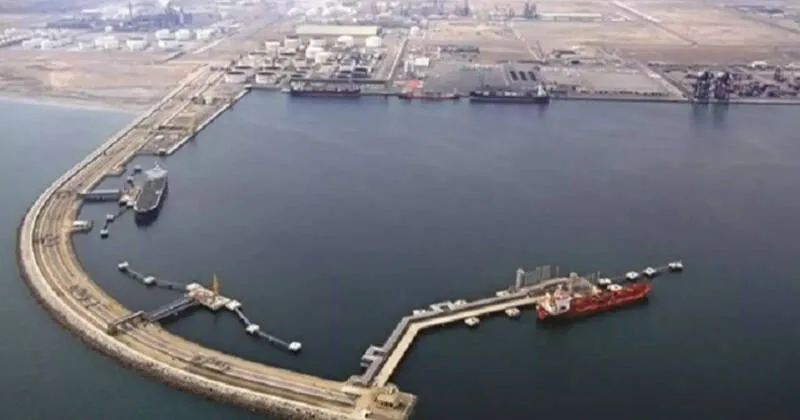
The United States has finally bowed to India’s demand to lift sanctions on Iran’s strategic Chabahar port, restoring a vital link for New Delhi’s regional trade and connectivity plans. The move marks a major diplomatic victory for India, which has invested heavily in the construction and operation of the port under its full control.
Chabahar, located in Iran’s Sistan-Baluchistan province, is a deep-sea port that serves as India’s direct gateway to Afghanistan and Central Asia, bypassing Pakistan entirely. The sanctions, extended by the US last month to include Chabahar, had forced India to halt operations temporarily.
India has consistently argued that Chabahar is a humanitarian and economic lifeline for Afghanistan, facilitating the transport of essential goods such as food grains and medicines. New Delhi also highlighted that the port is crucial for maintaining regional stability and promoting connectivity with landlocked nations. Responding to India’s consistent pressure , Washington has now granted a waiver on sanctions until early next year, enabling the full resumption of operations.
India’s Strategic Gateway
Chabahar has long been central to India’s regional strategy. When the US first imposed sanctions on Iran in 2018, the port was exempted due to India’s diplomatic efforts. The exemption allowed New Delhi to maintain its engagement with Tehran while advancing its connectivity projects in the region. India’s focus on Chabahar deepened after the signing of the India–Iran–Afghanistan trilateral agreement in May 2016, during Prime Minister Narendra Modi’s visit to Tehran. The pact aimed to establish an international transport corridor through Chabahar, enhancing trade access to Afghanistan and beyond. India took charge of operations at the Shahid Beheshti Terminal under India Ports Global Limited (IPGL) in 2018, further cementing its presence.
New Delhi’s commitment is reflected in its substantial financial contributions, a $120 million investment for port development and a $250 million loan for associated infrastructure. India had also allocated ₹100 crore in its 2024–25 budget to support Chabahar’s expansion. With the recent sanctions lifted, these investments are now secure.
Expanding Infrastructure and Connectivity
India plans to expand Chabahar’s handling capacity from the current 100,000 twenty-foot equivalent units (TEU) to 5 million TEU. The port is also being linked by a 700-km railway line running through Iran’s interior, aimed at improving connectivity to Afghanistan, Central Asia, and Russia. Both the port and rail projects are expected to be fully operational by mid-2026, significantly boosting India’s trade outreach.
Chabahar’s location on the Gulf of Oman, just 140 km from Pakistan’s Chinese-controlled Gwadar port, gives India a crucial strategic edge. While China and Pakistan have sought to expand influence through Gwadar under the China–Pakistan Economic Corridor (CPEC), India’s operational control over Chabahar counters that dominance. The temporary US sanctions had briefly undermined India’s regional leverage, but their removal restores New Delhi’s position as a major stabilising force in the Arabian Sea region.
Regional Implications
Meanwhile, reports suggest that Pakistan’s army chief, General Asim Munir, has been in direct contact with US President Donald Trump regarding a new port project in Pasni, Balochistan, only 150 kilometres from Chabahar. The initiative, reportedly tied to rare earth mineral exploration, reflects Islamabad’s anxiety over India’s revived advantage. However, Washington has yet to respond to the proposal, underscoring its recognition of India’s growing strategic role.
With the Chabahar waiver reinstated, India has reaffirmed its diplomatic clout and commitment to regional connectivity. The decision not only safeguards India’s economic interests but also strengthens its position as a reliable partner for regional development and stability in the Indian Ocean and Central Asian corridors.













Comments