





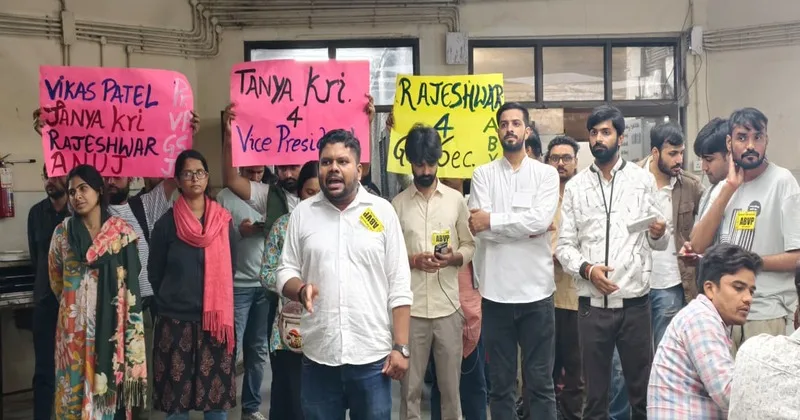
NEW DELHI: As the JNU Students’ Union elections approach, the campus atmosphere is once again charged with political discussions. However, this time, the tone is distinctly different. The left-wing student groups, who have long dominated the university’s political sphere, now appear to be on the defensive, while the Akhil Bharatiya Vidyarthi Parishad (ABVP) has emerged with renewed confidence, organization, and a result-oriented image.
In the previous JNUSU elections, the Left groups contested separately and suffered major setbacks—losing several school-level councillor seats and a decisive defeat in the post of Joint Secretary. In contrast, ABVP achieved a historic victory in that category, propelled by its strong organizational structure, consistent student outreach, and constructive initiatives.
These repeated defeats have generated a visible sense of unease within the Left camp. Across campuses such as Delhi University, Hyderabad University, and Panjab University, leftist student organizations have been witnessing a gradual decline in influence. Students today are increasingly distancing themselves from confrontational and slogan-driven politics, leaning instead toward accountability and tangible results—a shift now clearly evident even in JNU’s ideologically vibrant environment.
Fearing another loss, the Left groups have temporarily set aside their internal differences to form a united front. However, this alliance appears to be a product of political necessity rather than ideological alignment. Among students, there is a growing perception that this unity is fragile and unsustainable, owing to internal disagreements over ideology, leadership, and priorities within the Left bloc itself.
Meanwhile, ABVP has remained consistently active at the grassroots level—raising issues of student welfare, engaging constructively with the administration, and ensuring visible improvements in campus facilities. Its actions over the past term have demonstrated a clear focus on solution-oriented leadership, rather than the politics of obstruction. Consequently, political dialogue in the university has shifted from slogans to substance, underscoring ABVP’s growing influence.
Many students now believe that campus politics is evolving from rhetoric toward accountability, performance, and a nationalist perspective. The central question has changed from “Who protests more?” to “Who delivers more?”
During its previous tenure, ABVP implemented several impactful initiatives—reviving the long-defunct Railway Reservation Centre, restoring the ‘U-Special’ bus service, improving healthcare facilities, and maintaining a sustained dialogue with the university administration. These initiatives have significantly enhanced ABVP’s credibility among students.
As one student aptly remarked, “Students now want to see who actually takes up issues and delivers results. Mere slogans no longer work.”
While the Left alliance has attempted to project unity by bringing multiple organizations together, it remains internally divided and ideologically inconsistent. Many students feel that this lack of coherence and clarity has eroded the Left’s traditional base on campus.
Unlike previous years, the Left’s campaign this time lacks both energy and conviction. Their slogans and statements often seem reactionary responses to ABVP’s initiatives rather than expressions of an independent vision.
Across the campus, students are increasingly gravitating toward constructive, result-oriented, and nationalist politics. Many believe that through its consistent engagement, performance, and accountability, ABVP has emerged as a credible force, while the Left alliance continues to depend on outdated slogans and waning ideological rhetoric. The political space once dominated by the Left is now being steadily reclaimed by ABVP’s grassroots-driven and nationalist approach.
















Comments