





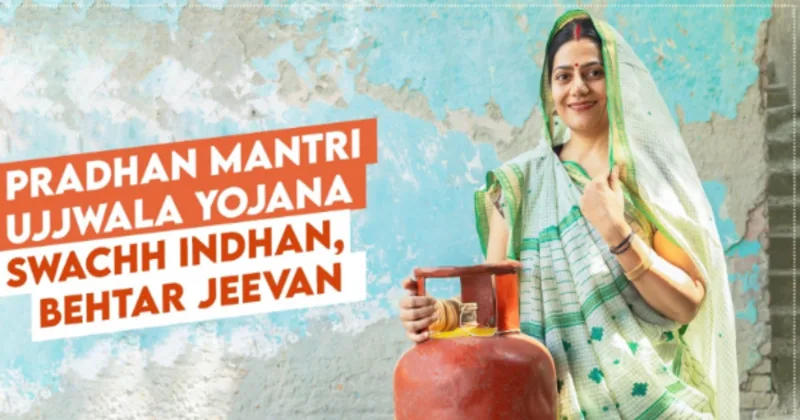
While introducing the Pradhan Mantri Ujjwala Yojana (PMUY) in May 2016, it was not merely a social welfare initiative but the beginning of India kitchen clean energy revolution. The scheme sought to substitute smoky stoves and wood with the blue flame of Liquid Petroleum Gas (LPG) so that every woman irrespective of her economic status, could cook in a clean, safe and respectable environment.
PMUY marks nine years of Blue Flame revolution on May 1, 2025 it is one of India’s most recognizable public health and environmental initiatives. The numbers narrate the story, 10.33 crore LPG connections have been disbursed among women belonging to below-poverty-line households in the nation, making India dream of access to clean fuel a ground reality.
From Smoke to Blue Flame
Before Ujjwala Yojna, rural households used to rely on cow-dung cakes and firewood fuels that created serious indoor air pollution, resulting in chronic respiratory problems in children and women. The scheme altered that reality by providing adult women of economically weaker sections and backword, tribals with deposit-free LPG connections.
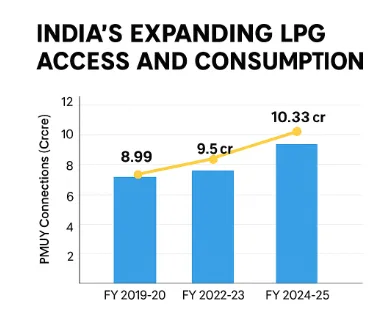
On March 1, 2025, India has 32.94 crore active domestic LPG consumers, of which one-third 10.33 crore are PMUY beneficiaries. That means every third household consuming LPG today is associated with this flagship welfare programme.
Ujjwala 2.0: Reaching the Unreached
Based on initial success, Ujjwala 2.0 was rolled out by the government in August 2021, focusing on families still left behind. The second phase introduced with a people-centric approach by relaxing documentation process. Migrant families who were usually left behind because of unavailability of proof of address or ration cards, now access connections through easy self-declaration.
By January 2022, the target of 1 crore new connections was attained eight months before target. By witnessing success, the government raised the target to 1.60 crores by December 2022. This momentum carried through with another 75 lakh connections sanctioned for the 2023–26 period which were implemented successfully by July 2024.
Expanding the Last-Mile Delivery Network
One of the most important drivers of Ujjwala success has been the growth of the distribution network of LPG in rural India. Since the programmes was started, Oil Marketing Companies have played the role of bringing villages which hitherto were out of reach for energy infrastructure.
From April 2016 to October 2024, 7959 new distributorships were initiated throughout India, and an impressive 93% (7,373) of them are based in rural regions. This decentralised growth increased convenience and confidence at the grassroots level.
The total distributorship network expanded from 13,896 in 2014 to 25,481 in 2024 with a 83% increase in a decade. Rural distributors grew from 6,724 to 17,560 a 161% increase with indication that energy inclusion is no longer limited to urban areas.
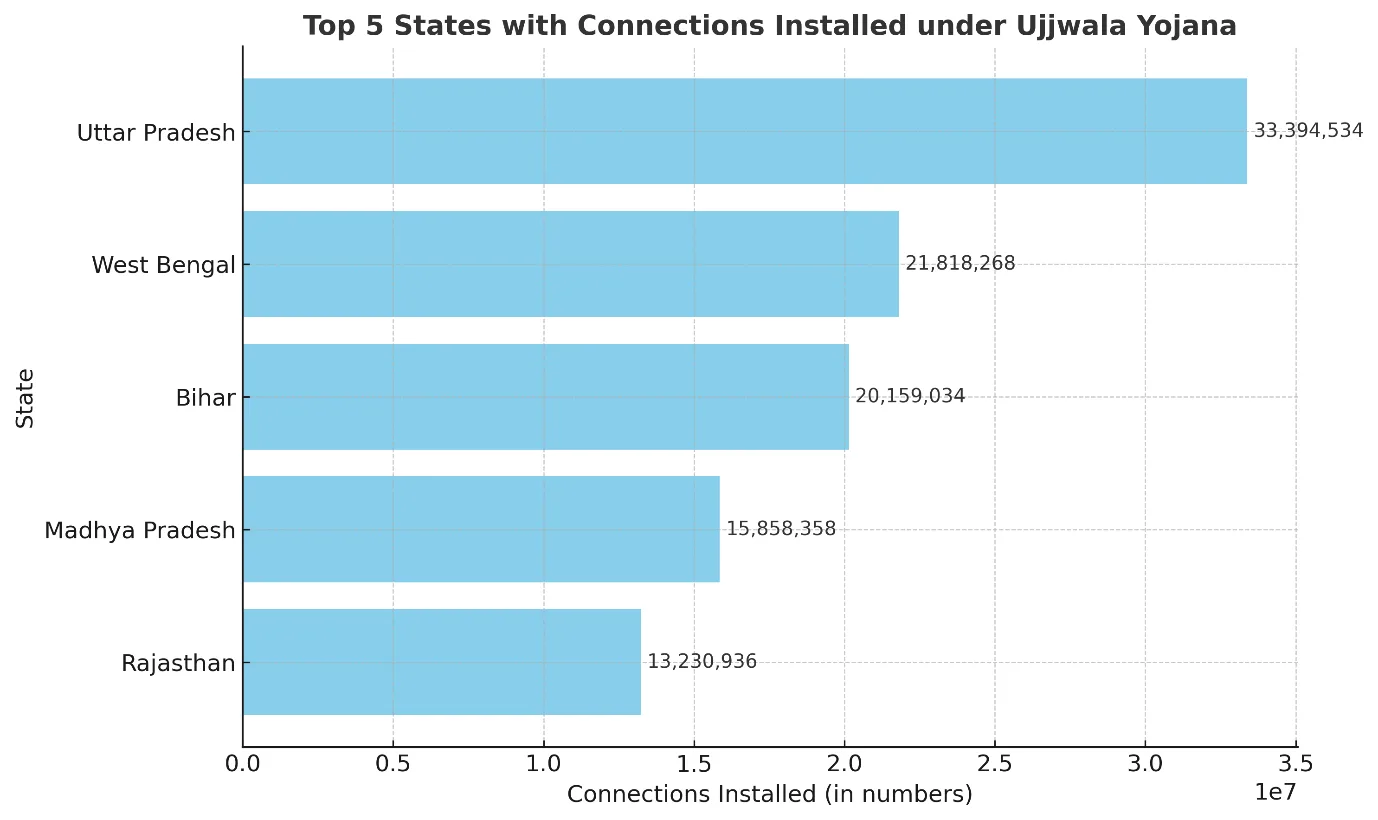
The largest number of LPG connections installed under the Pradhan Mantri Ujjwala Yojana (PMUY), dominated by Uttar Pradesh, West Bengal and Bihar. Uttar Pradesh is leading the charge with more than 3.33 crore connections both a testament to its huge population and the government planned welfare reach. The state strong performance is also in sync with Chief Minister Yogi Adityanath drive towards enhancing household access to energy as part of Uttar Pradesh vision to become a $1 trillion economy. Access to clean cooking fuel is also driving women empowerment and health enhancement in rural UP.
West Bengal led by a ruling opposition party is in the second spot with 2.18 crore connections. Because of political issues between the Centre and the state, the coverage of the scheme proves the compelling desire of rural and economically weaker sections for cleaner energy options. Bengal government from time to time criticized the Centre regarding payment of subsidies and beneficiary details giving a political twist to the success story.
Bihar with more than 2.01 crore connections stands at number three. The timing is opportune since the state is in an election period and performance under Ujjwala Yojana can emerge as a key campaign issue. For Bihar rural voters, the scheme represents hard cash from central welfare programmes.
Affordability and Global Comparison
PMUY success also lies in the way it brought LPG within reach of economically weaker families. PMUY is the world’s largest clean cooking programme of its type, distributing domestic LPG at an effective rate of approximately Rs 35 per kg a marker of inclusive energy access.
To put this into context, the effective price of an LPG cylinder in Delhi for PMUY consumers is Rs 803, whereas the same cylinder sold to non-PMUY consumers is much more expensive. Looking at neighbouring nations, India subsidized price is still one of the most affordable.
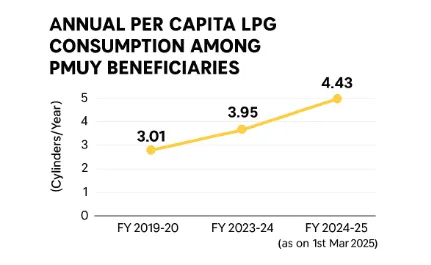
The consistent increase in per capita LPG use, from 3.01 cylinders in FY 2019–20 to 4.43 cylinders in FY 2024–25, indicates that PMUY connections are not simply symbolic that they are utilized regularly. This repeated use indicates a behavioural change toward cleaner, newer cooking habits.
The top states driving this change Uttar Pradesh, West Bengal, Bihar, Madhya Pradesh and Rajasthan, together have a substantial percentage of total PMUY beneficiaries. Their success speaks to administrative dedication as well as local campaigns for awareness that promoted the use of LPG in even the most distant homes.
In other part of country such as Uttar Pradesh and Bihar, where dependence on biomass was traditionally strong, the ubiquitous use of LPG has had tangible improvements in domestic health, cleanliness in the kitchen and women security.
Health and Social Impact
Independent researches consistently validate PMUY as far-reaching advantages. By substituting smoky fuel, it has significantly minimized indoor air pollution, saving rural households from respiratory diseases that previously afflicted them. Women who carried the burden of kitchen smoke now live and breathe healthily.
The transition also reduced the everyday work of gathering firewood, freeing up hours of toil per week. That time is invested now in money-making activity, schooling or merely enhancing family life. Ujjwala has freed time, energy and self-respect for rural women.
Improved nutrition has naturally followed. Improved access to LPG facilitates the preparation of several meals a day, enabling households to add varied and healthy foods to their diet a quiet but significant changes in household health benefits.
Environmental benefits are equally significant. Lower dependence on firewood translates into less deforestation and better local environments, complementing PMUY with larger climate objectives under the Paris Agreement.
Global Energy Recognition
India’s clean cooking initiative hasn’t gone undetected. The International Energy Agency (IEA) has notched PMUY as a major achievement for enhancing the environment and women’s health. As IEA Executive Director Fatih Birol said “Providing access to LPG across India by 2020 is a major achievement. It is not an energy issue, it is an economic and social issue.”
World Health Organisation (WHO) report in 2018 identified India as one of the only countries actively addressing indoor air pollution a worldwide public health issue. The report noted how PMUY contribution to decreased exposure to toxic particulate matter was an inspiration to developing nations across the globe.
Behind the Numbers: A Cultural and Economic Shift
The story of Ujjwala isn’t merely one of gas cylinders, it’s one of social change. In thousands of villages, the LPG cylinder is a indicator of modernity a sign that a family has transcended poverty to dignity. The blue flame has permeated folk ballads, local celebrations and women’s self-help groups as a sign of new living.
Economically as well the ripple effects are evident. With more time available to them outside of gathering fuel, women can actively contribute towards microenterprises, agriculture and education. The rural LPG distributorship chain, with more than 17,000 rural dealers, has also generated thousands of small-scale business and employment opportunities.
Looking Ahead: Sustaining the Flame
The government also continues to refine PMUY for long-term sustainability. Initiatives now aim at promoting repeated refilling of cylinders so that affordability does not deter repeated use. Subsidies and digital booking and refilling platforms have ensured the process is easier than before.
In the future, the task is to keep refill affordability in balance with global price fluctuations of energy. Advancement such as compact LPG cylinder sizes, community refilling facilities and solar-LPG hybrid technology are being researched in order to provide an uninterrupted supply even to far-flung areas.
Nine years since its launch, the Pradhan Mantri Ujjwala Yojana has evolved into far more than a government scheme it’s a movement of the people. It captures the Aatmanirbhar Bharat spirit by empowering women, enhancing health, safeguarding the environment and laying the groundwork for inclusive development.
As India journeys towards Viksit Bharat 2047, the blue flame of Ujjwala burns brightly and illuminating not only kitchens, but also the way to a cleaner, healthier and better future.











Comments