





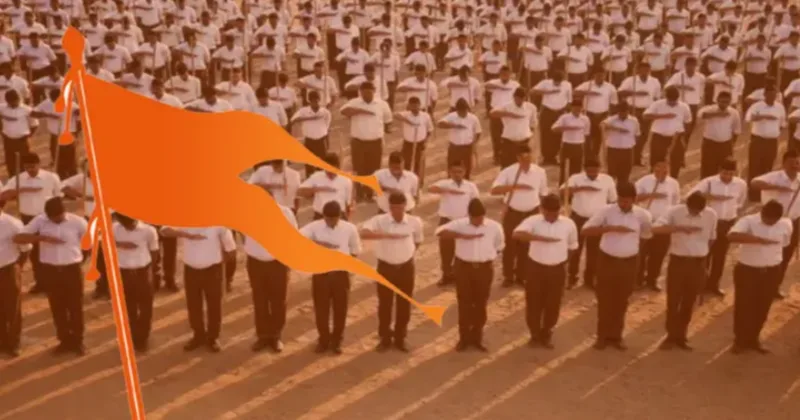
Many political parties, foreign-funded intellectual falsity, and non-governmental organizations profit off the fragmented, uninformed, mentally slave, and “self first, nation last” mindset of Bharatiyas, particularly Hindus. As a result, it is natural for them to reject and take political action against individuals or groups that they see as threatening to their “Self or Family First” goal. What is happening is a battle for Bharat’s soul. The hatred surrounding RSS has existed for a century. The disgusting faux narratives and politically motivated efforts against Sangh activities during the centenary year demonstrate unparalleled dread among our great nation’s detractors. It is emblematic of our history, in which a large portion of the population was methodically split, allowing a much smaller portion to enslave us by promoting a fabricated narrative.
The organisation serves as a silent guardian, believing in acting discreetly in society. As we all know, words cannot have a long-term impact, but someone’s efforts may. Based on this notion, the RSS never publicizes its efforts to help, grow, and unite the Bharatiyas and the nation. As a result, it is quite simple to sling mud at a silent person or group. As a result, missionaries, Islamic extremists, a few political parties, and media outlets began to demonize the RSS and discussed unconstitutionally outlawing the group.
Renowned historian Walter K Andersen, known for his authoritative studies on contemporary Bharatiya politics, has remarked that Congress leader Rahul Gandhi has mistaken the Rashtriya Swayamsevak Sangh (RSS) as a religious organization like “many in the West and also in India”. That strategy, he added, may undermine Mr Gandhi’s efforts to present himself as a Hindu and a patriot.
Andersen, the former head of South Asia studies at the Johns Hopkins University School of Advanced International Studies, is well-known for having studied the RSS in-depth for almost 50 years. He is the author of publications like “Brotherhood in Saffron.” He discussed how the RSS is viewed in the West, the difficulties it faces—such as addressing caste discrimination—how to reach out to minorities and win over the intellectual elite, and his outlook for the BJP’s future.
Rahul Gandhi, the president of the Congress, and a few other leaders are known to have little affection for the Rashtriya Swayamsevak Sangh (RSS). A little-known reality, however, is that the RSS does not despise the Congress Party or its leaders, despite popular belief. The reason the RSS doesn’t despise Rahul Gandhi in spite of his outspoken attacks on it is due to Sangh’s philosophy, the leadership’s history, and their thought process, which has developed over a century. The RSS has collaborated with a wide range of political parties and leaders since independence keeping “Nation first” mindset. In an attempt to launch an onslaught against the RSS, the present Congress leadership is ironically disregarding its own past, in which numerous Congress leaders have collaborated closely with the RSS on a number of subjects.
Fake narratives of Sangh being homosexual and exploit Women
On social media, many of these false myths are shared. Spreading false information is not implied by freedom of expression. Without interruption, the Sangh Swayamsevaks keep up their diligent job. Since accusations are merely slander shrouded in smoke. It is more likely that a critic’s peculiar thinking was the result of their ignorance or a childlike cognitive process. The Sangh’s 100-year history makes it abundantly evident that thousands of Swayamsevaks gave up their personal lives or lost their lives in service to the nation, all the while clinging to the principles of unity, national identity, and Hindu awakening.
“To think and act for the welfare of the nation” is the exclusive responsibility of RSS. Thousands of people work as “pracharaks” who lead a renounced life with the sole purpose of serving the nation. During natural calamities or whenever the nation needs it, RSS is ready to help and support people of all castes, religions, colors, and creeds. A few examples are the conflicts with China and Pakistan, the fight against the illegal emergency declared by Prime Minister Indira Gandhi at the time, the peace process during the unrest in Punjab, and the enormous amount of effort made to bring society back together.
Those who wish to destroy Bharat’s legacy, art, and culture will always face opposition from the RSS. Since the majority of people in Bharat are Hindu, the RSS will oppose any attempt to split or disintegrate the Hindu community or Bharatiya, no matter how strong the opponent. The haters are trying to continue their long-standing strategy of discrediting RSS and making all Indians fearful. This strategy would ensure that minorities stay together against the BJP while also subtly instilling dread in the hearts of BJP voters, as the majority of BJP officials have backgrounds in the RSS.
Society and the nation are never the top objectives of someone with a selfish motivation or a greedy attitude; they want fame, fortune, and power at the expense of the nation and its social cohesion. These selfish people are doing precisely this to the RSS and numerous other organizations that put in endless effort to improve the environment, the globe, and a nation. To make the nation great, a democracy needs criticism, in-depth analysis, opinions, and suggestions. However, if the agenda is harmful and serves to support our nation’s enemies, citizens need to be more vigilant and aware and respond to such false narratives with relevant and factual information.
The issue is whether we should put our faith in an organisation that has been serving the country selflessly for decades or in a party that opposes the use of force against adversaries and rejects the constitution. It is cheap to create fake narratives. Real journalism is expensive. Finding significant new information that is in the public interest and contextualizing it so that we may use it to better the human condition is journalism’s main duty. In addition to their civic duty to guard against financial and social abuse and fraud, media firms also have a need to avoid destroying or demeaning our culture.
All of the societal evils that stand in the way of our country’s advancement can be fought with the help of the media. It can be very helpful in promoting solidarity among the masses. The government can be criticized and pressured by the media for its misdeeds and poor policies. It influences public opinion in addition to informing, educating, and entertaining people. Its main objective should be to improve society overall. The public needs to be cautious of the different narratives that have been developed since responding to them without comprehension and analysis paralyzes the system, society, and nation. The motto of every story should be “Unity and Nation First.”
Although the RSS has been perceived by some as “an Indian version of fascism” due to its paramilitary tactics and emphasis on discipline, Christopher Jaffrelot, director of the Center for Studies and Research (CERI), contends that the RSS cannot be simply labeled a fascist movement because of its Hindu nationalism, which has been used to minimize the role of the state. He continues by arguing that the philosophy of the RSS sees society as a secular organism whose spirit is ingrained in a socio-cultural system rather than race and will eventually be restored via persistent grassroots efforts. According to him, the ideology of the RSS “did not create a theory of the state and the race, which were key factors in European nationalisms such as “Nazism and Fascism.” Additionally, he asserts that racial uniformity is not as important to RSS leaders as cultural unity. The nation has an organization that only thinks positively about the nation and trains its citizens to develop their personal and national character, as well as to volunteer in the event of national needs or calamities. Congress, the Left, and other opposition parties are unable to accept this fact.
If the Sangh is power-hungry, then-HM Sardar Patel and then-PM Pandit Jawaharlal Nehru’s proposal to combine the Sangh with the Congress would have been easily granted by Golawalkar Guruji, the Sangh’s Second Sarsanghchalak. Since its inception, Sangh has had a singular vision: to bring Hindus together to build their national and personal character. If Sangh is fighting for political power, it would be easier for it to do so because of its large social base and affiliated groups.
The RSS originated before both the Jan Sangh and the BJP. Actually, the RSS is the parent organisation of multiple organisations known as “the Sangh Parviar” that operate in various fields. These organizations receive mentoring from RSS, and frequent meetings with the RSS top working committee are held to discuss updates on their work or to get advice on a range of topics. Since 1925, RSS has provided services to the country without expecting anything in return. Individuals cease pursuing their career goals and married lives, join RSS, and leave behind their homes and families. In a night of darkness, RSS shines brightly.
The issue is whether we should put our faith in an organisation that has been serving the nation selflessly since 1925 or in a party or individuals that back terrorists, Naxalites, anti-Hindutva organisations, and other groups that work against humanity in general. All I can say to those who despise RSS is that you are welcome to join up and investigate it out for yourself. False narratives and half-truths are always detrimental to the nation and society. Come live up to the motto “Nation First, Nothing Else Matters” and then express yourself appropriately.












Comments