





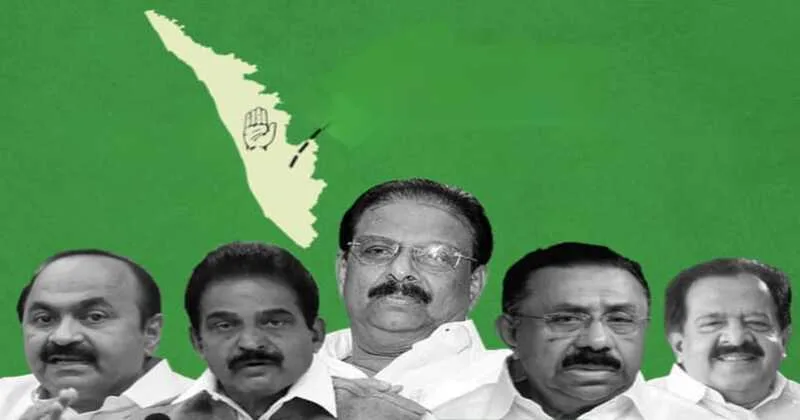
There is a growing perception that the reorganisation of the Kerala Pradesh Congress Committee (KPCC), undertaken to refurbish the party’s image ahead of the Assembly elections, has instead further weakened the Congress in the state. Many believe that replacing K. Sudhakaran with Sunny Joseph as KPCC president has disrupted the fragile internal equilibrium rather than strengthening the organisation. The move has unsettled existing group dynamics within the party, throwing its internal power balance into disarray. With the more focus of K.C. Venugopal, national General Secretary of AICC, to the state politics ahead of assembly poll, current Opposition Leader V.D. Satheesan is also perceived to have lost much of his earlier influence. The once-powerful ‘A’ and ‘I’ groups, traditionally led by former chief minister and late Oommen Chandy and the former opposition leader Ramesh Chennithala respectively, now appear to be in a state of fatigue and confusion.
Crisis over secretary-level reorganisation
The turmoil has stalled the reorganisation process at the secretary level. The plan to increase the number of KPCC secretaries to 140, equal to state assembly seats, was intended to accommodate various group interests and pacify those overlooked for the post of general secretary. Reports indicate that the leadership aims to appoint one secretary per Assembly constituency. However, protracted discussions over these appointments have plunged the reorganisation into crisis.
The delay in finalising the list has left several leaders disgruntled. Many newly appointed office-bearers, including vice presidents and general secretaries, have not yet assumed charge due to the rigid stance of Opposition Leader V.D. Satheesan. He has insisted that the newly appointed leaders should take charge only after the secretary appointments are completed to ensure a balanced representation of groups. As a result, 59 individuals appointed as general secretaries and 13 vice presidents remain in limbo, unable to assume their posts. Currently, only 50 secretaries continue from the previous committee, and since they were not promoted, they are expected to be retained for continuity. In addition, the leadership’s plan to induct 90 new secretaries, bringing the total to 140, has generated competition and resentment, with over 200 aspirants vying for these positions.
Youth Congress swearing-in amid party discord
Amid the turmoil in the parent organisation, the oath-taking ceremony of the new state office-bearers of the Youth Congress Kerala will be held today at the KPCC headquarters, Indira Bhavan. The event follows the resignation of former Youth Congress president Rahul Mangkoottil after allegations of sexual harassment. O.J. Jenish will assume charge as the new state president, while Binu Chulliyel will serve as the working president.
However, factional disputes have clouded the Youth Congress reorganisation as well. The absence of Abin Varkey, who was once considered close to the ‘I’ group led by Ramesh Chennithala, has triggered discontent. Group A, under K.M. Chandy, has also expressed dissatisfaction with the high command for overlooking Abhijith, another aspirant for the top post. Abin Varkey himself has publicly voiced his displeasure. The absence of several senior leaders at the swearing-in ceremony has not gone unnoticed. While Ramesh Chennithala is unable to attend due to his mother’s death anniversary observance, uncertainty persists over whether V.D. Satheesan and other key leaders will be present, highlighting the deepening divisions in the party.
Discontent across communities and groups
Various groups within the party, as well as community organisations, have openly protested against the KPCC reorganisation. Many see the new structure as a manifestation of AICC organisational general secretary K.C. Venugopal’s continued dominance over Kerala Congress politics. Venugopal’s influence, extending to both the KPCC and Youth Congress appointments, has drawn criticism from traditional factions that feel sidelined.
The Nadar Service Federation (NSF) has publicly condemned what it called the neglect of the Nadar community in the reorganisation. The community, which holds considerable electoral influence in the southern districts, especially Thiruvananthapuram, accused the party of underrepresentation. According to the NSF, out of the twelve office-bearers chosen from Thiruvananthapuram, only one belonged to the Nadar community. The federation expressed anger that N. Shakthan, interim president of the Thiruvananthapuram District Congress Committee and a KPCC vice president, was the only Nadar leader given a significant position, while none were included in the party headquarters.
The NSF statement went so far as to warn that if the Congress leadership continues to ignore community representation, it may again find itself in opposition after the next Assembly elections. “If the party believes one percent representation is sufficient for a community that contributes much more in votes, then it must clarify whether it only values one percent of our support,” the statement read.
Protests by Orthodox and minority groups
Adding to the discontent, the Orthodox community has also voiced strong objections to the exclusion of leaders such as Chandy Oommen MLA and Abin Varkey. Former KPCC president K. Muraleedharan, too, has publicly criticised the reorganisation. Muraleedharan’s recommendation of Minority Cell vice chairman K.P. Harris for the post of general secretary was ignored, and sitting general secretary Maryapuram Sreekumar was removed, further fuelling resentment.
Group A had submitted several names for consideration, including former DCC presidents and senior KPCC office-bearers such as K.P. Dhanapalan, Abdurahman Haji, and K.C. Abu. Rinku Cherian, a former KPCC secretary, was also proposed. However, none of these names were considered in the final list. Even Chandy Oommen’s name, forwarded by the ‘A Group’ Political Affairs Committee, was overlooked, though many believed he would at least be accommodated as a general secretary. This exclusion has deepened the frustration among ‘A Group’ leaders, some of whom are now considering refusing the posts allotted to them unless a resolution is found.
VD Satheesan’s uneasy position; Growing perception of centralised control
Opposition Leader V.D. Satheesan, once a close ally of K.C. Venugopal, has also grown increasingly critical of the reorganisation. KPCC president Sunny Joseph is widely regarded as Venugopal’s nominee, which has complicated Satheesan’s position within the party hierarchy. His recommendations for several key posts have been ignored, further straining relations between the two leaders.
For instance, Satheesan had proposed Philson Mathews for the post of Kottayam DCC president, but instead, the leadership is reportedly considering appointing him as a general secretary, bypassing Satheesan’s recommendation. Similarly, Satheesan’s choice for the Thiruvananthapuram DCC president, Chempazhanthi Anil, has been sidelined. It now appears that the incumbent, N. Shakthan, recently removed from the position of KPCC vice president, will continue as DCC president, signalling the leadership’s reluctance to accommodate Satheesan’s preferences. The overall picture emerging from the reorganisation is one of growing centralisation under K.C. Venugopal’s leadership. The KPCC’s reshuffle has failed to bridge factional divides and has instead alienated several influential leaders and communities. What was intended as a strategic move to strengthen the party’s image ahead of the Assembly elections has, in effect, exposed deep fissures within the Congress in Kerala.
As the party struggles with leadership disputes, delayed appointments, and community resentment, its organisational machinery appears increasingly paralysed. The reorganisation, meant to project unity and renewal, has instead underscored the Congress’s internal fragility and waning grassroots confidence. With the Assembly elections approaching, the party faces the difficult task of reconciling warring factions, restoring trust among its traditional support bases, and proving that its leadership remains capable of cohesive political action in Kerala.











Comments