





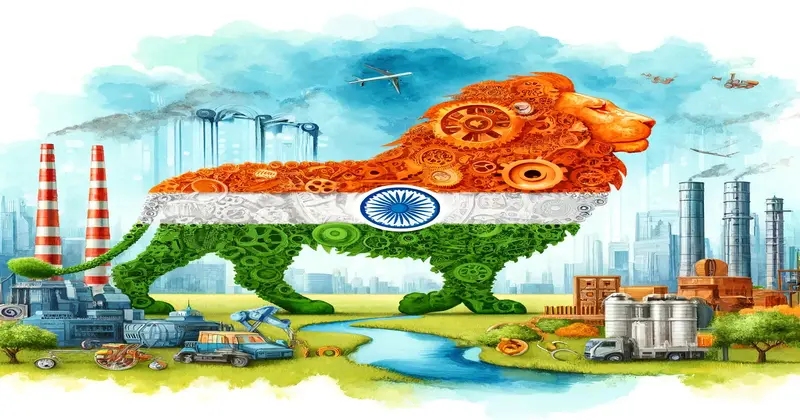
Atmanirbhar Bharat is indeed the core principle in India’s journey towards Viksit Bharat. Embracing and adopting Swadeshi commodities is a key chapter in India’s march towards the vision of 2047. New Delhi aims to seek multi-vector self-reliance. Be it defence, agriculture, textiles or technology and innovation; India not just aims to manufacture for its own well-being but aspires to indulge in state-of-the-art production for the sake of global good. India is on a path to emerge as a solid manufacturing hub and export-oriented market. In this direction, here are the top commodities exported from India and appreciated across the globe. These products are not just scripting India’s growth story but is fuelling the developmental and economic prospects of the globe.
- Bharat: Manufacturing hub of BrahMos missiles
BrahMos supersonic cruise missile was much hailed as the “game changer” during Operation Sindoor. This world’s fastest cruise missile helped India carve strategic deterrence against enemy atrocities and strengthen the national security apparatus. BrahMos jointly produced by India and Russia now has a global demand. Recently, Philippines signed a contract with India worth Rs. USD 375 million to purchase the BrahMos. Along with this, countries such as Vietnam, Indonesia, Singapore, Thailand and many West Asian as well as Latin American countries have expressed aspirations to purchase BrahMos from India and the discussions are underway.
BrahMos is not just a big boost to the defence indigenization programme of India, but also helps to ensure the security paradigm in many countries, thus helps to restore balance of power. In this direction, Defence Minister Rajnath Singh recently flagged off the first batch of indigenously produced BrahMos missiles at Lucknow Aerospace unit.
Apart from BrahMos, Made-in-India Akash NG, drones and loitering munitions, Tejas Mk Light Combat Aircraft(LAC) has global platform. Thus, India is emerging as a pivotal defence manufacturing and export hub as defence indigenization is a key pillar in realizing the vision of Atmanirbhar and Viksit Bharat.
2. Jaipur foot: World’s most affordable prosthetic leg
Swadeshi Jaipur foot is India’s age-old and much-preserved knowledge. Times Magazine has hailed the Jaipur Foot as one of the greatest innovations of 20th century. It is a rubber-based prosthetic leg for below knee dysfunction. It was co-developed by Dr. Pramod Karan Sethi and Ram Chandra in 1969. It is low-cost, water-resistant and flexible.
Jaipur foot is not just used by the physically-challenged masses of India but by the people across the globe who suffers from amputees. It has indeed become a symbol of India’s soft power potential and humanitarian assistance. More than 1.7 million disabled people hailing from more than 34 countries across Global South are today empowered with the Jaipur Foot, hence a testament to India’s initiatives in bolstering south-south cooperation.
3. Reliance refineries: Ensuring energy security
Reliance refineries is one of the world’s largest and most advanced oil refinery ecosystem. The Jamnagar refinery complex is the world’s largest standalone, single-site refining unit. It has played a key role in making India an export hub of petroleum products. The refinery has processed over 216 different grades of crude oil, the only refinery to do so in the world.
The key destinations to which the products exported from Jamnagar reaches includes USA, UAE, Australia, Singapore and many other countries across Europe and Africa. With this, the energy sector of India is ensuring resilience in global energy supply chain and stability in energy prices in an era of energy war and insecurity. Thus, India is helping to run the global economy which is predominantly dependent on large-scale fuel consumption at multiple levels.
4. Indigenous nuclear reactor components: Assuring clean energy credentials
Apart from being the world’s largest crude oil refinery hub, India also has considerable stake in ensuring a shift towards clean energy. In this direction, India at a vast scale indigenously produces nuclear reactor components. For example, L&T manufacturers produces a wide range of indigenous nuclear reactor components such as Pressurized Heavy Water Reactors(PHWRs), Fast Breeder Reactors and Research Reactors.
These indigenous nuclear reactor components are exported to France, United States, Israel, Bhutan, Sri Lanka etc. Thus, India’s voyage towards clean energy and civil nuclear energy is completely rooted in self-reliance. Ofcourse, India’s nuclear indigenization saga also is aiding various other countries, in achieving sustainable development goals.
5. Vaccines and generic drugs: India as the medicinal hub of the world
The pharmaceutical industry of India ranks globally third in terms of production. It supplies 50 per cent of the vaccines demanded across the globe. Infact, 40 per cent of the generic medicines needed in the US is supplied by India. The nation is also the world’s largest supplier of the generic medicines accounting for 20 per cent of the global demand.
Most importantly, medicines manufactured in India are exported to nearly 200 countries. With consistent government assistance such as production-linked incentives, affordable pricing mechanisms India’s pharmaceutical industry is set to be a boon for the global medical ecosystem, with affordable pricing and resilient supply chain.
6. India’s rice: Feeding the world
India today stands as the world’s largest rice exporter. The country is responsible for nearly 40 per cent of the global rice trade. For example, Basmati rice is very unique and native to India that no other nation was able to replicate the authenticity of Basmati. The Basmati rice variant is exported to Saudi Arabia, UAE, USA and Germany etc. The unique grain structure, incredible aroma and irreplaceable taste has indeed created a global market for the Basmati rice.
Even the non-basmati rice variants have huge demand. Many African and Asian countries predominantly import this rice. Thus, it can be said that India is a key global player in ensuring the food security of the world.
7. India is an emerging ecosystem automobile component
India’s export market with respect to automobile components is worth more than USD 22 billion. The potential rise of the automobile export prowess is esteemed to be 5.5 per cent with every passing year. In the automobile component sector India, enjoys trade surplus with over USD 300 million. India’s automobile sector is expected to reach USD 100 billion(only with regard to automobile exports) by 2030.
The major automobile components manufactured in India that has global demand includes, drives, transmission, steering, engine components such as piston, cylinder heads etc. India is also a global exporter of vehicle replacement parts. India’s automobile sector is thus one of the hallmarks in the developmental story of the Indian economy.
8. India: An epoch for digital revolution
The digital revolution exclaimed in India in the past decade need not be mentioned separately. The public digital infrastructure paradigm is growing in India by leaps and bounds. The Digital India mission has made people more empowered, technologically sharper and has brought millions to the mainstream of development.
Digital India has brought transparency, accountability, inclusivity and accessibility in governance, a key aspect of good governance. Digitization of financial sector, education sector has acted as a beacon of prosperity and economic growth. For example, the UPI revolution in India has been a key catalyst of financial inclusion. As of August 2025, the total transactions through UPI surpassed 20 billion which is worth Rs. 24.85 lakh crore.
The Swadeshi UPI model of India is being replicated across globe in countries such as UAE, Singapore, France etc. Thus, the digital revolution in India is not just acknowledging the growth story of India but is also inspiring and championing digital revolution across globe.
9. Semiconductor revolution of India
The semiconductor chips are set to define the prospects of fourth Industrial revolution. India is neither left behind in the semiconductor revolution. Government has unleashed a wide range of initiatives to groom India into an epicenter of chip designing and manufacturing. To realize this goal semiconductor manufacturing units are being established in six states. In 2021, Union Cabinet has approved Rs. 76,000 crore of outlay for the semiconductor mission.
In the recent Global Investors Summit 2025, India’s maiden indigenous semiconductor chip was presented, marking India’s high-stake aspirations in the semiconductor industry. Currently, semiconductors integrated in India are exported to approximately 27 countries such as Germany, United States. Thus, in the long-run India will emerge as a self-reliant nation in the semiconductor sector and will indeed be a significant player in the fourth industrial revolution.
10. The dairy sector of India
The dairy sector of India is a testament to grassroot empowerment. Not just that, India’s largest cooperative dairy farming ecosystem Amul has global scale and recognition. Amul milk and other dairy products are exported to over 50 countries in Asia, Africa, Europe and even to the USA. The White revolution and cooperative dairy farming espoused in India is a global model to anchor grassroot empowerment and seek self-reliance in the agriculture or allied sector.
These are just the handful of commodities with a proud tag of Made-in-India that has global esteem and appreciation. The list is vast that renders India the title of a manufacturing hub. India’s production and export story with respect to swadeshi commodities is set to further revolutionize with sound policies and solid government support, ultimately fueling the economic growth, prosperity and stability of India and the world.














Comments