





The North Eastern state represents 28 per cent of the country’s bamboo stock, and Tripura has 2,397 sq. km. of bamboo forests, forming about 23 per cent of the state’s geographical area. Muli bamboo comprises about 80 per cent of the bamboo resources, and this is the only single-stand (non-clump forming) species most widely used in the state.
Tripura enjoys good natural bamboo production due to its favourable tropical climate, high rainfall, and well-drained soil, which allow over twenty-one native species to thrive. The state’s large forest area and its deep-rooted tribal tradition of using bamboo contribute to its rich bamboo resources.
Tripura Bamboo Mission (TBM)
Tripura has common varieties like Muli, Barak, Bari, and Mritinga. Other types found in the state include Paora, Rupai, Dolu, Pecha, Makal, Kanak Kaich, and Jai.
A total of 50,828 hectares of plantation has been raised so far, including 3,147 hectares on private land, through various schemes such as the National Afforestation Project, JICA, IGDC, Tripura Bamboo Mission, Rural Development, ADC, and the National Bamboo Mission.
Launched by the Government of Tripura in 2007, the Tripura Bamboo Mission (TBM) aims at the integrated development of the state’s bamboo sector, focusing on plantations, handicrafts, incense sticks, and industrial applications. The mission’s objectives include increasing sector turnover, generating employment, providing livelihood opportunities (especially for women and minorities), and establishing market linkages through a cluster development approach. TBM provides training, technological linkages, and infrastructure support through Common Facility Centres (CFCs) for artisans and producers.
Economic Impact and Employment
The estimated yearly turnover for bamboo handicrafts in Tripura is around Rs 35.34 crore, based on the value of annual craft sales generated by about 1.49 lakh artisans.
While this value reflects only the artisanal craft sector, the overall economic potential of Tripura’s bamboo industry is significantly higher. The Tripura Bamboo Mission is working to increase turnover through value addition, industrial development, and better market linkages. It is estimated that around 6.1 million mandays (person-days) are generated per year through harvesting and utilisation of bamboo in various forms.
The favourable environment allows bamboo to regenerate and spread naturally through its rhizome root system. Some species are highly resilient and adaptable to changing conditions. Bamboo roots are excellent at binding soil, which helps prevent soil erosion. This creates a self-sustaining ecological cycle where the plants protect and enrich the soil they grow in.
TBM aims to develop the entire bamboo value chain, from cultivation to finished products. Its primary goal is to improve the lives of poor producers, particularly women and tribal communities, by creating jobs and boosting income. Tripura is working to establish strong market linkages and organise the marketing of bamboo products. Tripura introduces and promotes modern technologies for bamboo treatment, processing, and production. The strategy involves setting up Common Facility Centers (CFCs) within clusters to provide shared infrastructure and resources. TBM has significantly increased the turnover of the state’s bamboo sector. The mission has successfully generated employment opportunities for a large number of people. It promotes value addition in the sector, leading to a wider range of handicraft products and new applications.
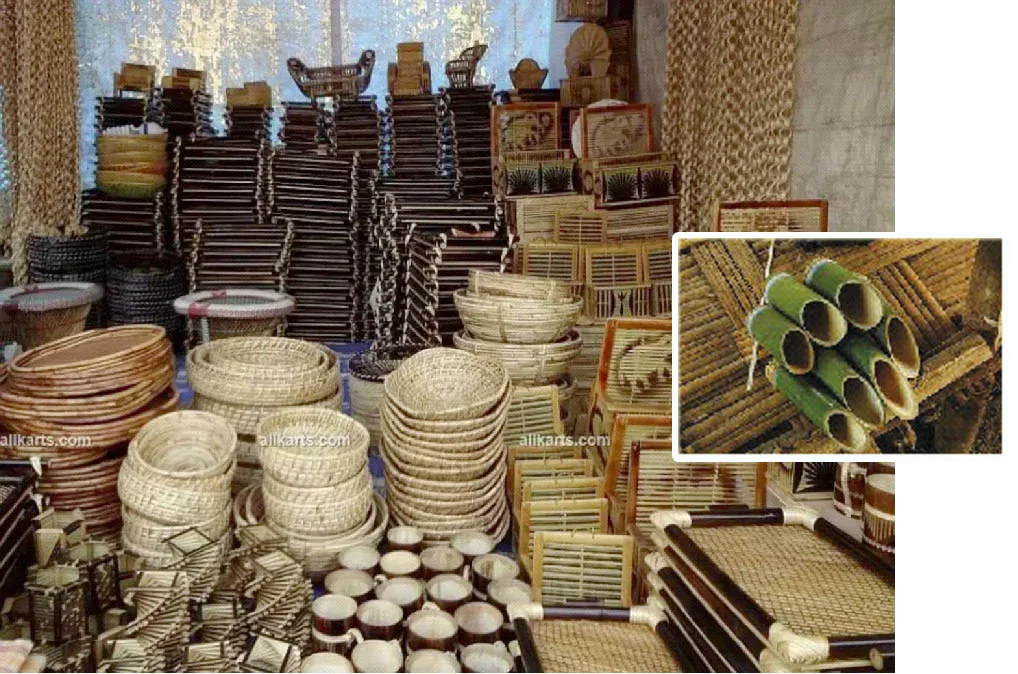
The state of Tripura produces a wide variety of bamboo products, including traditional handicrafts such as baskets, mats, chairs, and tables, as well as modern sustainable and eco-friendly items like pens, and home décor, and water bottles, which is a growing market as a replacement for single-use plastics. Industrial products such as bamboo ply boards, tiles, laminated boards, corrugated sheets, flooring, fencing, and wall panels are widely used in construction and furniture making. A traditional delicacy, Muya Awandru, is prepared using bamboo shoots, rice flour, and ‘berma’ (fermented fish).
The total economic potential is considered much greater than the current turnover, as only 1–2 per cent of the state’s total bamboo is currently used for value-added products. The government is promoting industrial growth by establishing a Bamboo Park in Agartala, designed to facilitate the setup of bamboo-based industries such as floor tile and round-stick manufacturing units.
A strong bamboo economy can boost Tripura’s overall growth through job creation, income generation, and industrial development by focusing on value addition, modernisation, and improved market linkages, expanding industries beyond traditional crafts to include high-tech products and exports and ensuring sustainable supply chains.
Employment And Investment Opportunities
The development of the bamboo sector is expected to create millions of mandays of employment and increase the income of farmers and artisans. Bamboo extraction, processing and handicraft production create jobs for a large number of people, including approximately 1.49 lakh artisans in Tripura. Value-added products and new industries lead to higher incomes for farmers, artisans and traders, boosting rural economies. BAs Tripura prioritises sustainable bamboo cultivation it can set a standard for other states, mitigating climate change and protecting the region’s rich biodiversity. The expansion of the bamboo economy will necessitate improvements in transport and logistics. This includes developing better road networks which can facilitate trade and boost the economy and overall development of the entire region.














Comments