





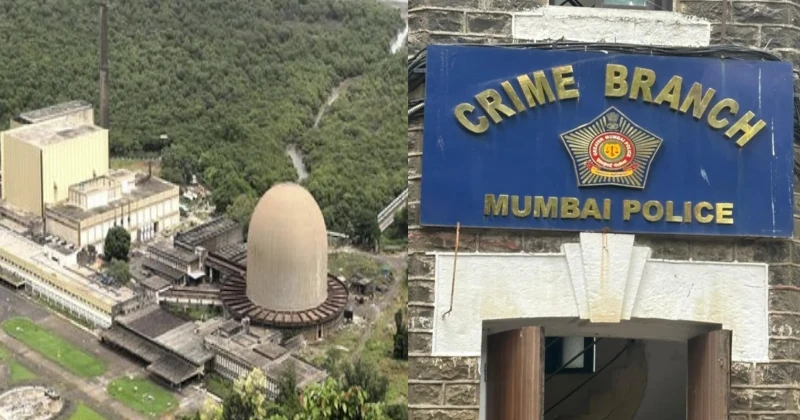
The Mumbai Crime Branch, in coordination with the National Investigation Agency (NIA) and the Intelligence Bureau (IB), has arrested Akhtar Hussain Qutbuddin Ahmed (60) for posing as a senior scientist from the Bhabha Atomic Research Centre (BARC). The arrest, carried out during a late-night raid in Versova, has sent shockwaves through the country’s intelligence and security circles, with investigators uncovering documents and maps allegedly linked to nuclear bomb designs raising the spectre of one of the most serious internal security breaches in recent years.
According to officials, the raid on Akhtar’s residence led to the seizure of 14 highly sensitive maps, technical blueprints, and forged identity documents, including a fake BARC identification card under the name Ali Raza Hosseini bearing Akhtar’s photograph. The forged ID, investigators noted, was of such high precision that it could have potentially been used to gain access to restricted facilities or classified data within India’s premier nuclear research establishment.
The #Mumbai Crime Branch, with support from the National Investigation Agency #NIA and Intelligence Bureau #IB, arrested "Akhtar Hussain Qutbuddin Ahmed", posing as a Bhabha Atomic Research Centre (#BARC) scientist. The arrest took place in Versova, where a raid uncovered… pic.twitter.com/ZIPSQpCFBB
— IDU (@defencealerts) October 23, 2025
In a startling twist, forensic teams discovered that some of the sensitive maps and diagrams were printed at a local shop in Andheri, raising disturbing questions about how nuclear-related schematics or their imitations ended up in civilian printing circuits. Investigators are now working to determine whether the data originated from an actual classified leak or was part of a larger espionage effort to replicate nuclear systems using forged documentation.
“All recovered material is under intense forensic and technical examination to verify its authenticity,” an officer from the NIA confirmed. “Given the nature of what was seized, this case is being treated as one of extreme national importance.”
The raid also led to the recovery of multiple fake passports, Aadhaar cards, PAN cards, driving licences, mobile phones, and pen drives. Digital evidence from these devices is currently being analyzed by cyber-forensic experts to trace any possible communication with foreign handlers or intelligence agencies.
Akhtar, who lived with his wife and son in Versova, has been placed under intensive interrogation, while his family members are also being questioned to determine their knowledge or possible complicity.
Preliminary investigations have unearthed that Akhtar Hussain was previously arrested in Meerut, Uttar Pradesh, under charges of waging war against the Government of India and violating the Official Secrets Act. Though he was released on bail at the time, intelligence records show that Akhtar has been on the radar of national security agencies since 2004.
In a revelation that deepens suspicions of long-term espionage links, sources disclosed that Akhtar was deported from Dubai over two decades ago after being accused of attempting to sell Indian nuclear information to foreign diplomats. While the charges then resulted only in cases of forgery and cheating due to lack of conclusive evidence, his resurfacing in Mumbai with alleged nuclear blueprints has reignited concerns over foreign infiltration and sleeper networks.
Intelligence officials have described the case as “one of the most severe internal security threats in recent memory,” given the potential misuse of sensitive nuclear data. Central agencies are now tracing possible foreign connections, suspecting Akhtar may have collaborators both within India and abroad.
An official involved in the probe stated, “The pattern, forged IDs, and nature of materials seized point towards a deep and deliberate espionage effort. This is not the work of an amateur or a conman—it bears the hallmarks of coordinated intelligence operations.”













Comments