





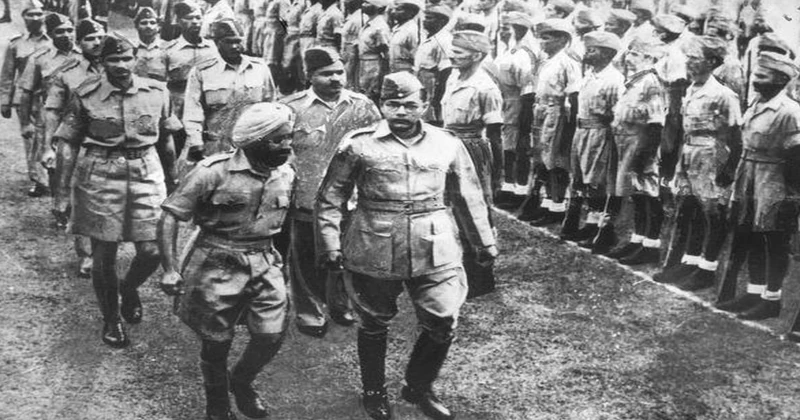
Amidst of the Second World War, while much of the world was consumed by the clash of global empires, a revolutionary declaration resounded from Singapore’s Cathay Building that shook the very foundation of British colonial power. On October 21, 1943, Netaji Subhas Chandra Bose proclaimed the establishment of the Provisional Government of Free India the Azad Hind Sarkar a government in exile that dared to claim sovereignty for a still-colonised nation.
This was not a symbolic proclamation. It was a strategic, ideological, and military assertion of India’s right to self-rule. The Azad Hind Government, backed by the Indian National Army (INA), was Bose’s audacious challenge to the British Empire a declaration that India would fight for her freedom not through pleas or petitions, but through armed struggle and sacrifice.
Subhas Chandra Bose, once a rising star within the Indian National Congress, had grown disillusioned with what he saw as the timid pace of India’s freedom movement under Mahatma Gandhi’s non-violence doctrine. His conviction was clear the British would not quit India through moral persuasion but only through militant resistance.
In 1941, after escaping house arrest in Calcutta in disguise, Bose travelled through Afghanistan, the Soviet Union, and Germany, seeking international alliances that could support his vision of a liberated India. When the tides of war shifted to Asia, he moved to Japanese-occupied Southeast Asia, where the seeds of the Indian National Army (INA) had already been sown.
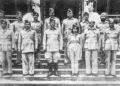
On October 21, 1943, Bose formally announced the establishment of the Azad Hind Government a sovereign Indian administration operating beyond British control. He assumed the roles of Head of State, Prime Minister, and Minister for War and Foreign Affairs, declaring:
“It is not merely a Government in exile. It is the Government of the free Indians of the East Asia, and it represents the will of the entire Indian people.” The newly formed government adopted the rousing salutation “Jai Hind”, chose “Kadam Kadam Badaye Ja” as its marching song, and introduced a tricolour flag featuring a springing tiger symbolising courage and resurgence.
The Rani of Jhansi Regiment, led by Dr. Lakshmi Swaminathan (later Lakshmi Sehgal), became the first all-female combat unit in Asia, epitomising the spirit of equality and patriotism in Bose’s vision of an independent India.
Within weeks, the Axis powers Japan, Germany, Italy, Croatia, and Thailand formally recognised the Azad Hind Government, giving it diplomatic legitimacy. Japan handed over the Andaman and Nicobar Islands, which Bose renamed Shaheed (Martyr) and Swaraj (Self-Rule) Islands the first Indian territories symbolically freed from British rule.
The INA, originally organised by Captain Mohan Singh, had faltered amid leadership disputes and Japanese interference. But under Bose’s leadership, it was reborn as the Azad Hind Fauj disciplined, ideologically driven, and fiercely nationalistic.
Unlike its earlier incarnation, Bose’s INA transcended barriers of religion, caste, and region. Regiments named after national heroes — Gandhi, Nehru, and Azad — marched together under one flag, pledging their lives to the cause of India’s freedom. The soldiers swore allegiance to Netaji and the nation, under the motto:
“Ittefaq, Etemad, Qurbani.”
The INA’s strength peaked at nearly 60,000 soldiers, including civilian volunteers from the Indian diaspora across Southeast Asia. It had its own currency, postage stamps, and national symbols, functioning as the armed wing of the Azad Hind Government.
March to Imphal: Military campaign of the INA
In early 1944, the INA and Japanese forces launched an ambitious campaign to invade British India through Burma. They captured parts of Arakan and Manipur, and on April 14, 1944, the INA hoisted the Indian tricolour in Moirang, near Imphal a historic moment marking the first raising of India’s flag on liberated soil.
However, the campaign faltered at Imphal and Kohima, where fierce Allied resistance and severe logistical setbacks led to devastating losses. The defeat of Japan in 1945 sealed the fate of the Azad Hind Government.
The collapse of Japan and Bose’s reported death in a plane crash on August 18, 1945, ended the INA’s military campaign — but not its impact. The INA trials, held at Delhi’s Red Fort between 1945 and 1946, became a rallying cry for national unity.
The first public trial of Shah Nawaz Khan, Prem Sahgal, and Gurbaksh Singh Dhillon turned into a nationwide political storm. The INA Defence Committee, comprising eminent figures like Bhulabhai Desai, Asaf Ali, Sharat Chandra Bose, Tej Bahadur Sapru, and Kailash Nath Katju, fought to defend the officers.
Mass protests erupted across India, uniting citizens beyond communal lines. The INA’s sacrifice rekindled patriotism, igniting waves of solidarity within the armed forces culminating in the Royal Indian Navy Mutiny of 1946, when Indian sailors raised slogans of “Jai Hind” and “Netaji Zindabad” against the British Empire.
Though militarily defeated, the INA’s impact was psychological, political, and revolutionary. It shattered the myth of British invincibility and inspired Indians to envision sovereignty as not merely a dream, but a right to be fought for.
As historian Hugh Toye noted, “The INA may have lost the battle, but it won the war for Indian hearts.”
When India finally gained independence in 1947, the echoes of “Jai Hind” the greeting born under Bose’s government became the salutation of a free nation. While India remembers Netaji’s declaration of the Azad Hind Government on this day, the world also recalls other historic milestones of October 21:
- 1879: Thomas Edison perfected the practical incandescent light bulb, ushering humanity into the modern electrical age.
- 1966: The Aberfan disaster in Wales killed 144 people, exposing industrial negligence and changing Britain’s safety laws.
- 1967: Over 100,000 Americans marched in Washington, DC, in one of the largest anti-Vietnam War protests, reshaping global civil resistance.
The Azad Hind Government’s existence though brief marked the first declaration of Indian sovereignty after centuries of foreign rule. It was the embodiment of militant patriotism, a reminder that freedom often demands defiance, discipline, and sacrifice.
Even today, as India stands tall among global powers, the legacy of October 21, 1943, endures a day when Subhas Chandra Bose and his soldiers dared to dream of freedom on their own terms, long before the world was ready to grant it.
“Give me blood, and I will give you freedom.” — Netaji Subhas Chandra Bose.












Comments