





In Mainpuri district, Uttar Pradesh, a man accused of involvement in a “Love Jihad” case has been sentenced to twenty years of rigorous imprisonment by the Special POCSO Court, presided over by Judge Jeetendra Mishra. The convict, Shehensah Khan, had assumed the identity of Rajkumar to lure and abduct a minor Hindu girl, taking her to multiple locations before being apprehended by the Uttar Pradesh Police. Remarkably, the district court delivered the conviction within fifteen months of the FIR registration. In addition to the prison term, the court imposed a fine of Rs 25,000, directing that failure to pay would result in an additional four months of imprisonment. Following the sentencing, the accused was immediately taken into judicial custody.
The case was initiated when the victim’s father, Charan Singh, lodged an FIR (No. 168/2024) at Karhal Police Station on April 14, 2024. Based on his complaint, Rajkumar alias Shehensah Khan was formally booked under Sections 363 and 366 of the Indian Penal Code (IPC) for kidnapping and abduction with intent to compel.
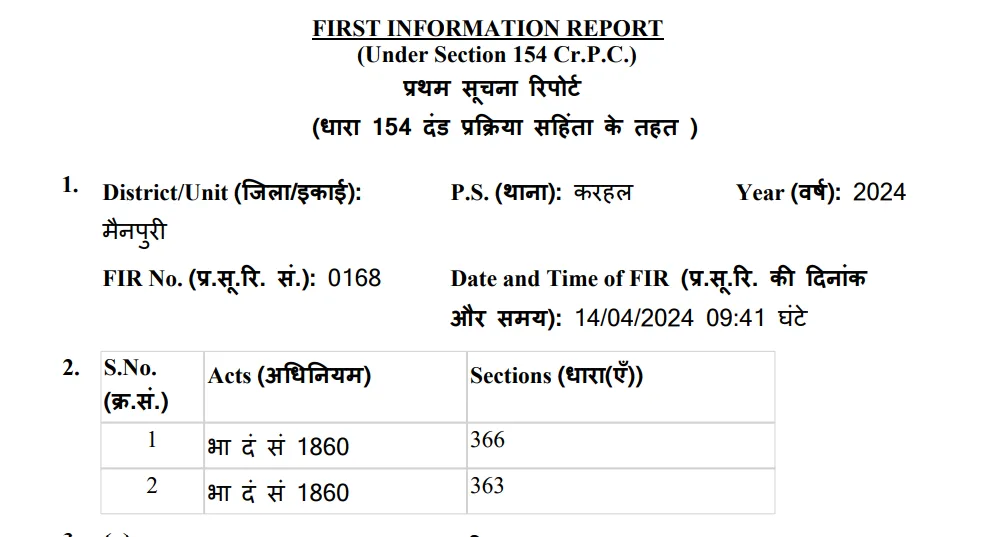
In his complaint to the police, Singh stated, “On April 13, my two daughters had gone to the nearby Durga Devi temple. From there, Rajkumar, a native of Kasganj, came and took my elder daughter with him. My younger daughter returned home and informed me about the incident. When she tried to stop her sister, the elder one shouted at her and warned her not to tell anyone. Since then, my elder daughter’s mobile phone has been switched off. Rajkumar works at the dam construction site, currently operating in our village. We managed to speak to him over the phone but didn’t ask about our daughter, fearing that he might switch off his phone as well.”
After a protracted legal battle spanning over 15 months, the Special Court in Mainpuri has delivered a landmark verdict in Special Trial No. 78/2024 (Sessions Case No. 1047/2024), titled State vs. Rajkumar @ Shanshah Khan. Presided over by Judge Jeetendra Mishra, the judgment was pronounced on October 16, 2025, culminating in the conviction of the accused under multiple sections of the Indian Penal Code (IPC) and the Protection of Children from Sexual Offences (POCSO) Act, 2012.
Case Background
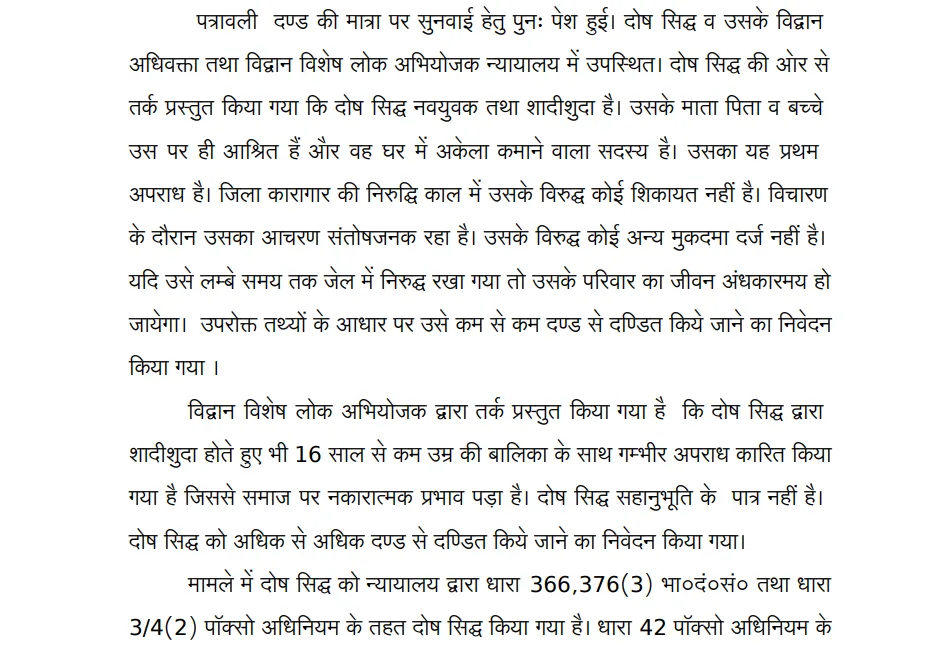
The case stems from Case Crime No. 168/2024, registered on April 14, 2024, at Karhal Police Station, Mainpuri. The accused, Rajkumar, alias Shanshah Khan, son of Nizamuddin and a resident of Nagla Sahjan, P.S. Kotwali, Kasganj, faced charges under Sections 363 (kidnapping), 366 (kidnapping to compel marriage), and 376(3) (rape of a minor under 16) of the IPC, alongside Sections 3/4(2) of the POCSO Act, which address penetrative sexual assault on a minor.
Judicial Proceedings
The investigation, led by Investigating Officer Shri Krishna Singh, progressed. Statements from witnesses were recorded under Section 161 of the Cr.P.C., and the victim’s statement under Section 164 Cr.P.C. was secured before a Magistrate. A charge sheet, filed on June 18, 2024, added the graver charges of Section 376(3) IPC and Section 3/4(2) POCSO Act based on the victim’s account of sexual assault. The trial commenced with charges formally framed on July 12, 2024, to which the accused pleaded not guilty, opting for a full trial.
The prosecution presented a robust case, supported by six witnesses and eleven documentary exhibits. Key evidence included the victim’s statement, the written complaint, medical reports, and school records confirming the victim’s age.
Prosecution’s Case and Key Testimonies
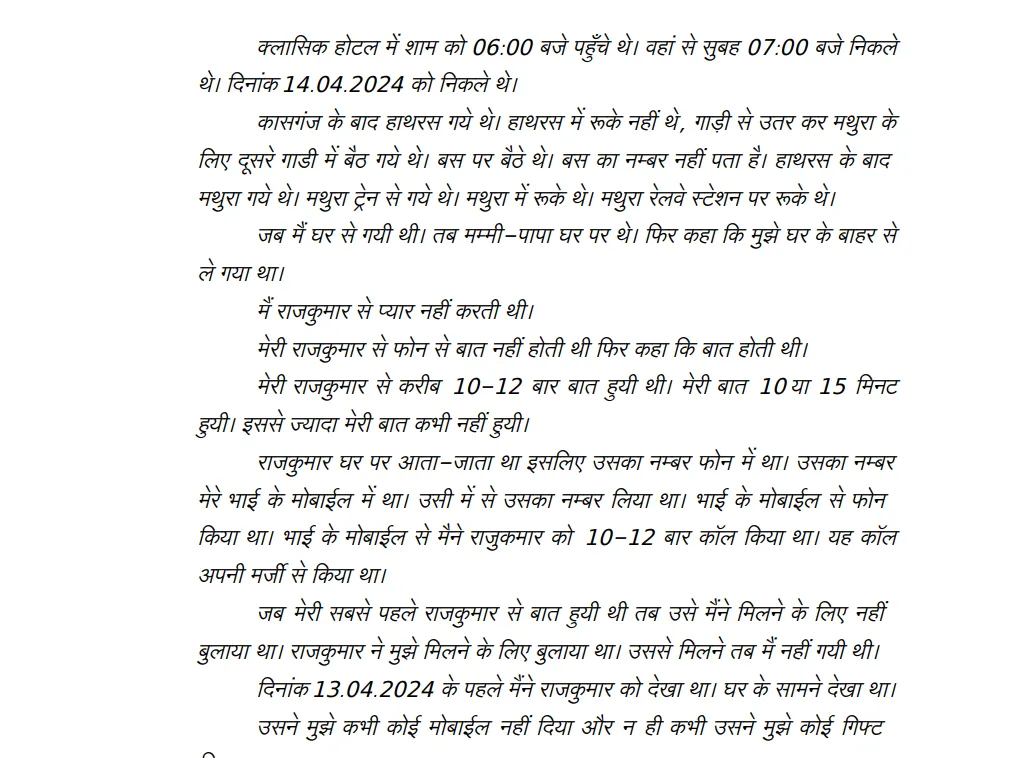
The victim, aged approximately 14 years and 11 months at the time of the incident, provided a harrowing account. In her testimony and statement under Section 164 Cr.P.C., she affirmed her date of birth as May 4, 2009, and stated that the accused “coaxed and lured” her with promises of food and clothes. She described being taken to the Classic Hotel in Kasganj via motorcycle, where the accused gave her a cold drink with “something mixed in it,” causing her to feel drowsy and “slightly unconscious”.
She testified that the accused “did the wrong thing” (“galat kaam kiya”) with her forcibly (“jabardasti”) at the hotel. She further detailed subsequent travel by train to Hathras, Mathura, and Noida before being brought back. Her consistent statements formed the bedrock of the prosecution’s case.
She also told, “He [the accused] told me that he was taking me outside the house. I didn’t love him. He didn’t talk to me much, just occasionally. We spoke about 10 to 12 times, and each conversation lasted around 10 or 15 minutes. We didn’t talk much beyond that. He used to come and go from our house, and I had his phone number. His number was in my brother’s mobile. I had called him from my brother’s phone and spoken to him. I called him about 10 to 12 times from my brother’s phone, talking about our religion. When we first spoke, he didn’t ask me to meet him. Later, he called me to meet him, but I didn’t go. Before the incident on April 13, 2024, I had seen him at our house. He had come to our house earlier. He never gave me a mobile phone, nor did he give me any gifts. I never asked him for anything.”
The victim’s father corroborated the sequence of events, explaining the delay in filing the FIR due to his attempts to locate his daughter.
Medical findings
According to the court order, the Forensic Science Laboratory (FSL) report dated May 25, 2024, pertaining to the case, provided details regarding the material exhibits submitted for examination.
The report confirmed that the victim’s jeans contained traces of blood. Additionally, the victim’s underwear was examined as part of the evidence.
The FSL report primarily highlighted the presence of blood on the jeans. The report also indicate the presence of semen in the underwear. The defence relied on the medical examination, specifically the Supplementary Report, which stated that no spermatozoa were detected in the slide prepared from the vaginal swab.
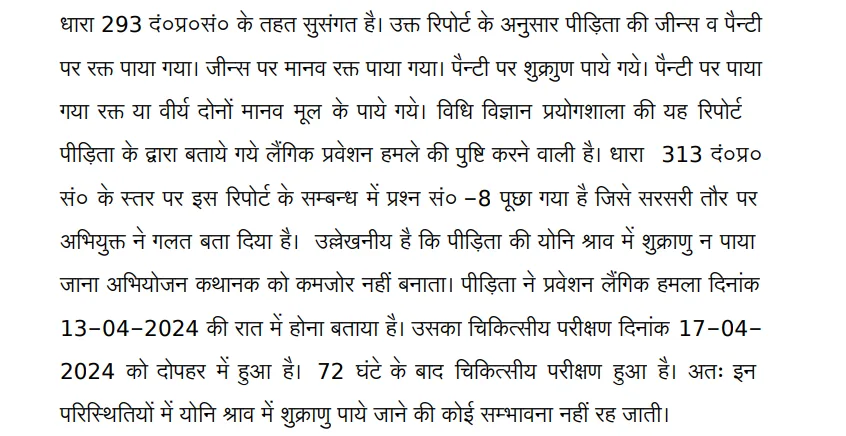
This distinction formed a significant point in the defense’s arguments, which contended that the absence of spermatozoa weakened the claim of sexual assault, despite the circumstantial evidence and testimony provided by the victim.
Defence’s Counterarguments
The defence, led by M. Ali, challenged the prosecution’s case on several grounds. They argued that the one-day delay in filing the FIR was suspicious, questioned the reliability of the victim’s testimony due to minor inconsistencies, and emphasised the lack of medical corroboration. The defence also contended that the victim’s travel across multiple cities without attempting to escape suggested consent, a claim the prosecution vehemently refuted, citing her minor status and the effects of intoxication.
The accused, in his statement under Section 313 Cr.P.C., denied all allegations, claiming he was falsely implicated. A lone defence witness, Allabaksh, was presented to support his innocence but failed to sway the court.
Why is this Love Jihad?
In a cunning and manipulative scheme, Rajkumar, alias Shanshah Khan, exploited his familiarity with the victim’s family to ensnare a 14-year-old girl from her village. Known to the family as a laborer on a nearby river dam project, he used his assumed identity as “Rajkumar” to mask his true intentions and build trust.
Prior to April 13, 2024, he had been communicating with the victim via phone, subtly grooming her with deceptive charm. On that day, he lured her with promises of buying clothes, as she later testified, stating he “coaxed and lured” her. The outing, presented as a simple trip to Kasganj, was a pretext, as he took her to the Classic Hotel, where he forcibly committed a “wrong thing”, according to her testimony.
The prosecution framed this as a calculated act, with allegations of “Love Jihad” surfacing, suggesting that, had the victim not returned to Mainpuri, the accused might have coerced her into converting to Islam. Notably, despite being married, the accused’s defense counsel argued in court that the victim’s family fabricated the case to pressure him into marrying the girl, a claim the court rejected in light of the victim’s consistent testimony and evidence.
Judicial Findings
The court addressed two critical questions: the victim’s age and whether the prosecution proved the charges of kidnapping and sexual assault. Citing Supreme Court precedents, including Jarnail Singh vs. State of Haryana (2013) and P. Yuvaprakash vs. State (2023), the court relied on school records to confirm the victim’s date of birth as May 4, 2009, establishing her as a minor under 18 years at the time of the incident.
Invoking Section 29 of the POCSO Act, which presumes guilt in cases of penetrative sexual assault unless disproved, the court found the victim’s consistent testimony credible.
Despite the absence of medical corroboration, the court noted that a victim’s account in sexual assault cases, particularly involving a minor, holds significant weight. The accused failed to rebut the presumption of guilt, leading to his conviction under Sections 366 and 376(3) IPC and Sections 3/4(2) of the POCSO Act.
Verdict and Sentence
On October 16, 2025, the court convicted Rajkumar @ Shanshah Khan, sentencing him to 20 years of rigorous imprisonment. His bail bonds were cancelled, and he was taken into judicial custody, with the time served during the investigation and trial set off against his sentence.
Under Section 376(3) of the Indian Penal Code (IPC) and Section 3/4(2) of the Protection of Children from Sexual Offences (POCSO) Act, 2012, the accused is sentenced to 20 years of rigorous imprisonment and a fine of Rs 20,000 (twenty thousand rupees). In default of payment of the fine, the accused shall undergo an additional three months of imprisonment.
Under Section 366 of the Indian Penal Code (IPC), the accused is sentenced to seven years of rigorous imprisonment and a fine of Rs 5,000 (five thousand rupees). In default of payment of the fine, the accused shall undergo an additional period of imprisonment as determined by the court.
In default of payment of the fine, the accused shall undergo an additional one month of imprisonment.
The entire amount of the fine shall be paid to the victim as compensation. The bail bonds of the accused are cancelled, and the sureties are discharged.
















Comments