





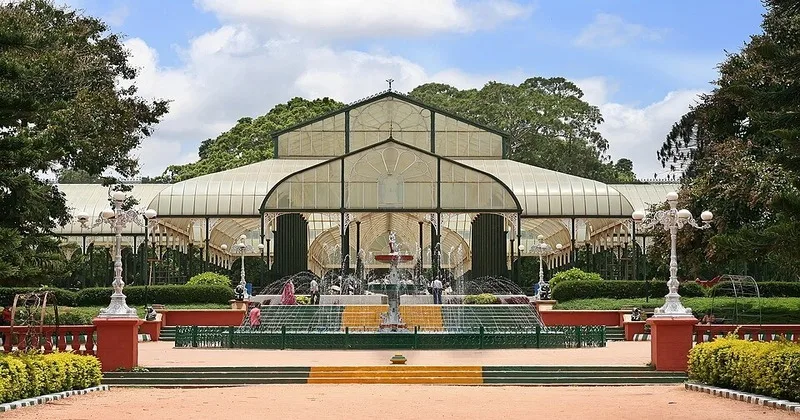
Bengaluru: The Siddaramaiah-led Congress government is under fire for its controversial decision to utilize portions of Lalbagh Botanical Garden, Bengaluru’s century-old green landmark, for the proposed Bengaluru Tunnel Road project. Environmentalists, heritage conservationists, and opposition leaders have condemned the move, calling it a reckless step that could cause irreversible ecological and geological damage to one of the city’s most iconic spaces.
The government initially stated that only a small portion of Lalbagh would be temporarily used to store construction materials for the tunnel road. Deputy Chief Minister D.K. Shivakumar sought to allay public fears, claiming that the land would be vacated after the project’s completion. But subsequent disclosures that the tunnel route itself would run beneath Lalbagh have sparked outrage, raising concerns about the threat to the 3,000-million-year-old Peninsular Gneiss, also known as Lalbagh Rock, a national geo-heritage site.
After Congress Govt's move of earmarking land next to Lalbagh Rock for Tunnel Road, I have written to Union Minister of Mines, @kishanreddybjp garu, to direct the Geological Survey of India to conduct a comprehensive geological impact assessment of the project.
The present… pic.twitter.com/wseh5TXzmP
— Tejasvi Surya (@Tejasvi_Surya) October 15, 2025
Opposition voices have accused the Congress government of disregarding Bengaluru’s environmental and cultural heritage in the name of urban development. Bangalore South MP Tejasvi Surya has strongly opposed the project and written to Union Mines Minister Kishan Reddy, urging him to direct the Geological Survey of India (GSI) to carry out a detailed geological impact assessment.
“Following the Congress government’s move to identify land next to the Lalbagh rock for the tunnel road, I have requested Union Minister Kishan Reddy to initiate a comprehensive study on the potential geological, seismic, and hydrological impact of the project. This tunnel threatens one of Bengaluru’s oldest and most valuable natural formations,” Surya said in his letter.
He warned that the current alignment of the tunnel road passes dangerously close to the Lalbagh rock, risking structural damage to the geological formation and disturbing the ecological balance of the park. “Before disturbing even an inch of Lalbagh, a full scientific and environmental study is essential. This is not just about rock and soil — it’s about Bengaluru’s legacy,” he added.
Citizens’ groups have also joined the outcry, questioning the need for a tunnel that prioritizes private vehicle movement rather than addressing the city’s growing public transport crisis. “What Bengaluru needs is a robust, affordable, and reliable public transport system, not a billion-rupee tunnel that destroys our heritage,” Surya posted on X.
Environmental experts warn that tunneling activities near Lalbagh could destabilize rock formations, affect groundwater levels, and alter the hydrology of the surrounding region. “The Lalbagh rock is a geological treasure that has survived billions of years. Any disturbance for short-term infrastructure gain is an environmental crime,” said a senior geologist from the Indian Institute of Science.
Heritage activists argue that Lalbagh is not merely a park, but an ecological and cultural identity of Bengaluru. Founded in the 18th century by Hyder Ali and later expanded by Tipu Sultan, Lalbagh is home to over 1,800 species of flora and several species of migratory birds. “Using any portion of Lalbagh for industrial or infrastructure purposes violates its historic sanctity,” said environmental campaigner Leo Saldanha of ESG (Environment Support Group).
Critics also point out that the Congress government’s development model has consistently prioritized road expansion and flyovers over sustainable transport planning. “The tunnel road reflects a car-centric approach that excludes the common citizen,” said urban planner Sandeep Anirudhan. “It is tragic that the government would consider touching Lalbagh the city’s lungs for yet another vanity project.”
The Congress government, however, continues to defend its plan, reiterating that no permanent structure will come up within Lalbagh and that “only temporary space utilization” will occur. Yet, with public distrust mounting and the opposition sharpening its tone, the government faces a growing backlash for tampering with Bengaluru’s heritage.
















Comments