






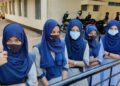
According to reports, a student arrived at the school wearing an Islamic Hijab instead of the prescribed uniform. Teachers objected and informed the parent, who took the child home. The following day, the parent, identified as P. M. Anus, insisted that wearing the Hijab was their fundamental right, claiming that the student had previously worn only a scarf.
Matters escalated when a group allegedly associated with the Social Democratic Party of India (SDPI)—the political wing of the now-banned Popular Front of India (PFI)—reportedly entered the school premises and threatened the management and staff, most of whom are Christian nuns. The confrontation quickly turned into a religious dispute over the dress code, prompting the school to declare a temporary closure on 13 and 14 October.
The parent later alleged that the teachers had been mentally harassing his ward, calling her “arrogant and disobedient”. However, Principal Sr. Heleena Ancy and the management firmly rejected these claims. The Principal stated that the incident had caused panic among students and that the school had maintained a uniform policy “for several decades”. Parents are informed of the dress code during admission and are required to accept it as a condition of enrolment, she said.
“The student in question had been attending school in full uniform for the first four months without any objection,” the Principal added.
A turning point came on 13 October, when the Kerala High Court intervened and directed the reopening of the school, affirming that the institution’s right to enforce a uniform policy outweighs an individual’s right to wear religious attire. Citing a 2018 judgment, the court reiterated that schools are entitled to determine their dress code, and those who disagree may seek alternatives. The court also directed the state government to provide police protection to the school when it reopens.
Speaking to the media, the school’s counsel Adv. Remy Thomas welcomed the decision, saying it reaffirmed the school’s autonomy. The Parents Teachers Association (PTA) president, Joshi, said the uniform rule had been accepted by all parents at the time of admission. Social worker Jose Christopher Xavier also expressed support for the management’s stance.
In a letter addressed to parents following the controversy, Principal Sr. Heleena Ancy explained the situation that led to the temporary closure of the school.
“The recent incident has deeply affected the normal functioning of our school,” the Principal wrote. “Several students requested holidays in view of the tension that arose after a student arrived wearing non-permissible attire. Following this, pressure mounted from the student’s parents and from certain outsiders who are not the well-wishers of the school. Many of our teachers and non-teaching staff have gone on leave as a result of this pressure, making it impossible to maintain a peaceful teaching environment.”
She added that the decision to suspend classes was taken after consulting the Parents Teachers Association (PTA).
“Therefore, after seeking the opinion of the PTA members, it has been decided that the school will remain closed on October 13 and 14,” Sr. Ancy stated.
Reaffirming the institution’s commitment to its educational mission, the Principal said, “We hope to continue imparting exemplary education in the future, based on the freedom our country provides and the rights of the management. We expect the continued cooperation of all parents in upholding these values.”
Observers note that the Principal’s letter subtly hints at a recurring pattern — that sections of the Muslim community in the country, and particularly in Kerala, tend to raise issues under the guise of religious rights, often sowing seeds of separatism from a young age, beginning in schools.
Kerala has witnessed similar incidents in the past. In September 2022, a dispute over the Hijab erupted at Providence Girls Higher Secondary School, Kozhikode. Earlier, in 2019, the Muslim Educational Society (MES) had issued a circular banning the Niqab and face-covering Hijab across its 150 institutions, citing uniform discipline.
The latest episode, however, is being seen as a warning sign. If such confrontations over religious identity and attire continue to spread across schools, it could pose a serious challenge to Kerala’s educational environment and threat to realm of institutions.
In Kerala, there appears to be a systematic effort to transform educational institutions into ideological zones influenced by Islamic narratives, where every global development, particularly those related to Islam, is mirrored within campuses.
Recently, students in one such institution staged a mime performance in solidarity with the Muslims of Gaza, signalling how international religious issues are being drawn into school environments.
Observers note that the CPM and CMI have consistently resorted to appeasement politics, extending tacit support to such activities in exchange for votes. This recurring trend, they argue, highlights the nexus between Communist forces and radical Islamic elements, united by mutual interests in controlling Kerala’s politics and street power.










Comments