





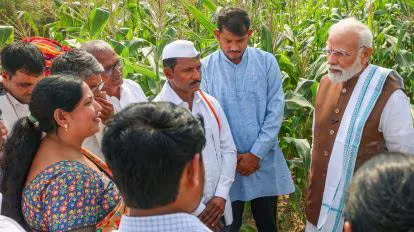
At a special Krishi event held at the Indian Agricultural Research Institute (IARI) in New Delhi, Prime Minister Narendra Modi launched, inaugurated, and laid the foundation stone for projects and schemes collectively valued at over Rs 42,000 crore. The event witnessed the unveiling of two flagship agricultural schemes, PM Dhan Dhaanya Krishi Yojana and Mission for Aatmanirbharta in Pulses, with a combined outlay of Rs 35,440 crore.
These initiatives aim to enhance productivity, promote sustainable agricultural practices, strengthen the value chain, and ultimately empower farmers towards achieving self-reliance in food security and exports.
PM Dhan Dhaanya Krishi Yojana: Transforming 100 agricultural districts
The PM Dhan Dhaanya Krishi Yojana has been introduced with an outlay of Rs 24,000 crore. The scheme is designed to enhance agricultural productivity, encourage crop diversification, improve irrigation infrastructure, and facilitate long-term and short-term credit access in 100 identified low-performing agricultural districts.
Under this scheme, registered farmers will receive access to high-yielding seeds, bio-fertilisers, and mechanised farm tools like seed drills and harvesters. Moreover, the scheme promotes sustainable farming practices and direct market access through digital platforms and mobile applications.
The government also plans to strengthen storage infrastructure, expand irrigation networks, and modernise rural mandis to connect farmers to national and international markets.
Mission for Aatmanirbharta in pulses
Complementing the Dhan Dhaanya Yojana, the Mission for Aatmanirbharta in Pulses has been launched with an allocation of Rs 11,440 crore. Its core objective is to achieve self-sufficiency in pulses production and reduce dependence on imports.
The mission focuses on:
1. Enhancing the productivity of major pulse crops through research and technology adoption,
2. Expanding area under pulse cultivation,
3. Strengthening the value chain, from procurement to processing and storage, and
4. Reducing post-harvest losses through scientific management.
By 2030-31, the mission aims to cover 370 lakh hectares under pulse cultivation and distribute 126 lakh quintals of certified, high-yield, and climate-resilient seeds to farmers. The government will also encourage state-level five-year rolling plans for pulse production to ensure consistent monitoring and regional self-reliance.
PM Modi: “Reforms in agriculture began in 2014”
Addressing the gathering, Prime Minister Modi said that these new schemes will “transform the fortunes of millions of farmers” and strengthen India’s march towards becoming a developed nation.
“For 21st-century India to achieve rapid development, reforms in the country’s agricultural system were essential and that process began in 2014,” he stated.
Highlighting the progress achieved under the NDA government, he said India’s agricultural exports have nearly doubled over the past eleven years, while food grain production has risen by about 90 million metric tonnes. The country’s fruit and vegetable output has grown by over 640 lakh metric tonnes, placing India among the leading food producers globally.
India becomes global leader in milk and fisheries
PM Modi mentioned that India now ranks first globally in milk production and is the second-largest fish producer in the world.
He also noted that six new fertiliser plants have been established to ensure timely availability of nutrients for farmers, and that over 25 crore soil health cards have been distributed in the last decade to encourage scientific farming.
The Prime Minister informed that the agriculture budget under the NDA government has seen a six-fold increase compared to previous regimes. Furthermore, he said GST reductions on farm machinery and inputs have provided maximum benefits to rural India, reducing production costs for farmers.
Emphasising the need to diversify India’s crop pattern, Modi urged farmers to shift focus beyond traditional crops like wheat and rice and include pulses and oilseeds to ensure protein and nutritional security.
He stressed that the success of the PM Dhan Dhaanya Krishi Yojana depends on its implementation at the grassroots level, where 100 low-performing agricultural districts will be transformed through technological and institutional support.
“Farmers have the biggest role in making India a developed nation. Our policies, investments, and innovations are all directed towards empowering them,” the Prime Minister said.
Allied Sector Push: Projects worth Rs 5,450 crore inaugurated
In addition to the major schemes, PM Modi inaugurated and dedicated to the nation projects worth Rs 5,450 crore in the agriculture, animal husbandry, fisheries, and food processing sectors. He also laid the foundation stone for new projects valued at Rs 815 crore.
Among the inaugurated projects were:
1. Artificial insemination training centres in Bengaluru and Jammu & Kashmir,
2. Centres of excellence for dairy and animal husbandry at Amreli and Banas,
3. An IVF laboratory in Assam under the Rashtriya Gokul Mission,
4. Milk powder plants at Mehsana, Indore, and Bhilwara, and
5. A fish feed plant under the Pradhan Mantri Matsya Sampada Yojana at Tezpur, Assam.
Support to farmers under ongoing schemes
During the event, PM Modi also distributed certificates to farmers under various government missions:
Certified farmers under the National Mission for Natural Farming, MAITRI technicians, and Primary Agriculture Cooperative Credit Societies (PACS) that have been converted into Pradhan Mantri Kisan Samriddhi Kendras (PMKSKs) and Common Service Centres (CSCs).
These certifications are part of the government’s efforts to integrate cooperative and digital frameworks into rural agricultural systems.
Union Agriculture and Farmers’ Welfare Minister Shivraj Singh Chouhan lauded the Prime Minister’s consistent commitment to the farming community.
He said that in the latest GST reforms, the government has reduced tax rates on farm equipment to ease the financial burden on cultivators.
Chouhan highlighted the increased Minimum Support Prices (MSP) for Rabi crops and said that under the Pradhan Mantri Kisan Samman Nidhi (PM-KISAN) scheme, over Rs 3.9 lakh crore has been directly transferred into farmers’ bank accounts through Direct Benefit Transfer (DBT).
He further informed that under the Pradhan Mantri Fasal Bima Yojana, Rs 1.83 lakh crore has been disbursed as insurance claims to farmers affected by crop losses.
A vision for Aatmanirbhar Krishi Bharat
The launch of PM Dhan Dhaanya Krishi Yojana and Mission for Aatmanirbharta in Pulses underscores the government’s long-term vision to make India’s agricultural sector self-sufficient, sustainable, and globally competitive.
With strategic investments in technology, infrastructure, and research, and a strong emphasis on empowering small and marginal farmers, these schemes are expected to strengthen India’s position as an agricultural powerhouse while ensuring food and nutritional security for its 1.4 billion citizens.
“This is not just a scheme,” Modi concluded, “it is a movement towards Aatmanirbhar Krishi Bharat, where every farmer contributes to building a developed India.”
















Comments