





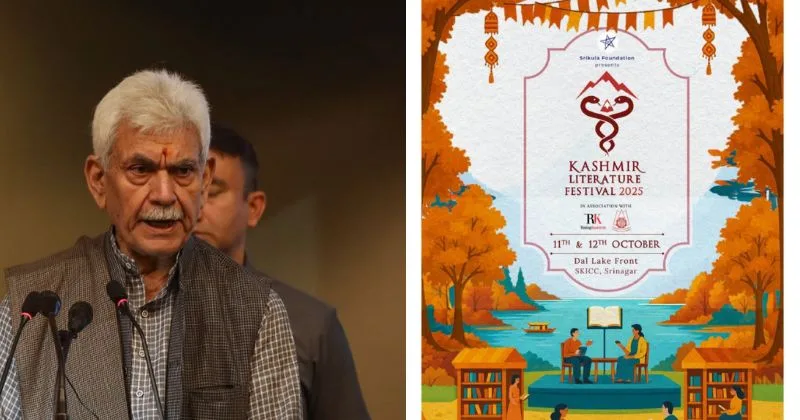
On October 12, the second and last day of the Kashmir Literature Festival, there were people from all walks of life who thronged its venue, the majestic Sher I Kashmir International Conference Centre (SKICC) located on Dal lake shore. Such events in the Union Territory (UT) of J&K happen very rarely but with changing times, it can be expected that these things will happen in Srinagar, as also elsewhere, more regularly.
On October 11, Lieutenant Governor Manoj Sinha called for correcting the narrative regarding Jammu & Kashmir by identifying the misinformation and countering it with verified facts. He was at the Kashmir Literature Festival to inaugurate it when he made these remarks.
“For decades, a manipulated narrative was propagated here in J&K. Writers and media figures grudgingly admit now that, out of fear of terrorists and their ecosystem, they were forced to promote the narrative being pushed from across the border in the Valley,” Sinha said.
Writers must do research and use critical proof to challenge and correct the misleading historical accounts. The terror ecosystem has been dismantled and now is the time to present the true narrative of J&K, free from all bias and fear of guns, to strengthen the trust and accelerate socio-economic growth, Sinha said.
The modern history of J&K, including facts pertaining to its formation and consolidation in March 1846 by Maharaja Gulab Singh, need to be told and retold without biases. Unfortunately, inspired by leftists and separatists, many distortions have been introduced by contemporary historians into these narratives. These biases and falsehoods have to be forcefully countered with verified facts so that false narratives fall like a pack of cards.
During the colonial era and after independence, a group of writers distorted our history to shape their ideological agenda. “Today the young historians must provide accurate and factually correct accounts challenging those lies. In the last few years, new writers have tried to do justice to the injustice done to the history of India, which is an excellent initiative. Efforts are also being made to take Indian literature to the world, which is highly commendable,” he said.
Sinha highlighted the need for offering new perspectives and vision to the readers in a rapidly evolving world to meet unprecedented challenges and opportunities, and understanding of nature, culture and people’s well-being.
It is worth mentioning here that the historical facts regarding J&K were distorted in many ways by some authors who sought to deny its past. These distortions ranged from falsely naming Anantnag to Islamabad, addressing historical Shankarchaya hill as Takht-e-Suleman and renaming many villages. The trick used by these false historians was to systematically try to erase an undeniable Hindu past of the Kashmir (derived from Kashyapmir, descending from revered Sage Kashyap).
Sinha called literature the “soul of a nation” and writers the “engineers of human consciousness’’. He said that literature has the power to awaken minds and guide societies toward wisdom and harmony. “Engineers build the structures of progress, but writers build the structures of thought. Through their words, they awaken society’s mind, inspire imagination, and guide generations towards wisdom and harmony,” he said.
Quoting ancient Indian texts, Sinha said that India’s civilizational ethos has always placed great value on knowledge and scholarship. “A scholar gets respect not only within the country but all over the world,” he said, referring to Vedic verses that celebrate learning and friendship with scholars. Drawing a personal connection, Sinha said though he studied engineering at his alma mater Banaras Hindu University (BHU), and not literature, he found a strong link between the two. “When I worked on mathematical and scientific designs, I aimed to create solutions that could accelerate social development. Similarly, a writer creates structures of words that stimulate social consciousness and inspire progress,” he noted.
Sinha said that writers and thinkers are like gardeners who choose and nurture words as carefully as flower plants, shaping the emotional and intellectual landscape of a nation. He stressed that literature provides society with imagination, empathy, and moral clarity values essential for nation-building.
The LG also narrated a parable about an emperor advised by a wise writer to remember the phrase “This too shall pass,” underscoring the importance of equanimity in both joy and sorrow. “Whether in happiness or in pain, this message reminds us of life’s balance and the enduring power of words,” he said.
The LG commended the organisers for bringing together distinguished minds and said such festivals reaffirm Kashmir’s identity as a land of wisdom, culture, and creativity. “Literature reflects the heartbeat of a nation. It is through the words of writers that civilizations evolve, heal, and find their purpose,” he said.
Amongst the various programmes, the panel discussions on “Narratives in Kashmir” were very interesting and resonated with the audience. Brigadier Sushil Tanwar, a decorated serving officer and author of the much acclaimed book “Mukhbir” highlighted the importance of narrating the stories of common man in Jammu & Kashmir and their close relationship with security forces.
The need for contesting negative narratives with honest story telling & highlighting the number of sacrifices made by common people along with the security forces is also an intellectual responsibility, he said. Lieutenant General (Retired) DP Pandey, Yuvraj Srivastava, Founder Srikula Foundation, senior officials, prominent literary personalities, members of Srikula Foundation, people from different walks of life and youth in large number attended the inaugural ceremony.
More than 50 speakers and authors from diverse fields participated in the event, which hosted sessions on contemporary literature, history, media, art, technology, and cultural heritage, with special focus on young voices, women writers, and Kashmiri literature. A book fair, art exhibition, and events showcasing Kashmir’s rich traditions were other highlights of the event, according to the organisers.
According to Naira Manzoor of the Srikula Foundation, said their aim was to strive to preserve, celebrate and promote the rich literary heritage of Kashmir.










Comments