





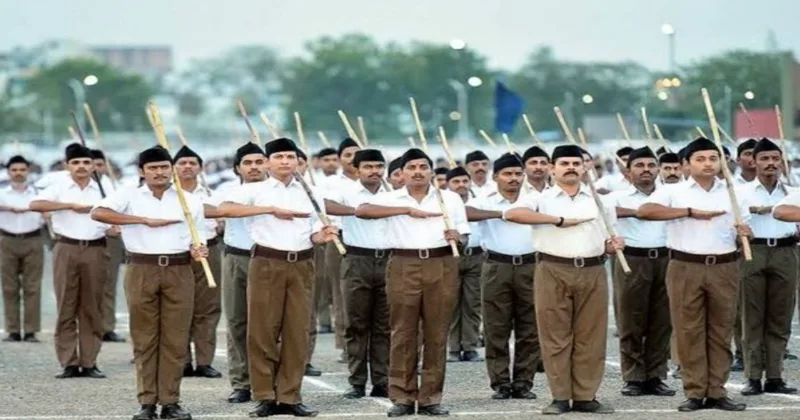
After centuries of enslavement and colonial thought, our nation is once again on the rise. Even after gaining independence, we were taught to assimilate Western culture and worldviews, which weakened us more. Since we have been united as Bharatiya since last few years, we have advanced in all areas and have the best reputation on the global stage. We hope to be in “Amrit Kaal”, we become developed nation with the status of “Vishwaguru” by 2047. The government cannot do it alone; society as a whole must also participate if we are to move rapidly and precisely in the right path.
Many institutions and organisations, large and small, are working to enhance society and build the nation. One of the most prominent of organizations is the Rashtriya Swayamsevak Sangh, which was founded in 1925 and is celebrating its centennial. Its purpose is to reestablish “Bharatiyatva” and make Bharat “Vishwaguru” again. To do this, RSS has undertaken a number of initiatives and significant challenges. Although there are millions of swayamsevaks working, would this be enough to effect positive change in a nation of 140 crore people with a diverse population in terms of culture, language, and socioeconomic level in the near future? We will see rapid and precise shift if society, various non-governmental organizations, social workers, celebrities from multiple sectors, and others all participate.
How should society, including institutes, NGOs, business and industry leaders, and celebrities, assist the national cause?
The RSS has selected the five “Panch Parivartan” points as its primary goals as a concern. Among them are: 1. Swadeshi or Swa Bodh 2. The environment 3. Social Equanimity 4. Sense of civic duty. 5. Family enlightenment. Every individual in society must support and participate in each actionable step for transformation to occur at all levels, which is why influencers play such an important role in their sphere of influence. Influencers include army veterans, scientists, social workers, company and industry executives, media figures, doctors, engineers, legal experts, certified public accountants, sports, television, and film celebrities, environmentalists, educators, and others.
Aside from these essential five points, the RSS plans to host Hindu Sammelans (gatherings) and other events at over one lakh locations across Bharat in the coming months. The purpose is to unite society and work for national goals. Unity is essential to counter bogus narratives against the “Idea of Bharat” that are regularly fabricated by Deep State global market forces using domestic adversaries.
Why is it so important to work on these point?
Social Equanimity
Foreign invaders thoroughly researched and analyzed Hindu vulnerabilities and fault lines. In order to split Hindu society and maintain their power for a longer amount of time, they so utilized poisonous tactics. Their main strategy was to divide Hindus along caste lines, which they were successful in doing, so that Hindus would begin to hate each other. As a great nation, we have endured a great deal of social, economic, and spiritual suffering. We continue to suffer as a society and as a nation because of this mindset. According to Angus Maddison’s book, the largest economy in terms of GDP prior to the British invasion was devastated during British rule, and the GDP was less than 3% after they left Bharat. That is why it will be important to prioritize the issue of social Equanimity.
Swa Bodh and Swa Deshi
Self-reliant Bharat is the means to carry out the tasks of the twenty-first century. Bharat’s self-reliance is focused on global happiness, collaboration, and peace. A culture that believes in ‘Jai Jagat’, is concerned with the welfare of mankind, regards the entire world as a family, prefers the thought of ‘Mata Bhumi: Putro Aham Prithivyah’ in its faith, that culture that regards the Earth as Mother, that Bharat Bhumi, when it becomes self-sufficient, ensures the possibility of a happy-prosperous world. Bharat’s progress has always been linked to global progress.
The recent situation in Russia and Ukraine highlights the need of self-sufficiency; relying largely on imported fuel and other key goods is perilous. Surprisingly, we import numerous things that were originally invented in Bharat centuries ago with the appropriate abilities. However, entrepreneurs and employment that could easily be developed in Bharat have became dependent on China. The RSS and affiliated organisations works with the government and other institutions to equip our youth with the essential knowledge and skills.
The environment
Bharat has a rich history and practice of living in peace with nature. Our nation’s value system has a strong respect for nature. Historically, protecting nature and wildlife was a fundamental article of Sanatan Dharm, expressed in people’s daily lives and supported by Vedic literature, folklore, Dharmic beliefs, art, and culture. Over 2000 years ago, the Bharatiya ethos conceived some of the essential ideas of ecology, such as the interrelationships and interconnectedness of all life, and represented them in an ancient canonical treatise, the Ishavasyopanishad. It states: “The Supreme Power created this cosmos for the welfare of all of its creations. As a result, each individual living form must learn to reap the benefits of being a member of the system in close relationship with other species. “No species may infringe on the rights of others.” This is a key principle of sustainable development. We can reach similar levels of progress, wealth, and welfare without resorting to irresponsible consumption. In this approach, Bharat maintains a “samanvay” (Co-ordination) between its rich traditional past and modernity while minimizing harmful environmental impacts.
Bharat, one of the world’s fastest growing economies, is at a crossroads. On the one hand, there is an urgent need for economic growth, as millions of people rely on development to improve their level of living. On the other hand, there is a pressing need to address environmental issues like pollution, climate change, and resource depletion. Environmental issues in Bharat are escalating at an alarming pace. The environmental issues are profound and extensive, ranging from suffocating urban air pollution to widespread water contamination and increased soil erosion.
These challenges not only imperil millions of Bharatiyas health and livelihoods, but they also impede long-term development and economic growth. The various governments, society at large, and citizens should take more decisive action to address environmental challenges.
Civic sense
Bharat has the most culturally rich heritage, and Bharatiyas lived in a clean, healthy environment with good manners. So, first and foremost, we must address the issues that have led to the loss of these attributes by the majority of Bharatiyas. However, The fact that the educated youth of today does not believe that they should be held responsible for their conduct is somewhat disheartening. They don’t give a damn about how their behavior impacts those around them. We claim that rules are designed to be broken, and we break them. However, what impact does that have on those who make the rules? What impact does that have on those who genuinely try to abide by the rules? We are aware that our activities have a direct impact on these impacts, which we observe on a daily basis. However, we don’t hold ourselves responsible. We don’t care and take it for granted.
As inhabitants of this wonderful nation, it is our duty to abide by all laws, rules, and regulations established by the Bharatiya Constitution. Every activity we take should be done with the understanding that it won’t violate the law or negatively impact the environment, society, or Nation. The attitude should be that all government property is my property, and I must protect and care for it.
Family enlightenment
Happy and healthy families are the building blocks of a peaceful and prosperous society. Over time, Bharat developed a distinct family system. In compared to other countries, Bharatiya families are more compliant and resilient. Sharing and caring are essential components of family health and stability. A system based on “all for one, and one for all” appears to be the fundamental motivator for success in Bharatiya homes.
Today, the family system has undergone tremendous upheaval. There are various issues facing modern Hindu households. How do we handle these issues while keeping families happy and healthy in the modern era? Can we take cues from our culture and apply them to current conditions to strengthen our families? Can we provide interventions at various levels to alleviate the suffering of men and women who are experiencing difficult times in their relationships? It is necessary to work on this as it is not possible to have a prosperous society without reviving the proper family system.
United influencers in various professions can bring about positive change in society at a rapid pace, therefore their engagement is important in “Nation first” programs, and RSS is attempting to weigh in on these influencers to make a faster impact.













Comments