





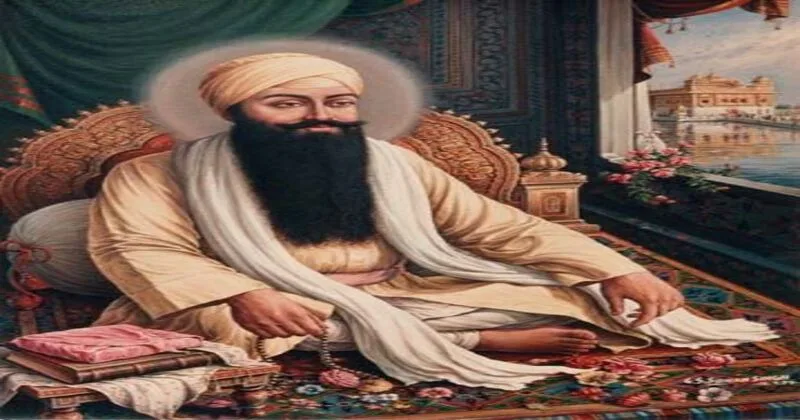
Guru Ram Das Ji, the fourth Guru of the of Ten Guru Tradition, stands as a radiant symbol of humility, devotion, and divine service. He is remembered not only as a spiritual leader but also as the visionary founder of Amritsar, the holiest city of the Punjab. His contributions are both spiritual and social, ranging from the composition of sacred hymns, the strengthening of community systems, and the establishment of a town that became the heart of Punjabi’s identity.
Born as Bhai Jetha Ji, he rose from humble beginnings through his deep faith, selfless service, and unshakable devotion to his Guru, Guru Amar Das Ji, the third Guru of Ten Guru Tradition. His life story demonstrates how service, discipline, and divine love can transform an ordinary being into a supreme soul.
Early Life and Childhood
Guru Ram Das Ji was born on September 24, 1534 in Lahore, (now in Pakistan). His parents were Baba Har Das Ji and Mata Daya Kaur Ji (also known as Anup Devi Ji). His birth name was Jetha, meaning “the firstborn.”
From childhood, Jetha showed signs of purity and divine inclination. Unlike other children who sought pleasure in play and worldly activities, young Jetha was contemplative, gentle, and often found helping the needy or spending time in spiritual reflection. His simplicity and honesty won the hearts of those around him.
However, tragedy struck early in his life when his parents passed away during his childhood. Orphaned at a young age, Jetha moved to the town of Goindwal Sahib, where the third Guru, Guru Amar Das Ji, resided. This move would change the course of his destiny forever.
Meeting with Guru Amar Das Ji
At Goindwal, Jetha came under the spiritual influence of Guru Amar Das Ji, who had established a strong religious community centered around service (seva), equality, and devotion. Jetha joined the langar (community kitchen), serving food, cleaning utensils, and helping visitors with humility and love. He considered every act of service as worship.
Guru Amar Das Ji soon noticed Jetha’s tireless devotion, discipline, and deep understanding of spiritual truths. His humility and obedience were exemplary. Over time, Jetha not only became one of the most trusted disciples but also became part of the Guru’s family when Guru Amar Das Ji married his younger daughter, Bibi Bhani Ji, to him.
Appointment as the Fourth Guru
As Guru Amar Das Ji aged, he faced opposition from some of his relatives regarding the succession of Guruship. However, his deep spiritual insight guided him to choose Jetha, his devoted disciple and son-in-law, as his successor. On September 1, 1574, Guru Amar Das Ji installed Jetha as the Fourth Guru, bestowing upon him the name Guru Ram Das Ji, meaning “Servant of God.”
Guru Ram Das Ji accepted this divine responsibility with utmost humility. His leadership marked a new phase in Bharatiya history, one of expansion, organisation, and spiritual depth.
The Founder of Amritsar
One of Guru Ram Das Ji’s greatest contributions to history was the founding of the city of Amritsar, originally called Ramdaspur. Guru Amar Das Ji had earlier instructed him to establish a new town near a small pool of water, where people could gather for meditation and spiritual solace.
Guru Ram Das Ji purchased the land and personally supervised the digging of a holy pond (Amrit Sarovar). The Guru himself worked alongside laborers, carrying baskets of earth on his head to set an example of humility and equality. This pond later became the sacred pool of Amrit, after which the city Amritsar, meaning “the Pool of Nectar”, was named.
Later, the fifth Guru, Guru Arjan Dev Ji, would build the Harmandir Sahib (Golden Temple) at its center. Thus, Guru Ram Das Ji laid the foundation of what would become the spiritual nucleus of Sikhism.
Teachings and Philosophy
Guru Ram Das Ji’s teachings form an essential part of the spiritual path. His writings emphasise humility, devotion, selfless service, equality, and remembrance of the divine name (naamjap).
He taught that humility is the greatest virtue that brings one closer to God. Through humility, he believed, the ego is destroyed and divine grace is attained. He also continued the emphasis on meditating upon ‘Naam’, (the Divine Name) and urged his followers to rise early in the morning (Amrit Vela) and meditate upon God’s name with full concentration and love.
Equality and Seva
Like his predecessors, Guru Ram Das Ji rejected caste distinctions and social inequality. In the langar started by Guru Amar Das Ji, everyone, rich or poor, high or low ate together as equals. He also emphasised the importance of honest living and sharing with others “Kirat Karo, Naam Japo, Vand Chhako” (earn by honest means, meditate on God, and share with others).
He introduced the sacred Lavaan, four hymns that form the core of the Anand Karaj (marriage ceremony according to Sikh traditions). These hymns describe the four stages of spiritual evolution, symbolised through the union of husband and wife.
Strengthening of Institutions
To ensure that the growing community remained united and organised, Guru Ram Das Ji established the Masand System. The Masands were representatives appointed by the Guru in different regions. Their duty was to guide the local Nanak Naam leva sangats, collect offerings (Dasvandh), and send reports to the Guru.
Guru Ram Das Ji’s Literary Contributions
Guru Ram Das Ji composed 638 hymns, which are included in the Guru Granth Sahib Ji. These hymns are full of spiritual wisdom, poetic beauty, and deep emotion. His compositions appear under various Ragas (musical measures), reflecting his devotion to the musical expression of divine love.
Qualities and Leadership
Guru Ram Das Ji was a rare combination of humility, vision, and divine radiance. Despite being a Guru, he lived like a humble servant, always putting others before himself. He inspired devotion not through power or command but through love, simplicity, and self-sacrifice.
Passing of Guru Ram Das Ji
Guru Ram Das Ji’s earthly journey came to an end on September 1, 1581 in Amritsar. Before his passing, he appointed his youngest son, Guru Arjan Dev Ji, as his successor—the fifth Guru of the Ten Guru Tradition.
Legacy and Influence
Guru Ram Das Ji’s influence on Punjab’s Traditions and Indian spirituality is profound and everlasting. His life embodies the perfect balance between spiritual devotion and worldly responsibility. The institutions he strengthened, the hymns he composed, and the city he founded continue to shape the identity of India across the world.
Guru Ram Das Ji’s life is a shining example of how divine love and humility can transform the world. Through his actions, he demonstrated that true greatness lies not in authority or wealth, but in service, humility, and love for all beings. His message transcends time and religion, continuing to inspire seekers on their journey toward spiritual realisation.











Comments