





A far-left zombie apocalypse broke out across Western universities after the October 7, 2023, massacre in Israel by Hamas terrorists. The spectacle was grotesque: mobs of self-proclaimed “progressives,” waving Palestinian flags and chanting jihadist slogans, turned campuses into ideological battlegrounds. Communist-Islamist solidarity, united by a common hatred for Jews and Western civilization, peaked as violent attacks, stalkings, and threats against Jewish students proliferated. It was a moment when the veil of liberal academia dropped, revealing the deep rot of ideological intolerance within.
A religious community that constitutes just 0.2 percent of the global population suddenly found itself relentlessly cornered and boycotted. Jews were hounded in lecture halls, ostracized from student unions, and vilified in media departments that once boasted of “inclusivity.” But as history has shown, the Jewish-Israeli diaspora does not cower. It rallies swiftly, strategically, and with an iron will.
Within days, billionaire philanthropists and business icons from the global Jewish community sprang into action. Michael Dell, founder of Dell Technologies, joined a group of powerful figures who leaned on media networks to label Hamas correctly as a terrorist organization. Barry Sternlicht of Starwood Capital Group mobilized the “Facts for Peace” campaign to wage an information war against anti-Israel propaganda. Bill Ackman, the outspoken CEO of Pershing Square Capital, demanded that universities release the names of students who signed pro-Hamas statements so employers could blacklist them. Ronald Lauder and Marc Rowan halted multimillion-dollar donations to the University of Pennsylvania, while Leon Cooperman withdrew his financial support from Columbia University.
The message was clear: antisemitism would not be tolerated, and those who funded hate would pay a price. The speed and ferocity of this counteroffensive left the woke ecosystem, ironically bankrolled by another billionaire Jew, George Soros, seething with discomfort. But it was also a display of community strength, cultural pride, and unwavering commitment to the motherland.
The Silence of India’s Global Rich
Now, contrast this with the Indian diaspora, particularly the billionaires and corporate giants who adorn the Forbes list but rarely the battleground of national honor. Despite rampant Hinduphobia in Western academia and media, despite the vilification of India as “authoritarian” or “Islamophobic,” the Indian elite abroad have been largely mute.
When terror struck Pahalgam or when Trump imposed tariffs targeting Indian exports, there was no vocal outrage from the diaspora. Lakshmi Mittal, Anand Mahindra, and other business magnates have donated millions to Harvard, Yale, and Stanford universities that have published some of the most anti-Hindu, anti-India narratives, yet none demanded accountability.
Vinod Khosla remains one of the few Indian billionaires who dared to publicly call Trump’s trade war a “self-inflicted wound” that could drive India towards Moscow and Beijing. His statement was pragmatic, not nationalist, but at least it was something. In contrast, figures like US-based venture capitalist Asha Jadeja Motwani bizarrely urged Indians to “melt” Trump with emotional diplomacy, suggesting that appeasement could win over Washington. Her post on X (formerly Twitter) was met with criticism from both left and right, a reminder that the diaspora’s ideological compass is often more Californian than civilizational.
So why is the Indian diaspora arguably one of the most successful migrant groups in history so timid when it comes to defending its motherland? Why do their billionaires appear detached and self-serving, unlike their Jewish counterparts?
A Tale of Two Civilizations
The answers lie buried in the histories of both nations.
India achieved independence in 1947 after centuries of Islamic invasions and British colonization. Freedom came. Partitioned and bloodied—at the cost of millions of lives. But worse than the physical wounds was the psychological inheritance: a deep-rooted civilizational inferiority complex. Macaulay’s education system had produced elites who were fluent in English but estranged from their roots, who saw pride in aping the colonizer and shame in defending Dharma.
Israel, by contrast, was born a year later, in 1948, forged in the furnace of persecution and genocide. The Holocaust had annihilated six million Jews—yet instead of despair, it gave rise to unbreakable unity. The Jews understood that survival required not apology but assertion. They built their state, and their diaspora built the bridges to sustain it.
Filmmaker and Zionist writer Frederic Eger documented how the Jewish diaspora in the US, Britain, France, and Russia lobbied governments and funded Zionist movements. Anglo-American Jews financed land purchases through the Jewish National Fund. Russian Jews lobbied Stalin’s USSR to vote for Israel’s creation in 1947. The United Jewish Appeal and similar organizations funnelled billions into nation-building not just for material development, but for the survival of identity itself.
That legacy continues today. Since October 7, overseas Jews have sent $1.41 billion to Israel’s war and rehabilitation funds. Tech giants like Intel have committed $25 billion for new plants in Israel despite the ongoing conflict. It is not merely philanthropy; it is civilizational loyalty.
The Indian Awakening Under Modi
India, meanwhile, squandered five decades before Atal Bihari Vajpayee launched serious engagement with the diaspora through the Pravasi Bharatiya Divas initiative. Prime Minister Narendra Modi has revived that spirit with renewed vigor, blending diplomacy with cultural confidence. His outreach to Non-Resident Indians (NRIs) has rekindled pride among global Indians, who now increasingly identify with Bharat rather than just “India.”
The numbers speak. The Indian diaspora invested over US$7 billion in Gujarat International Finance Tec-City (GIFT City) funds last year. Total NRI investments accounted for 35% of India’s FDI inflows in 2023. Remittances hit a record US$135.46 billion in 2024-25, the highest in the world.
But remittance is not mobilization. Money alone does not move. What Israel has and India lacks is ideological synchronization: the courage to be unashamedly Zionist, or in Bharat’s case, unapologetically Hindu.
Israel allows dual citizenship, ensuring that every Jew can live globally yet belong nationally. India, bound by outdated legal caution, denies that right, offering only an OCI card with limited privileges. The result is an emotional distance: the Indian abroad becomes a global citizen, not a cultural warrior.
Rediscovering the Hindu Spine
The Jewish diaspora thrives because its people never abandon tradition, even while embracing modernity. From Tel Aviv to New York, they observe rituals, speak Hebrew, and rally for their homeland’s survival. That continuity sustains their political power and moral clarity.
Indians, in contrast, often carry the residue of colonial guilt, afraid to appear “too Hindu,” too patriotic, or too different from their Western peers. Liberalization gave Indians wealth; it did not always give them pride. Many in the diaspora hesitate to assert their identity, fearing loss of social capital in the liberal corridors of the West.
Yet the tide is turning. A new generation of Hindus, emboldened by India’s economic rise and Modi’s assertive diplomacy, is reclaiming its voice. From students defending Hindu temples in California to think tanks countering Hinduphobia in Washington, small but significant shifts are visible.
Still, for Bharat to truly mirror the Jewish example, its wealthy diaspora must do more than invest; it must believe. Believe in the civilizational idea of India, in Sanatan Dharma as the moral compass of the world, and in nationalism as the legitimate language of belonging.
India’s moment of unity will come not from appeasement, but from assertion. Like Israel, Bharat must teach its diaspora that love for the motherland is not parochia, but it is powerful.
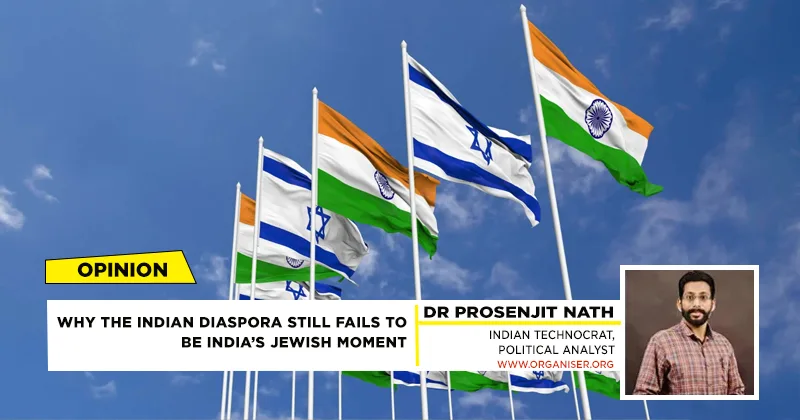
Until then, Israel will remain the model of diaspora patriotism and India, its distant, hesitant cousin, still learning to find its voice in a global chorus that rarely sings its song.















Comments