





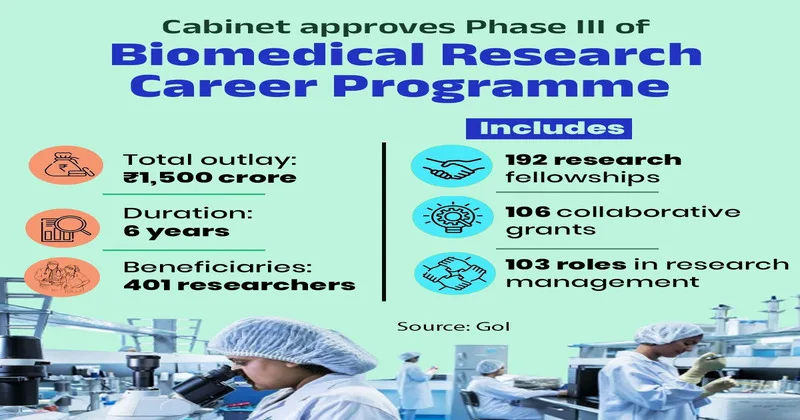
Union Cabinet meeting chaired by Prime Minister Narendra Modi approved for the continuation of Biomedical Research Career Programme (BRCP) Phase-III, which is a resounding confirmation of India’s intent to establish a robust scientific foundation with the vision of Viksit Bharat 2047. A total sanctioned cost of ₹1,500 crore of which ₹1,000 crore will be contributed by the Department of Biotechnology (DBT) and ₹500 crore by Wellcome Trust of UK. This programme is scheduled to operate from 2025-26 to 2030-31, with fellowships extending till 2037-38.
Cabinet’s approval for Phase-III of the Biomedical Research Career Programme will nurture scientific talent, support fellowships, collaborative grants and build world-class biomedical research capacity across India. https://t.co/RG4hDJ4s11
— Narendra Modi (@narendramodi) October 1, 2025
From modest start to International acclaim
The BRCP was started in 2008-09 as a collaboration effort between DBT and the Wellcome Trust UK, under the aegis of the DBT/Wellcome Trust India Alliance. Its objective was clear, to offer a top-notch fellowship to Indian scientists in basic, clinical and public health sciences.
The first phase established a paradigm for biomedical research of international standards in India. By Phase II (2018-19), the program had expanded to cover collaborative and interdisciplinary research, thus creating a generation of scientists whose research echoed across the globe. DBT reports reflects that the scheme has helped hundreds of mid and early-career researchers, with publications and patents having significant impacts that put India on the international biomedical map.
Media coverage in Phase II highlighted how fellowships of India Alliance retained India’s best talent, who would have migrated to foreign nations for work. This has also solved India’s problem of “brain drain” by providing conditions for “brain gain.”
What Phase-III will bring to India
The third phase of BRCP has significant constituents:
1. Early career and intermediate research fellowships: These internationally accepted fellowships will fund young researchers at the early stage of their careers, providing them with opportunities for mentorship and finances.
2. Collaborative grants programme: Career Development Grants and Catalytic Collaborative Grants will facilitate 2-3 investigator teams from all over India to collaborate on high-impact issues in clinical and public health fields.
3. Research management programme: With the intent of strengthening systems, enhancing research governance and developing improved infrastructure for scientific work.
Phase-III also places strong focus on mentorship, networking, public engagement and forging new international partnerships. The state has been eager to see that scientific brilliance is not limited to metropolitan cities. BRCP-III focused to reach out to Tier-2 and Tier-3 cities, thus facilitating entry from budding scholars representing other parts of the country. This aligns with the government’s larger push for regional balance in higher education and R&D, as also seen in schemes such as the Anusandhan National Research Foundation (ANRF).
The DBT has envisioned certain outcomes from this phase:
- Training of more than 2,000 students and postdoctoral fellows.
- 10–15% boost in women involvement in research fellowships.
- 25–30% of collaborative programmes at technology readiness levels and above, thus being ready for translational and commercial use.
- Enhanced output in terms of patents, publications and international peer recognition.
India’s growing biomedical landscape
India has gradually increased its R&D spend in the life sciences. In the Science and Engineering Indicators 2023, India is one of the top five countries for research publications. Government statistics also reveal that India’s biotechnology industry grew at a 14% CAGR from 2014 to 2022, with a market value of $80 billion.
Initiatives such as Ayushman Bharat Digital Mission and One Health framework also point towards the approach in which biomedical research is not only about laboratories but in form of public health outcomes. BRCP focuses on translational research prevents scientific understanding from staying within journals and instead translates it into hospitals, diagnostics and preventive measures.
Right from the National Education Policy (2020) to the Anusandhan National Research Foundation Bill (2023), the government has made continuous efforts for research-driven growth. BRCP belongs here as a flagship human-capacity program in biosciences.
International collaborations like this also show how India is balancing self-reliance or Aatmanirbharta with global cooperation. The Wellcome Trust partnership exemplifies how India can harness external expertise while strengthening domestic capabilities.
Phases I and II of BRCP has already established India as a rising hub of biomedical sciences. Phase-III with its well-defined emphasis on talent, capacity and translation, will not only strengthen India position in international science but also ensures the biomedical research to reach down to common citizens in the form of improved health care, indigenous technology and better employment opportunities.
India finds its place in the world knowledge economy, efforts like BRCP underscore a more profound reality that investing in people and ideas is as necessary as investing in roads. The Cabinet approval of BRCP-III is not merely about research grants, it is about defining the future of Indian science under the visionary leadership of Prime Minister Narendra Modi.















Comments