





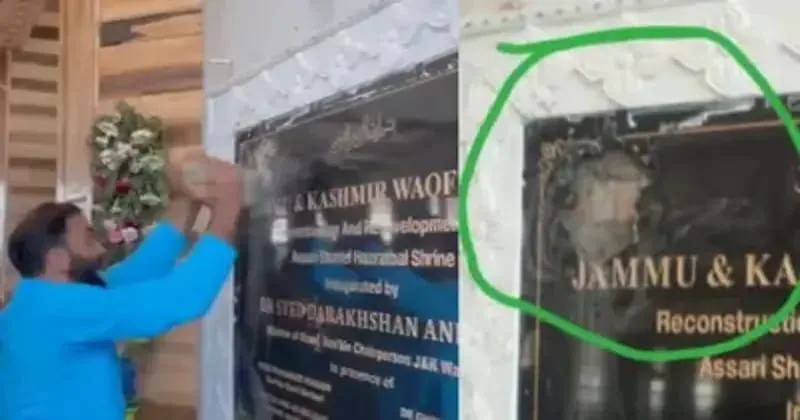
The recent vandalism of the national emblem in Kashmir should not be overlooked. It is more than just damage to stone, as such acts affect the pride of the country and the feelings of many who hold the nation close to their hearts. I felt saddened to see a symbol of our Republic defaced in a place long remembered as the crown of India, a land of rishis, of Shaivism, and of saints who once shared wisdom with the world.
It brings disappointment because it shows again that there are still people in the valley who resist peace, who hesitate to live as part of the wider nation, and who cannot accept the sight of a symbol that connects them to India. These are not simply confused villagers or ordinary enthusiasts acting in error. The forces behind such acts are separatist and radical groups that try to keep the valley apart from Bharat. Their actions are driven more by hostility and hatred than by genuine faith, and it is important to recognise them for what they are.
The emblem they destroyed is not just a design. It comes from the great pillar of Ashoka, the emperor who spread Dharma across the land. Those lions stand proud, looking in all directions, showing that Dharma watches all, protects all, covers all. Below it stands the wheel, the Dharma Chakra, the same wheel that rests in the heart of our flag. It is a wheel that has turned for thousands of years, from Vedic times to the Mauryan age to our present Republic. It is not foreign, it is not borrowed, it is not a sign of oppression. It is ours, born from our soil, from our ancestors, from our truth. When separatists and radicals broke it, they were not just breaking stone; they were attacking Dharma itself. They were spitting on the very roots of the land they stand on. Because Kashmir is not alien to Dharma. Kashmir was once its beating heart. From the writings of Abhinavagupta to the songs of Lalleshwari, from the teachings of Shaivism to the devotion of Pandits, the valley was rich with Sanatan thought. To attack the emblem is to deny that history, to deny their own blood. That is why it is not just a crime, it is betrayal.
And this betrayal has been going on for decades. The same animosity was at play when Kashmiri Pandits were forced out of their homes in the 1990s. Back then, the demands made on the streets had nothing to do with rights or employment; rather, they were about driving away Hindus, liberating the Valley, and severing ties to the country. Families whose temples had stood the test of time and who had resided there for ages were suddenly told to leave or face extinction. They lost their memories, their homes, and their land. Their culture was destroyed, their idols were destroyed, and their temples were desecrated. That was a man-made disaster, not a natural one, brought on by Islamist and separatist movements that could not stand the presence of Hindus in the valley. The world ignored it, Delhi stayed gentle, and the Pandits’ suffering was hidden behind the quiet. But that silence did not heal. It gave courage to those who hate India. They learnt that they can destroy, they can insult, they can drive out, and still the world will not act strongly. The emblem incident is only the latest step in that same chain of hatred. First they drove out Pandits, then they attacked soldiers, then they burned schools, and now they target the emblem. The target changes, but the aim remains the same, to keep India out of Kashmir’s daily life.
We must ask ourselves, who benefits from this? Ordinary Kashmiris do not benefit. They are tired of unrest. They want peace, they want to study, they want to work, and they want to travel. But the separatist leaders, the radical preachers, and the outside handlers sitting across the border benefit from this. They know that as long as the valley stays disturbed, they can hold on to influence. They know that as long as national symbols are insulted, they can tell the world that India has no place there. They feed on chaos like vultures. And they use the language of religion to cover their politics. They tell the people that a plaque is against faith, that an emblem is against devotion, but the truth is that faith was never harmed. The emblem harms no one. It does not reduce the holiness of any shrine. It only stands as a sign of the Republic. If they had faith, they would see it as part of the same Dharma that guides all. But they do not want faith, they want fire. They want hatred to continue so that their politics survives.
This is why it is foolish to explain away this act as a simple outburst. It was not simple. It was planned, it was deliberate, it was meant to send a message. The message is that separatists and Islamists still believe they can reject India openly. They believe that even after Article 370 was removed, even after the tricolour waves on every office, they can still tear down what belongs to Bharat. And this is where we must be clear. The abrogation of 370 was a big step, but it was not the end. The deeper battle is in the minds. Unless the poison of separatism is removed, these acts will continue. And they can only be removed when we stop giving excuses for them. It is imperative that we cease claiming that they are misinformed, confused young people, or overreacting. No, they are not overreacting, they are not misinformed, and they are not confused. They are extremists who seek to undermine unity. And we cannot combat them unless we identify them as such.
Think about the soldiers who protect the country day and night while standing on the borders, freezing in the snow. Think about the police officers who maintain peace despite being shot at and stoned. Think about the Kashmiri pandits who cried when they left their homes and who are still in possession of the keys to dwellings that have vanished. All of them have sacrificed for the idea of Bharat. And then a group of radicals think they can break an emblem and get away with it. Is this justice? Is this Dharma? No, it is not. It is an insult. It is an insult to the martyrs, to the victims, to the soldiers, to every citizen who believes in the Republic. And that is why we cannot treat it as a small event. It is not small, it is big. It touches every heart that beats for Bharat Mata.
Our ancestors faced such attacks too. Temples were broken, idols smashed, scriptures burnt, but Sanatan Dharma survived. The emblem is the modern symbol of that same Dharma in political form. To destroy it is to try again what invaders tried centuries ago. But just like then, they will fail now. Because Bharat is eternal. The wheel of Dharma cannot be stopped. It turns through time, crushing adharma, lifting truth. These separatists may shout, may destroy, may scheme, but they cannot change destiny. The destiny of Kashmir is with Bharat. The destiny of Bharat is with Dharma. This truth is stronger than stone, stronger than politics, stronger than hatred.
Some will say we must ignore these acts, that by reacting, we give them importance. I disagree. Silence is not strength. Silence is weakness. If we do not speak when the emblem is broken, tomorrow they will break the flag, the day after, they will break the very idea of India in the valley. Step by step, they test how far they can go. If we do not resist now, they will go further. We must draw the line here. We must say enough. No more insults, no more attacks, no more excuses. The emblem is sacred, Bharat is sacred, and those who touch it with hate are enemies of all Indians.
The valley can still find peace, but only if the truth is faced with honesty. It is clear that separatist and radical politics have brought great harm to Kashmir. It is also true that Hindus, the Kashmiri Pandits, are rightful sons of that soil, and their return should not remain only a hope but become a living reality. National symbols are never against faith; they rise above it, because they are meant to unite everyone. In truth, Bharat Mata is not distant from Kashmir, she is part of it, as its mother as much as the mother of any other region of India. The valley can heal if these truths are accepted. But as long as denial continues, as long as acts of vandalism are brushed aside, and as long as bitterness is encouraged, the wounds will not close.
I write this not as a scholar or legal expert, but as an Indian who loves this country. In the Kashmir I wish to see, children would play without fear, places of worship would stand side by side in respect, the tricolour would fly without disturbance, and the emblem would shine without being touched by anger. In that Kashmir, the forcibly removed Pandits would live again in their ancestral homes, the voices of Shaivism would echo once more through the mountains, and rivers would carry only peace and blessings. This vision is not impossible, but it needs honesty. Honesty about who disturbs peace, honesty about who rejects Bharat, honesty about who broke the emblem. And with honesty, there must also be strength. Not only the strength of soldiers, but the strength of Dharma, of unity, of culture, of truth.
The breaking of the emblem was meant to hurt our spirit, but it has not succeeded. If anything, it has reminded us that the journey is not finished, that we must remain alert, and that Bharat Mata still calls on her children to guard her dignity. That call must be answered. We must rise with confidence, with faith, with clarity. And we must remind the world again that Kashmir is, and will remain, a part of India. No separatist, no extremist, no vandal can change that. Stone can be broken, but not Dharma. A plaque can be destroyed, but not Bharat.
As long as even a single Indian heart beats with faith in Sanatan truth, the lions of Ashoka will stand tall, the wheel of Dharma will continue to turn, and the soul of our nation will stay untouched. That is my conviction, that is my opinion, and that is my prayer.














Comments