





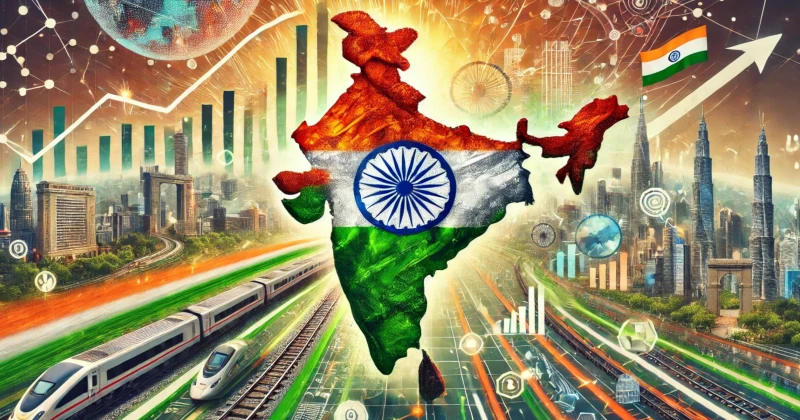
Bharat, which previously played a limited role in global arenas, is now leveraging innate endowments and large-scale industries to compete in 18 high-growth, dynamic platforms—both global and national. After conducting a thorough examination of fast-growing large-scale sectors as well as Bharat’s natural assets, capabilities, and strategic priorities, we identified 18 domains that might generate $2 trillion in revenue for the nation by 2030, up from $690 billion in 2023. They might help capture roughly 30 per cent of the additional GDP by 2040.
Without a doubt, Bharatiya industries—from electronics to green energy to defence—are not only propelling the country’s development but also upholding the century-old Swadeshi ideal that “Viksit Bharat” means “developed Bharat” by 2047, when the country’s GDP is projected to reach $30 trillion. This strategy’s demographic dividend proves especially persuasive. Bharat has a domestic market size that may spur growth and enhance global competitiveness, with more than half of the population under 30 and private spending accounting for more than 61.4 per cent of GDP in FY2025. By 2030, it is anticipated that there will be 75 million middle-class and 25 million wealthy households, accounting for 56 per cent of the population and resulting in hitherto unheard-of levels of consumer sophistication.
Let’s understand how different sectors will strengthen the self-reliant Bharat
Semiconductor and Electronics Industry
Bharat is home to over 20 per cent of the world’s chip designers and takes pride in being a global leader in the field. Ironically, practically all of Bharat’s semiconductor demand is being met by imports. To address this, the country’s semiconductor industry plans to establish entire semiconductor fabrication plants, expand electronics production for both domestic and international markets, and produce critical components for emerging technologies such as 5G, IoT, and electric vehicles. The government has sanctioned five semiconductor manufacturing units under the ‘Bharat Semiconductor Mission’, resulting in a total investment of USD 18.15 billion. This is a key milestone in Bharat’s semiconductor manufacturing goals and will benefit the local ecosystem. The government aims to expand the semiconductor sector to USD 150 billion by 2030, creating a broader market for both domestic and foreign businesses to enter the Indian market.
Agriculture
Agriculture, the backbone of Bharat’s economy, can benefit from digital transformation to increase productivity and reduce post-harvest losses. Organic farming, Precision farming, smart irrigation, and farm management software are examples of digital agricultural technologies that can provide farmers with data-driven insights and best practices, leading to more sustainable agricultural practices and increased food self-sufficiency. The incorporation of digital technologies into manufacturing and agriculture will increase self-sufficiency, while digital health initiatives will improve healthcare access for all. Embracing digital transformation, with an emphasis on cybersecurity and data protection, will pave the path for Bharat’s digital self-reliance.
Major Manufacturing Industries
In light of the current geopolitical and economic circumstances, Bharat’s defence sector is becoming increasingly self-reliant. In FY 2023-24, Bharat’s domestic defence output hit a new high of Rs 1.27 lakh crore, up nearly 174 per cent from Rs 46,429 crore in 2014-15. The goal is to increase defence output to Rs 3 lakh crore and exports to Rs 50,000 crore by 2029. The laying ceremony for the Rs 1,800 crore Brahma-BEML Rail Manufacturing Hub project, which will design, manufacture, and test trains, metro coaches, and defence equipment, is a significant step towards national self-reliance.
Beyond defence, electronics has emerged as a crucial industry in which Bharat’s production capacity has increased tremendously. Today, 99.2 per cent of all mobile phones sold in Bharat are manufactured in Bharat, making us the world’s second-largest mobile manufacturing country. With sustainability gaining traction worldwide, renewable energy has emerged as a revolutionary business that can attract significant investment and redefine the path to self-reliance. India’s historic achievement of 100 GW of solar PV module manufacturing capacity listed on the Approved List of Models and Manufacturers (ALMM) reflects the country’s rapid progress in developing a robust and self-sufficient solar manufacturing ecosystem, which is consistent with the national vision of Atmanirbhar Bharat and the global imperative for clean energy transition.
With such a strong push, Bharat’s Index of Industrial Production rose 1.5 per cent year-over-year in June 2025, led by a 3.9 per cent growth in the manufacturing sector. Similarly, Bharat’s manufacturing Purchasing Managers’ Index (PMI) reached a 16-month high of 59.1 in July, driven by strong demand, robust expansion, and a positive business outlook.
Rising Middle Class
Bharat’s middle-class population is projected to increase by more than 597 million people by 2040, contributing significantly to its economic growth. The growing middle-class population is predicted to account for more than 75 per cent of expenditure growth, creating new market opportunities and bringing millions out of poverty, reducing the proportion of impoverished households from 15 per cent now to only 6 per cent by 2031.
Robust Macroeconomic Indicators
Despite external constraints, Bharat’s economy remains impressively resilient. In nominal terms, the country is expected to reach a USD 30 trillion economy by 2047, with an average annual nominal GDP growth rate of 9 per cent-10 per cent. Bharat’s gross savings-to-GDP ratio is also forecast to improve, rising to 48 per cent by 2036-37 under a linear trend scenario, sustaining strong investment-driven growth. Despite some concerns about the country’s current account deficit and currency devaluation, overall development is healthy, with the services and industrial sectors expected to be the primary drivers of GDP growth.
Thriving Urbanisation and Infrastructure Development
Urbanisation and infrastructural development are predicted to increase markets, boost productivity, attract investment, and create millions of new jobs by 2035, making cities the major engines of Bharat’s economic ascension. The emergence of megacities, megaregions, and megacorridors is predicted to boost Bharat’s urbanisation rate, which is currently 36 per cent, to 50 per cent within the next decade. These urban areas are expected to account for over 70 per cent of Bharat’s GDP by 2036. Bharat will invest more than USD 290 billion annually in infrastructure through 2030 to support this urban transformation. This includes funding for projects like the “PM Gati Shakti National Master Plan,” which aims to unify 16 ministries—including Railways, Roadways, Ports, and Aviation—onto a single digital platform for coordinated infrastructure planning and implementation.
Manufacturing & Trade Diversification Strategies
Numerous programs, such as “Make in Bharat” and the “Production-Linked Incentive,” promote the country’s manufacturing sector and have attracted nearly €16 billion in investments and €1.1 billion in incentives from 14 different sectors. By establishing additional free trade agreements (FTAs) and expanding its commerce to new countries, including Africa, Latin America, and Central Asia, Bharat hopes to surpass USD 2 trillion in exports by 2030. Although Bharat has not benefited significantly from previous free trade agreements, there is hope that deals with many Asian, African countries, the UK, and the EU will substantially increase manufacturing and exports, as Bharat is considered an ideal location for the China + 1 plan.
Automotive Industry
Known as the “Chauffeur Capital” of the world, Bharat is transforming into a major hub for automobile production. By 2030, Bharat’s automobile industry is expected to increase its production capacity by more than 3.3 million vehicles. As the world’s largest 2-wheeler market, Bharat is expected to build and sell over 7.5 million vehicles by 2030, making it a major player in global automotive supply chains. Some of the primary drivers of Bharat’s automotive industry and industrial growth are rising domestic demand, encouraging government incentives for clean mobility, and reasonably priced production prices.
Space Industry
The space industry in Bharat is growing rapidly; by 2030, it aims to account for 8–10 per cent of the global market, up from 2 per cent in 2021. By 2047, it hopes to have a 15 per cent market share and position Bharat as a major player in the global space economy.
Topics on which the government, business community, and academia should concentrate
To decentralise India’s urban-centred higher education system, academia plays a crucial role in driving policy change. To serve the masses, “Atmanirbhar Bharat” must broaden the scope of its higher education beyond major urban areas and establish a robust network of institutional capacities at the regional and local levels. This calls for funding to expand rural public infrastructure and build local capacity. A knowledge society must be established in both rural and urban areas to achieve the goal of an independent Bharat, which would propel social and economic progress. To achieve our goal of “Viksit Bharat,” we must also consider some grey areas and associated issues as we undergo a paradigm shift in how we approach education, technology, research, and innovation. Additionally, the emphasis should be on internationalising our academic and education systems (NEP 2020) as well as developing an ecosystem that fosters international partnerships and collaborations in the fields of learning and research.
An innovative research culture in STEM and social sciences that may influence social transformation and economic prosperity must be at the heart of the “Atmanirbhar Bharat” goal. To make this transition by implementing NEP 2020 in our educational system possible, substantial resource investment and adjustments to public policy will be required. The ambition and ingenuity of a nation’s citizens are the driving forces behind its prosperity. Self-sufficient citizens will construct an independent Bharat. There are 140 crore Bharatiya in the country. Our population becomes our collective strength rather than a vulnerability if every family member makes a profitable contribution to the economy and, consequently, to Rashtra Nirman. People who actively participate and have faith in their own abilities will be able to accomplish great things. If someone is skilled and able to support themselves, they become independent. The government must support this by offering skill-building opportunities.
For Bharatiyas to be self-sufficient, our residents must maintain their individual determination and dignity as part of this concept, enabling the government to actively promote self-sufficient citizens. Subsidies, particularly those that benefit the comparatively wealthy, are therefore incompatible with a Bharat that is self-sufficient. The ethical wealth creation promoted by the Bharatiya ethos must now become a global development model to ensure that economic progress occurs without harming the environment. Bharat must lead the charge in demonstrating it at home to achieve this. In particular, Bharat must take the lead in “frugal innovation” to maximise the well-being of a significant segment of people by using Mother Earth’s resources as sparingly as possible. To demonstrate to the rest of the world the importance of “frugal innovation,” Bharat should lead the way in this regard.
Petroleum products, machinery, automobiles, plastics, and electrical and electronics products make up the top 5 worldwide exports, which account for more than half of the trade. Nevertheless, the proportion of these products in our exports falls short of our potential. The low percentage of high-technology exports from Bharat is a related problem. Exports of high technology make up 6.3 per cent of our total exports, compared to 29 per cent for China, 32 per cent for South Korea, 34 per cent for Vietnam, and 39 per cent for Singapore. China exported USD 652 billion, South Korea USD 192 billion, Singapore USD 155 billion, Malaysia USD 90 billion, and Bharat USD 20 billion in total high-tech goods. This will be rectified by the recent steps the Modi administration has taken to promote the production of electronics, medical devices, and surgical instruments, as well as to draw in foreign direct investment.
A self-sufficient Bharat will set the path for a more powerful, healthy, and prosperous Bharat, which will positively influence the world’s peace and mutual development.














Comments