





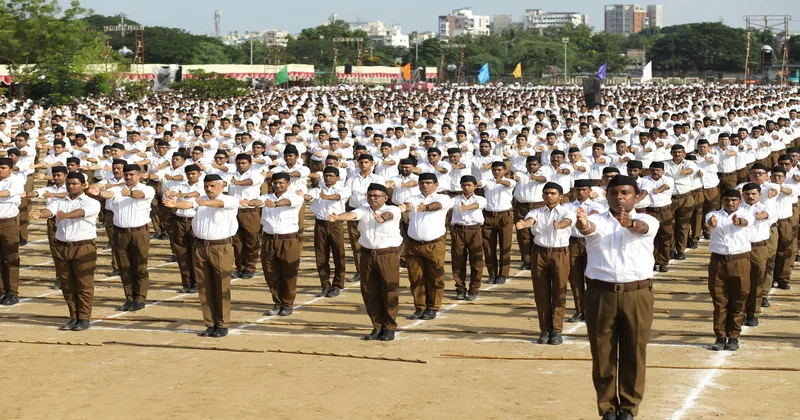
Today, Rashtriya Swayamsevak Sangh (RSS) is making headlines and a centre of discussions nationwide. Many hashtags are trending in social media. The cause is that the organisation is nearing the completion of its 100 years journey. This year’s Vijayadashami, which falls on October 2, 2025, will mark the centenary year (Shatabdi Varsh) of the RSS, which was established on the day of Vijayadashami in 1925.
The RSS’s functioning lies in the daily gathering of Swayamsevaks known as the ‘Shakha’, which is usually held in open grounds. Data from this year’s Akhil Bhartiya Pratinidhi Sabha shows that the RSS currently runs 83,129 daily shakhas at 51,740 places throughout 98 per cent of the country’s districts and 92 per cent of its talukas (administrative units). Additionally, there are 26,460 places hosting 32,147 weekly meetings (Saaptahik Milan), and these numbers are increasing steadily.
Youth and students make up 59 per cent of these shakhas. The swayamsevaks created in these shakhas have established more than 32 nationwide organisations and are also running about 1 lakh 29 thousand service works (Seva Kaary).
Swayamsevaks from these shakhas are often the first to reach whenever or wherever a disaster strikes, ready to offer help in any crisis. It is often said that a shakha is a continuous worship of Shakti. Coincidentally, the nation is currently observing the Sharadiya Navratri, a time devoted to the worship of Mother Shakti. In such a spiritually significant period, it becomes intriguing to explore the origins of the RSS’s very first shakha.
Today, the RSS may run over 83,000 shakhas nationwide, but imagine the time when the very first shakha was started. It is a fact of the matter that even today, despite favourable conditions, an ample number of resources and dedicated manpower, setting up a new shakha demands immense effort from RSS Swayamsevaks. But back then, it was the era of British rule. So how did the first shakha come into existence? How was the seed sown? How was it nurtured? How did it eventually grow and expand? Was it a smooth beginning, or were there challenges?
The very first shakha of the RSS began at ‘Mohite’s Baada’, which was a structure that resembled a house but had long been abandoned and left in ruins. Locals avoided it out of fear of ghosts, as it was widely believed to be haunted. However, Bhauji Kavre, a close friend of Dr. Keshav Baliram Hedgewar, had begun living there after the passing of his wife. He was unafraid of ghosts and had been residing in that place for five years. One day, Dr. Hedgewar asked him if he wanted to organise some activities for children, but was struggling to find a suitable place. To this, Bhauji immediately responded, “Why look elsewhere? Use my house!”
And so, children began to gather and play there. As the house was cleaned up overtime, a basement (Tehkhana) beneath the main hall was found. It has two rooms that were utilised for training sessions and meetings. At that time, there were only about 20 to 25 swayamsevaks in total. These early days laid the foundation of what would eventually become a massive national movement.
As far as challenges and obstacles are concerned, can we find a single great endeavour in the history of the world that was free from them? So, how could the RSS shakha be an exception? In reality, Mohite’s Baada originally belonged to Sardar Mohite. Due to financial hardship, he had mortgaged the property to a moneylender named Gulabsab Motisab Jain. For years, the moneylender Jain ignored the Baada, and Sardar Mohite was unable to repay his debt. People started to think of Baada as a haunted place after it collapsed into ruins.
Later, as the RSS shakha began to function there and the place was cleaned up, its condition gradually improved. Suddenly, the moneylender took notice and asserted his ownership, forbidding the children from playing there. In the meantime, Sardar Mohite’s children filed a legal claim over the property. Upon learning about this legal development, the children resumed playing there. However, the court ultimately ruled against Mohite’s children and declared the moneylender Jain as the rightful owner.
At that time, Dr. Hedgewar was in jail, having participated in the ‘Jungle Satyagraha’ along with other senior workers like Appaji Joshi. Before going to jail, Dr. Hedgewar had entrusted his close friend Rajasahab Laxmanrao Bhonsale with the responsibility of looking after the children attending the shakha. Following the court’s ruling, the moneylender began harassing the children again. When the matter reached Rajasahab, he offered his own royal elephant stable (Haathikhana)for the shakha to continue. Thus, in 1930, the shakha began operating from the Haathikhana.
From the very beginning, the British intelligence services had been keeping a close eye on the RSS. British officers pressured Rajasahab to stop supporting the Sangh and to shut down the shakha on his premises.To this, Rajasahab firmly responded, “The saffron of my ancestor Shivaji, which is flying on my palace, is the same that the RSS hoists in its shakhas. They chant the names of Shivaji and Samarth Ramdas and offer prayers. They are doing the very work that I consider my own. Therefore, the Sangh’s work is a sacred duty, and it will continue. As long as Laxman Bhonsale lives, no one can stop it.” Following Raja Saheb Laxmanrao Bhonsale’s firm and unequivocal response, the British officials had no choice but to leave in silence.
However, in 1932, Raja Saheb passed away. His son was still a minor and thus under government guardianship. This once again gave the British authorities an opening to exert pressure on the Bhonsale family, and difficulties in holding shakhas resurfaced. Subsequently, in 1933, the shakha began operating on another vacant plot of land owned by the Bhonsale family in Tulsi Bagh. Slowly, the work of the RSS was gaining momentum, and by that time, about 7-8 shakhas were running in Nagpur. For the next two years, things went relatively smoothly.
But in late 1934, the British government once again intervened. They ordered the Bhonsale family to immediately begin agricultural activity on the Tulsi Bagh land. After this, farming commenced, and once again, the shakha had to be shut down.
Eventually, a breakthrough came with the establishment of the shakha at Reshimbagh. A land owner known to Dr. Hedgewar offered his property at Reshimbagh for the use of the Sangh’s activities. Dr. Hedgewar accepted the offer with gratitude, and as a gesture of goodwill and practicality, he also gave him some money. The RSS formally acquired the land at Reshimbagh in 1934. When the shakha had to be vacated from Tulsi Bagh, Dr. Hedgewar said firmly, “Now we will conduct our shakha on our own land.” Thus, in 1935, the shakha started at Reshimbagh. Because it was now on land owned by the Sangh itself, and very close to Dr. Hedgewar’s residence, it came to be known as the “Kendriya Sangh-Sthan”. Since then, the shakha held here has been referred to as the “Kendriya Shakha”.
With time, the number of swayamsevaks continued to grow. By 1936, the shakha for swayamsevaks from the Mohite area was separated and resumed once again at the original Mohite Baada. Around 1944, in the name of development in the Reshimbagh area, the British government once again attempted to shut down the shakha through the Nagpur Improvement Trust. In response, it was decided that a public movement would be launched against this decision. All the prominent people of Nagpur supported this movement. Fearing the protest, the government caved in, and the so-called development efforts of the Improvement Trust failed to progress beyond mere paperwork, and shakha continued to spring up there.
Just three to four months after the passing of Dr. Hedgewar in 1940, a dramatic turn of events unfolded. The moneylender Jain, who had once prevented children from using Mohite’s Baada, had now fallen into severe financial distress. He was required to repay a sum of 12,000 rupees within three days. His lawyer happened to be acquainted with Shri Guruji, the second Sarsanghchalak of the RSS. Despite being well aware of Jain’s earlier hostility toward the Sangh, Shri Guruji did not hesitate. He immediately agreed to help. By reaching out to several swayamsevaks, he quickly collected the funds, and the entire sum of 12,000 was sent to Jain the very next day. Deeply moved by this gesture, Gulabsab Motisab Jain had a change of heart. Within a few days, he formally registered the ownership of Mohite’s Baada in the name of Shri Guruji.
Today, Mohite’s Baada is revered as a pilgrimage site by RSS swayamsevaks and is an integral part of the RSS headquarters in Nagpur. From that very first shakha that began in Mohite’s Baada emerged dedicated swayamsevaks like Eknath Ranadeand and Balasaheb Deoras, the great individuals who would go on to shape the organisation and serve the nation in remarkable ways. And it is from this humble yet powerful beginning that the RSS now moves forward to celebrate its centenary year (Shatabdi Varsh) guided by the vision of ‘Panch Parivartan’.














Comments