





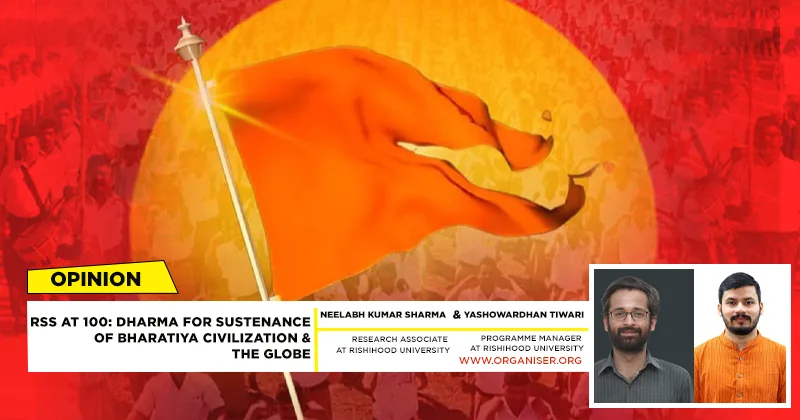
Bharat celebrates Vijayadashmi this year on October 2. Vijayadashmi literally translates to “the victorious 10th day”. We celebrate this day to commemorate Bhagwan Ram’s victory over Ravana’s army, and as an archetype, it refers to the celebration of the Victory of Dharma over Adharma, of values over valuelessness, of order over chaos, of civilisation over barbarism, and of persistence over brute force. But this year is even more important, as we celebrate the 10th decade, or 100 years of the Rashtriya Swayamsevak Sangh, an organisation that personifies the values of Bhagwan Ram in contemporary times. Though this article is meant to focus on the future of the RSS and its role in the global context, we will nevertheless begin with a few parallels between the incidents in the life of Shri Rama and the RSS.
The RSS was formed in 1925. It was a tumultuous time. The nation was assessing the aftermath of the Khilafat movement and the Moplah riots. And therefore, to unite the Hindus of this nation, this organization took upon itself this sacred task. The awakening was underway, and was certainly inviting many evil eyes. Lo and behold, there followed a series of bans by the ruling dispositions of the times, who were afraid of the potential of cultural transformation across the entire nation that the RSS carried in its belly. Mr Nehru did it. His daughter did it. Many of the visceral critics still attempt calls for imposing a ban on the organization. Every time it happened, the organization patiently endured and came out victorious. Doesn’t this reflect the life of Sri Rama? At the prime of his youth, when he was destined to be crowned the King of Ayodhya, those who were jealous of his potential exiled him so that they could enjoy power. But what happened to them, well, a turn of pages of itihasa lays everything bare for us to learn from. The exile made Ram a bhagwan; similarly, the RSS came out even stronger.
The RSS started with the vision of one Man, and subsequently grew into the largest social organization on the planet. When Shri Ram started his journey to bring back Ma Sita, he was joined by his brother Lakshamana, and then millions of Vanaras joined him. The same happened with the Sangh. Dr Hedgewar started alone, and was joined by Guru Golwalkar, followed by millions of swayamsevaks, who proudly bear the flag of the ethos of our civilisation. Shri Atal Bihari Vajpayee beautifully depicts this in his poem:
“कभी थे अकेले हुए आज इतने,
नही तब डरे तो भला अब डरेंगे |
विरोधों के सागर में चट्टान है हम,
जो टकराएंगे मौत अपनी मरेंगे ||
लिया हाथ में ध्वज कभी न झुकेगा,
कदम बढ रहा है कभी न रुकेगा |
न सूरज के सम्मुख अंधेरा टिकेगा,
निडर है सभी हम अमर है सभी हम,
के सर पर हमारे वरदहस्त करता,
गगन में लहरता है भगवा हमारा ॥४॥”
And finally, after defeating Ravana, Prabhu Shri Ram became the undisputed King of Bharata, and the ideals of his rule are still aspired to be emulated, as is reflected in the phrase “Ram Rajya”. The RSS too is now at the centre of Indian political hegemony, charting our Bharat’s future that is rooted in the ethos of our civilisation. Thus, it is pertinent to discuss the role of this organizational behemoth in shaping the future of Bharat.
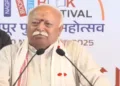
On October 2nd, Bharat prepares to celebrate the birth, rise and sustenance of the largest organisation in the world committed to social work, cultural transformation, and civilizational sustenance. Bharat has witnessed the arduous journey of the Rashtriya Swayamsevak Sangh from being a marginalized social body branded to have been cast in stone, to an ever-growing, fluid yet coherent, entity, rewiring the mainstream of Bharatiya body politic. In the three-day lecture series hosted at the grand Vigyan Bhawan in the heart of the national capital earlier in August, the Sarsanghchalak of RSS shared a sharp and measured assessment of the organization’s trajectory from 1925 till date, and chalked out the ‘future horizons’ of the RSS.
One of the most fascinating aspects of Dr. Mohan Bhagwat’s remarks was a graciously acknowledged confidence towards the possibility of emulating the structural model of RSS across other parts of the globe, through an engagement with similar social bodies or by providing the necessary assistance in setting up similar culturally-rooted organizations in other countries. This confidence reflects not just a firm belief in the resilience of RSS’ organizational framework, but also points towards a larger reality. It is a clear indictment of the withdrawal of forces pushing for globalization, and indicates a paradigmatic shift in the global dynamics of cultural hegemony. With the slow withering of the international liberal order and its agenda of globalization, the world is witnessing a rise of local cultures against the hegemony of monolithic global liberalism.
The dynamics of cultural hegemony is shifting from the dominance of monolithic cultural liberalism towards the hegemony of localized cultures in their respective regional spheres of influence. With the rise of indigenous localized cultures, we also witness a parallel rise of a renewed idea of civilizational nationalism. In stark contrast to the discourse around nationalism that arose in the West back in 1940s, what we experience in several countries of the Global South is a form of nationalist discourse expressed through the agency of their civilizational (also pre-colonial) values and signifiers. Civilizational nationalism (being used here for the lack of a better phrase in English) doesn’t comfortably fit in the received mould of Eurocentric definitions of nationalism, as the basis of people-to-people bonding transcends the crude identities of language and race. These primordial identities are replaced by more subtle, complex markers of overlapping cultures and traditional practices. As has been brilliantly articulated by Diana L. Eck in her works, Bharat experiences itself as a “sacred geography”. This sacred geography enacts its lived cultures as an ancient yet ever-young civilization, and the language of the cohesiveness of the sacred geography as a united entity is expressed through the idea of civilizational nationalism.
One may note here that the European idea of nationalism has led to the sowing of divisive tendencies amongst “imagined communities”. Laying the foundations of a nation on crude identifiers such as race, ethnicity and language, has led to rigidity and exclusiveness being ingrained into the conceptualization of such nations and nation-states. There is an essential epistemological difference between the understanding of nationalism in the west and Rashtravaad in Bharat. The root of the word ‘nation’ lies in the word ‘native’. Therefore, in European thought, a nation is identified by either of the two categories: language or race, since these factors determine who is a native and who is not. It is because of this that the European nation is divided on racial and linguistic lines. But the same formula can not be applied to Bharat. However, unfortunately many of our own leaders and scholars have tried to superimpose this artificial notion of nationalism based on primordial identities on us.
The European notion of nationalism led our forefathers to divide Indian states on the basis of linguistic identities. As a result, false micro identities started taking birth, due to which we see many fissures which dominate the Indian polity in today’s times. We have to go back to our roots in relation to the understanding of the Indian idea of nationalism, as is expressed by the term, Rashtra, whose root is “raj” which means to shine, to be vibrant, to be lustrous, to protect, and to be brilliant. If we notice, there is no connotation to either the issue of language or of race. Therefore the artificial divisions like that of Aryan vs Dravidian, South vs North, Tamil vs Sanskrit, Marathi vs Hindi, are all outcomes of articulating the idea of nationhood through a Eurocentric colonial framework. Our idea of Rashtra signals an essential unity, an essential aspiration to shine and protect. And that is the reason why in our culture, sovereignty has always been ascribed neither to the state, nor to the king, nor to the constitution, but only to the higher ideal of Dharma, since it is Dharma, and Dharmic way of living that unites this rashtra and makes us one. The RSS has been at the forefront of ushering in a cultural transformation based on Dharmic ideals, as it has a deep understanding of Dharma as that which provides sustenance and permanence to the Bharatiya civilization.
For the centenary year, Ma. Mohan Bhagwat ji, the Sarsanghachalak of the RSS, has charted out Sangh’s five-fold plan of transformation, the Panch Parivartan, keeping in mind the global purpose, the ideal of Vasudhaiva Kutumbakam, the well-being of all.
The first call for change by the RSS is the question of bringing about Social Harmony and Equity with Fraternity. In a world where Eurocentric Marxist thought articulates all social phenomena through the lens of social division, leading to the strengthening of caste and class discrimination, there is an urgent need to look at these issues through the lens of social cohesion. The way forward is simple: treat everyone as you would like to be treated by others. Bhagwat ji lays out a simple formula. Go and eat with your neighbours. Sit with them and talk. Participate in the happiness and sorrows of those around you. Do not discriminate. Consider everyone as if they were your own immediate family. This sounds very simple, but in essence reflects the eternal Hindu ideal of Advaita, to know for a fact that all differences of the material prakriti essentially converge into the unity of the purusha. It is the One eternal consciousness that is within all of us, and hence, we need to emulate this ideal in our daily lives. In doing so, we will be making our roots stronger, and stronger roots will necessarily lead to the blooming of our collective society.
The second issue is that of an environmentally-friendly lifestyle. This issue resonates with the principle of Integral Humanism, where the metaphor of “milking of a cow” has been used with regards to how much shall be extracted from nature. The current disposition towards usage of natural resources, based on the metrics of GDP and other industrial parameters, can never lead to sustainable living. A higher GDP necessarily connotes higher production, higher production leads to higher extraction of natural resources, and hence, greater exploitation of natural resources. Another issue added here is that contrary to the natural scheme of things where production follows demand, in present times, through carefully curated advertisement and promotional plans, an artificial need is created to create a market for the products that are not even necessary. This model of economic growth and development needs to be reviewed from the lens of the dharmic way to conduct ourselves, to use natural resources considering the fact that there is an essential interdependence between human beings and nature. Nature gives us life, so our duty is to use the resources judiciously and protect the world of nature which indeed is our mother, since she provides for all our needs.
The most pertinent issue is the third one, that is, Family Enlightenment, the strengthening of family as the fundamental unit of our civilization. One of the worst effects of modernity and the Marxist worldview is the disintegration of the family structure and promotion of Individuality. It is a well-thought-out attack, since it is the institution of family that preserves and propagates traditional civilizational values. So, in order to attack civilizational values, the best way is to destroy the family structure. It is for this very purpose that the ‘Urban Naxals’ who have the hegemony in academia force their young learners to start hating their teachers, parents, and elders, just in the name of seeking some abstract notion of “freedom”. It is because of this reason that we now see a degradation of civilizational values among the new generations, something which neither 600 years of Islamic rule, nor 250 years of British rule was able to manage. Since even in the most atrocious of times, it was the family that sustained individuals. But with the loss of family structures, the civilizational values start crumbling down. This is not just true in the case of Bharat, but in the Christian nations as well. Worldwide, we can observe the decline of even nuclear family structures. The ray of hope for Bharat is that here the transition has happened from joint family structures to nuclear family structures, but the latter haven’t disintegrated yet. Therefore, the institution of family still survives by and large in Bharat. Given this scenario, it becomes the duty of Bharat to lead the way forward in protecting this civilizational unit, not just for its own welfare but for the well-being of the entire world. Family values can be instilled simply by giving time to it, having a daily dialogue with your family, treating them with respect and adoration, and being grateful for their existence, which the Sangh advises to do.
The fourth issue is that of self-realisation and swadeshi. It basically means a focus on realising one’s own abilities. We should focus on knowing more about ourselves in terms of our ethos, our history, our heroes, our knowledge traditions, our way of doing business, our way of harnessing wealth, staying away from extravagance and worthless expenditure. We should also focus on becoming self-reliant as we once were before the Abrahamic invasions. We should also create organised systems of daan and dakshina for our own brethren so that they are well cared for and do not fall gullible to the trap of evil forces.
The fifth issue is the realization of fundamental duties by common citizens. It is important as citizens of this nation to contribute to its well-being by focusing on one’s duties towards the society and nation at large. We should focus on inculcating civic sense amongst ourselves and adhere to basic etiquettes. It is our responsibility to keep the country clean, follow the legal framework, and work hard for our own betterment so that it benefits the nation in turn. This idea also aligns with the philosophy of Integral Humanism where Pandit Deen Dayal ji says that the individual aspiration has to align itself with the national aspiration, it is only then that a swift progress can happen.
As the RSS marks its 100th year, the future horizons of the organization shine bright as they open up several avenues for expanding its social work across the globe. With the call for Panch Parivartan as its priority, the Sangh has much to share with the world and make our planet a better place to live in harmoniously.












Comments