





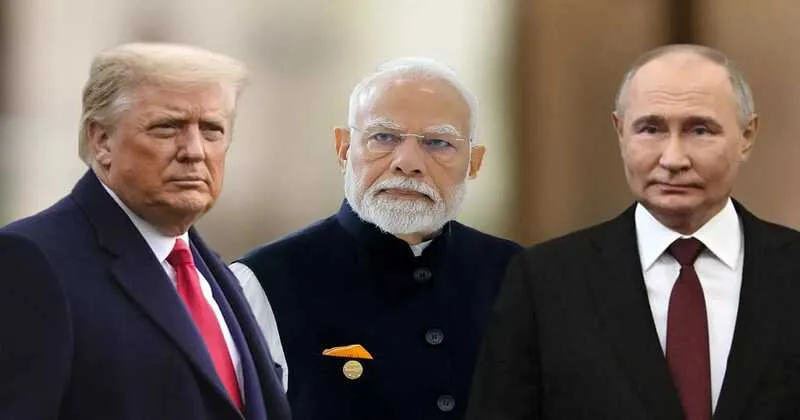
Prime Minister Narendra Modi is preparing for an intense phase of foreign diplomacy, with high-level meetings scheduled with leaders of both Russia and the United States over the next three months. These developments signal India’s central position in a turbulent global order.
The long-anticipated visit of Russian President Vladimir Putin to New Delhi has now been finalised. Putin will arrive on December 5 and 6 for the annual India–Russia summit. The visit was first discussed during National Security Advisor (NSA) Ajit Doval’s trip to Moscow in August, though dates were not confirmed at that time. Later, Prime Minister Modi met President Putin at the Shanghai Cooperation Organisation (SCO) summit in China, which further paved the way for finalising this high-level engagement.
Putin’s visit comes at a time when Washington has been increasingly pressuring New Delhi to scale back its close trade and energy ties with Moscow. Nevertheless, both sides have expressed confidence in the resilience of their longstanding strategic partnership. Issues likely to be discussed during the summit include trade expansion, defence cooperation, technology transfer, and collaborative projects in energy and space.
Speaking at the United Nations General Assembly, Russian Foreign Minister Sergei Lavrov dismissed speculation that India–Russia ties could be strained by Western sanctions or external pressure. He reiterated that Moscow stood firmly behind India’s national interests, adding that the personal rapport between Modi and Putin had helped keep bilateral relations warm despite global tensions.
Prospects of a Modi–Trump Meeting
Even as preparations are under way for the Putin summit, New Delhi is also setting the stage for a possible meeting between Prime Minister Modi and US President Donald Trump. The opportunity is expected to arise during the ASEAN summit scheduled to be held in Malaysia on October 26 and 27. Malaysia has extended an invitation to President Trump, and if he attends, the two leaders may hold their first bilateral meeting since Washington imposed a steep tariff regime on Indian goods.
This would mark the first Modi–Trump encounter since the US administration introduced punitive trade measures earlier this year. Trump’s government had initially announced a 25 per cent import tariff on Indian goods, but an additional 25 per cent tariff was later imposed as a penalty for India’s continued purchase of Russian oil. This brought the total tariff burden on Indian exports to the US to 50 per cent, placing India among the two countries facing the highest tariffs on American goods, the other being Brazil, which has also clashed with Washington over trade policies. Modi and Trump could not meet on the sidelines of the G7 summit in Canada earlier this year due to Israel-Iran conflict, Nevertheless, the ASEAN gathering offers a fresh diplomatic opening to reduce tensions.
Europe Pushes Back Against US Demands
Meanwhile, Washington’s attempts to build an international coalition to isolate India economically have failed to gain traction. President Trump had urged the European Union, G7 nations, and NATO allies to impose 100% import tariffs on Indian goods, mirroring US measures. However, all three blocs rejected his demand outright.
European Commission President Ursula von der Leyen reaffirmed that the EU remains committed to finalising its trade deal with India by the end of this year. In a further boost to India, Finland openly opposed Trump’s push for higher tariffs. Finnish Foreign Minister Elena Voltanen stated that her government was not seeking to increase duties on Indian exports but, rather, to lower them in pursuit of a mutually beneficial trade agreement.
At the same time, Finland emphasised that it wanted India to play a stronger role in efforts to end the Russia–Ukraine conflict. Voltanen remarked that while Europe was committed to bringing the war to an end, New Delhi’s growing global clout meant it could not remain on the sidelines.
Finnish President Alexander Stubb echoed this sentiment, describing India as a “superpower” that should not be viewed in the same category as Russia or China. While acknowledging the deepening partnership between Moscow and Beijing, particularly in energy trade, Stubb stressed that India had historically been a trusted partner of Europe and the United States. He underlined that strengthening trade ties with India was now a priority and noted that he had discussed this matter directly with Prime Minister Modi in a phone conversation in August.
These upcoming diplomatic engagements highlight India’s delicate balancing act in foreign policy. On the one hand, New Delhi has preserved its historic defence and energy partnership with Moscow, which remains critical for its security and economic needs. On the other, India has sought to deepen its economic, technological, and strategic ties with the United States and Europe, even as trade disputes and tariff wars create friction.











Comments