





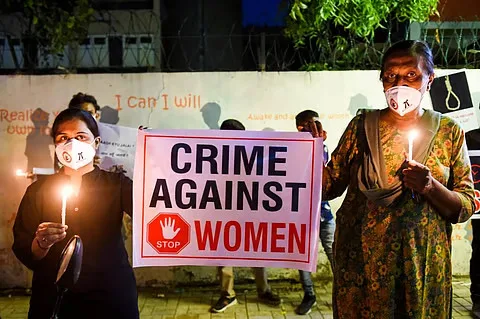
The National Crime Records Bureau’s (NCRB) “Crime in India 2023” report has once again placed Uttar Pradesh under the spotlight, with the state recording the highest absolute number of crimes against women in the country. According to the data, Uttar Pradesh reported 66,381 cases, accounting for 14.81 percent of the total 4,48,211 cases registered nationwide.
Yet, behind this overwhelming figure lies a crucial detail: the crime rate in UP stood at 58.6 cases per one lakh female population, significantly lower than the national average of 66.2. This statistical distinction suggests that while UP struggles with high absolute numbers due to its massive population base, the per capita risk of crime for women is comparatively less concentrated than in several other states.
UP’s rank in national crime map
The state ranked 13th among the 28 states when measured by crime rate against women and 17th when compared to all 36 states and union territories combined. In contrast, Delhi (133.6), Telangana (124.9), Rajasthan (114.8), and Haryana (110.3) reported far higher crime rates. Kerala, with 1,631.2 cases per lakh population, emerged as the state with the highest overall crime rate in 2023, followed closely by Delhi among UTs with 1,602 cases per lakh population.
For a state with over 24 crore population, UP’s numbers point to the immense challenge of managing law and order, but also to improvements in women’s safety metrics.
UP Police and government initiatives
Commenting on the data, Uttar Pradesh’s Director General of Police (DGP) Rajeev Krishna said, “The high case numbers reflect the size of the state, but the lower crime rate suggests that Chief Minister Yogi Adityanath’s zero-tolerance approach, increased police visibility, targeted safety schemes, and dedicated helplines are mitigating the per-capita risk.”
The government attributes much of this improvement to Mission Shakti, a flagship programme for women’s empowerment and safety, which includes helplines, fast-track complaint redressal, and increased awareness drives. State authorities argue that the relatively lower crime rate also signals rising confidence among women to report crimes that previously went unreported.
Enhanced patrolling in vulnerable areas, quicker judicial processes, and greater use of digital tools for emergency responses have been central to these reforms.
A breakdown of women-centric crimes in UP
The NCRB’s data indicates that most crimes against women in UP were perpetrated by known individuals, often within family circles. The largest category was “cruelty by husband or his relatives” (domestic violence), comprising 34 percent of the total.
Other major crime heads include:
Assault on women with intent to outrage modesty: nearly 20 percent of all reported cases.
Rape cases: constitute around 8 percent of total crimes.
Cybercrimes against women: contributing to 9 percent of total cases, highlighting a worrying digital trend.
This breakdown shows the dual challenge of tackling both traditional domestic abuse and emerging threats in cyberspace.
National trends beyond Uttar Pradesh
While Uttar Pradesh’s per capita crime rate offers a relatively better picture, other states and cities highlight deep concerns.
Delhi’s conviction rate drops
Delhi recorded a sharp fall in conviction rates in 2023. The capital’s conviction rate dropped to 78.1 percent, compared to 87.8 percent in 2022. Of the 56,990 completed trials, 44,502 ended in convictions, while 8,008 resulted in acquittals.
A retired IPS officer quoted in the media saying, “This shows that many cases were poorly investigated and lacked sufficient evidence. While more trials were completed, more acquittals followed.”
Delhi still recorded the highest number of absolute convictions among metros, followed by Kochi. However, Ahmedabad topped the chart for acquittals.
Bengaluru’s troubling kidnapping data
Bengaluru reported the lowest chargesheeting rate for kidnapping cases among metropolitan cities. Of 1,203 recorded abductions in 2023, the chargesheeting rate stood at just 3.8 percent. Shockingly, 1,139 of the victims were children, most of them adolescent girls.
Data shows that Karnataka as a whole recorded one of the lowest chargesheeting rates in the country, only 6.9 percent, second only to Sikkim at 2.4 percent.
Kerala report the highest crime rates
While Kerala registered the highest overall crime rate at 1,631.2 per lakh population, Gujarat (806.3), Haryana (739.2), Tamil Nadu (701.4), and Manipur (627.8) also reported far higher per capita crimes than UP.
This trend underscores how per-capita data often paints a different picture than absolute figures.
Broader crime picture in India
Beyond crimes against women, the NCRB 2023 report offered insights into India’s overall law-and-order challenges.
National Crime Rate: India recorded an overall crime rate of 448.3 per lakh population, while Uttar Pradesh stood significantly lower at 335.3.
Extremism and Terrorism: Cases of extremist violence dropped sharply from 446 in 2022 to 163 in 2023. Jihadi terrorism fell by 87 percent, from 126 cases in 2022 to just 15 in 2023. Left-wing extremism declined by over 44 percent, and North-East insurgency by 61 percent.
Casualties and Arms Looted: Civilian casualties fell, but deaths among police and army personnel rose by over 50 percent. Extremists looted 706 arms and nearly 20,000 rounds of ammunition in 2023, a sharp spike compared to the previous year.
Challenges that remain
Despite relative improvements, several challenges remain. Women continue to face high risks of domestic violence, cyber harassment, and physical assaults. Falling conviction rates, particularly in metros like Delhi, suggest structural weaknesses in investigations and evidence collection.
The abysmal chargesheeting rate in Bengaluru exposes the inability of law enforcement to build strong cases, leaving victims vulnerable. Similarly, the increasing proportion of cybercrimes against women highlights a new frontier of threats requiring urgent legal and technological interventions.
Complex but shifting landscape
The NCRB 2023 report paints a complex picture. Uttar Pradesh, with the highest absolute number of crimes against women, still manages a lower per capita crime rate than several smaller states. This contrast highlights how population scale influences perception and risk.
Delhi’s conviction rate fall, Bengaluru’s poor chargesheeting record, and Kerala’s high crime rate add layers of concern, underscoring that safety for women varies sharply across regions.
For UP, schemes like Mission Shakti and stronger policing are cited as reasons for relative improvement, but the continuing rise in domestic and cybercrimes indicates much remains to be done. Nationally, while extremist violence has reduced, women’s safety remains an unresolved crisis requiring sustained reforms in law enforcement, judiciary, and societal mindset.
As India looks to build a safer environment for women, the NCRB 2023 report serves as both a warning and a guide, pointing to achievements in some states while exposing critical gaps in others.










Comments