





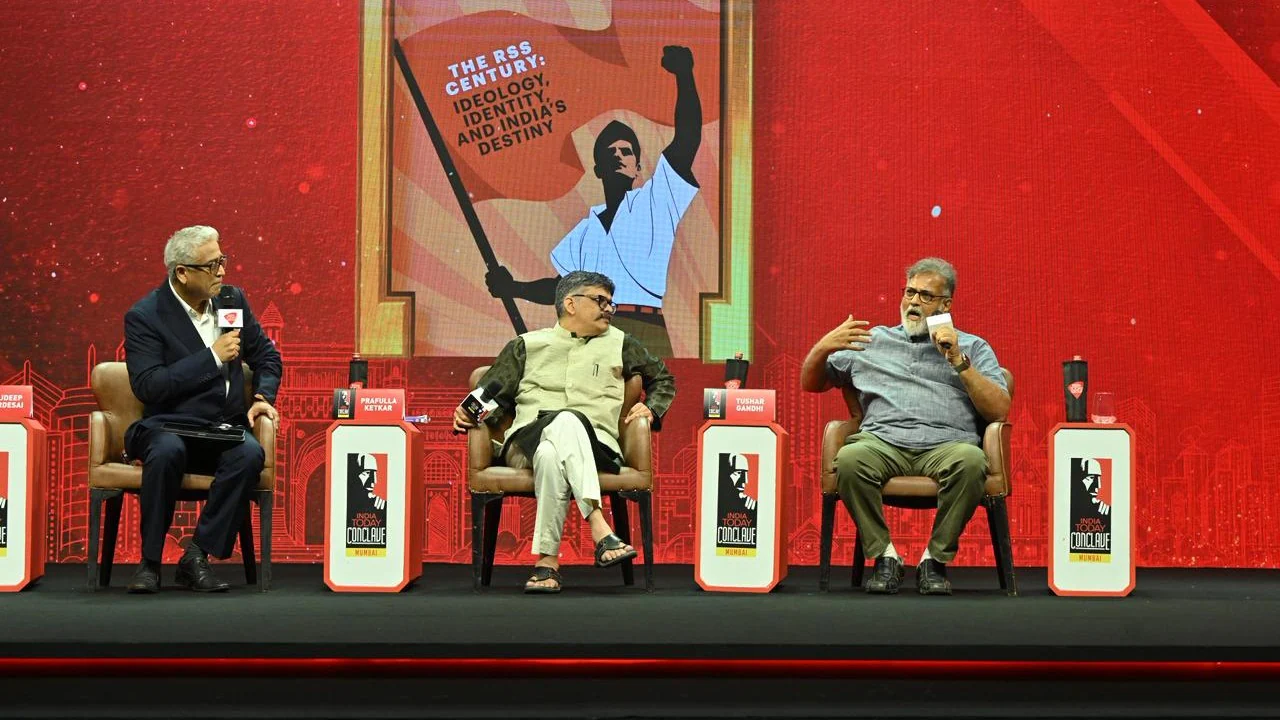
The India Today Conclave session titled “The RSS Century: Ideology, Identity, and India’s Destiny” witnessed a fiery exchange between Prafulla Ketkar, editor of Organiser, and Tushar Gandhi, great-grandson of Mahatma Gandhi. Moderated by Rajdeep Sardesai, the session turned into a heated battle of ideologies, reflecting the larger national debate on the RSS and its role in India’s civilisational journey.
Sardesai opened the session and questioned Ketkar about introductory remarks on the journey of the RSS.
Responding to Sardesai’s question on whether the RSS’s centenary marks the “assertion of Hindu Rashtra or cultural nationalism,” Ketkar outlined the organisation’s historical journey: “This journey is about first neglect, then contempt, then hatred, and now acceptance. In 1950-51, the first two academic books on RSS came up exactly after the completion of 25 years of RSS, one by J. Curran, who never visited India, calling it ‘religious militant nationalism’; it was his PhD thesis. Another was by Anthony Elenjimittam, a Christian pastor, who wrote about the philosophy and action of RSS for Hind Swaraj. So, all the adjectives, be it Hindu nationalism, Fascist, or whatever, are quoted from the book by Curran. Interestingly, the Gandhian Christian pastor who wrote about RSS is never quoted in academic circles. When RSS started, it was more of a mockery for many people in Nagpur. By 1940, RSS had reached 125 places in India when Dr Hedgewar passed away. And what we see today, with 83,000 shakhas and 32 inspired organisations, and the way the RSS thought process is gaining wide acceptance, that is a remarkable journey. You can like it or hate it, but you cannot ignore it.”
He argued that RSS philosophy defines Bharat’s uniqueness through the term “Hindu.” When Rajdeep asked him if this achievement was the arrival of some sort of “Hindu nationalism,” Ketkar said: “Yes, it is mainly because of three contending ideas. One was what the British taught us, and then the Nehruvian secularism, which accepted that ‘we are a nation in the making.’ Then there is the left point of view, that we are not a nation and we can never be a nation, that we are conglomerates of several nationalities, at most structured states. And then there is a third point, that we have been an ancient civilisational state and RSS stands for that, and that is what is now being accepted.”
To this, Tushar Gandhi said: “I admit that in India today Nathuram Godse’s voice finds more acceptance than Mohandas Karamchand Gandhi. For me, there is no religious nationalism or identity thing. It is basically the philosophy of hate, murderousness, which is being embodied in RSS. Not just since the inception of this country, but that ideology is being practised in India and we cannot deny it.”
Sardesai questioned if an organisation should be looked at with the same lens after all these years for what happened on January 30. Gandhi said: “No, I say so because it is happening to date.”
Tushar argued that the problem was not limited to 1948: “The Dabholkar, Pansare, Kalburgi, and Gauri Lankesh killings are also as much victims as Bapu. It continues to this day.”
Citing Organiser, Tushar said: “When Bapu fasted for peace in Kolkata, Organiser published ‘Nero fiddled when Rome burned,’ blaming Gandhi for saying Allahu Akbar. This rabble-rousing continues today. Gandhi pleaded in Bihar, Muslims shout Allahu Akbar while killing Hindus, Hindus shout Jai Shri Ram while killing Muslims—no religion preaches massacre. Yet RSS blamed Gandhi.”
Ketkar strongly defended RSS against allegations of hate: “I virtually grew up in an RSS family. What he quoted is written in Organiser when A.R. Nair was the editor. He came from a communist background; they have a tendency of quoting people. Organiser is a company of 14,000 shareholders, which RSS does not even own. I heard of Godse more from RSS haters than RSS supporters.”
“In fact, the first person who denounced Godse was Guruji Golwalkar. On 30th January 1948, he was in Madras, cancelled all programs, returned to Nagpur, and telegrammed Nehru calling the vile act a ‘blot on society in the eyes of the world. Even if it had the hands of one from the enemy country, this act would have been unpardonable, for the life of Mahatma Ji was dedicated to the good of entire humanity across the border.’ To say RSS ideology is based on hate is unfair.”
He added: “I believe people from a non-RSS background, even PM Modi’s haters, spread more hatred and are more un-Gandhian, carrying real or fake, unreal Gandhi surnames. For that matter, the kind of language they use even on social media against the PM is un-Gandhian. That’s why I quoted Anthony when he said, ‘Hind Swaraj.’”
People who critique RSS are more un-Gandhian, Ketkar said, “In 1949, Gandhi ji is asking Nehru about his view and Nehru is replying, ‘Bapu, your idea on Hind Swaraj and India are unreal and I don’t believe in it. Twenty years ago, I did not like it, today I don’t believe it.’ Taking Gandhi’s name and realising his ideas are two different things.”
“I want to ask one thing, Gandhi was the first person who talked about Ram Rajya. Was he communal? Gandhi spoke of cow protection. Was he communal? Gandhi said conversion is violence. Was he communal? That is what RSS stands for,” he added.
To this fact, Tushar warned against the selective use of Gandhi: “Yes, Bapu spoke of cow protection, but he opposed a ban on cow slaughter, saying we cannot emulate Pakistan. His Gram Rajya was about equality for the weakest, not the Ram Rajya we are told today. Don’t be selective in quoting Gandhi.”
On Golwalkar, he quoted: “In December 1947, Golwalkar said, ‘No power on earth could keep Muslims in Hindustan… by elections, not a single Muslim will remain.’ A month later, Gandhi was assassinated. RSS has always sought civilisational revenge, not justice.”
Sardesai repeatedly pressed Ketkar on whether RSS was exclusionary: “At its core, is RSS demonising the Muslim? When Mohan Bhagwat says Muslims share the same DNA, you have Bajrang Dal shouting ‘Jo Hindu hit ki baat karega, wahi raj karega.’ Are you riding two horses?”
Ketkar said: “No, absolutely not. There is a famous interview in 1972 by Guruji to Mr Jilani, an Iranian journalist, on this particular issue. See, for RSS, the word Hindu defined the USP of Bharat.”
Ketkar denied anti-Muslim intent: “Golwalkar never used the word ‘yavana snakes’ for Muslims. He spoke of Islamic fundamentalists, Christian evangelists, and Communist materialists. The RSS believes everyone in India is civilisationally Hindu. The idea of Hindu Rashtra is not to be created; it exists in our spiritual democracy.”
But Tushar rejected this: “RSS relief work is not selfless. Gandhi himself warned Dr. Sushila Ayyar that RSS does good only with evil intentions. They ferment hate in the name of service.”
Ketkar countered with personal experiences: “In Bhuj earthquake relief, or the Dadri plane crash where all passengers were Muslims, RSS never discriminated. I don’t remember a single case of bias. These accusations are baseless.”
“For RSS philosophy, the word Hindu defines the USP of Bharat. Civilisationally, it is about spiritual democracy, where a monotheist, polytheist, omnitheist, or even an atheist can all be Hindus. That freedom is given only in this land and that is the USP of this land. If everyone follows the same lineage, shouldn’t we talk? When we talk about caste issues, we talk about caste discrimination and social justice. Similarly, when religious discrimination happens, why can’t we talk about civilisational justice?,” said Ketkar.
RSS believes that everyone living in India is civilisationally Hindu because of the acceptance of multiplicity. This acceptance of multiculturalism and historical reality is the idea of Hindu Rashtra. Accepting this USP and then creating this unity is the idea of Hindu Rashtra. Ketkar argued that the idea of Hindu Rashtra is not exclusionary but an acknowledgement of this shared civilisational heritage. “Hindu Rashtra is nothing to be made. Accepting this USP and then creating this unity is basically the idea of India,” he said.
Tushar called RSS anti-Muslim, saying: “India has changed, it is not civilisational pride but civilisational revenge. It is being done by the hateful campaigns of RSS from independence to today. We who claimed to be Gandhians failed Indians.”
To this, Ketkar responded: “Being Hindu, for me all ways are accepted and true. For me, the problem is with people who do not accept it. In 2018, Bhagwat ji said in his lecture, one of the biggest critics of Gandhi or Congress’s Muslim policy was Ambedkar. Do you call him hateful? Sorry. Ambedkar was the only person who talked about exchange of population. In fact, both Savarkar and Golwalkar opposed it. And they believed that Gandhi would be the last person who would, unfortunately, have to accept the partition. But till the last moment, till the Congress accepted the partition resolution, Gandhi was the only person within Congress saying that he would not accept the partition. Many people believe that is the point here.”
As tempers rose, Ketkar highlighted RSS’s constructive role: “Some people are stuck up. You guys also talk only about BJP. Why? Don’t you realise that BMS is the largest labour organisation, even ILO has to take cognisance of it. Why don’t you understand the basic thing that ABVP is the largest student organisation? Even in campuses like Hyderabad Central University, all seven seats were recently won by ABVP. There is a Sanskar Bharati, which from folk arts to classical art, is integrating and bringing all the artists on one platform. Why are you not understanding—it is not just about politics. It is about understanding that being Hindu is synthesising even what you see as contradictory. And that is what even Gandhian satyagraha was. Gandhian satyagraha had two parts: one was what he was doing against the British, but there was also a constructive program. Tell me a single constructive program that Congress has done after Gandhi. I will give you hundreds of examples from RSS.”
He said: “Dr Hedgewar was a Congress member, a revolutionary, who worked along with the Bengal Anushilan Samiti, who was even a part of the Congress 1922 session organising committee. He was also a member of many drafting committees for the Socialist Party. And he made one interesting point about RSS: he said, ‘I don’t want to create an organisation in the society. I want to organise the entire society.’ So it was a way of mobilising Hindus. The problem that he diagnosed, most people at one point, Gandhi also thought so, was that we were caught up in many fragmentations: caste, language, and our perspective towards history. Unless that is changed, even if we get independence, our problems will not be solved. And that’s why he said, ‘I don’t want to raise an organisation, I want to organize the entire society.’ That was a different approach that unfortunately people miss.”
“Tell me one constructive program Congress has done after Gandhi. I will give you hundreds by RSS. ABVP is the largest student group, BMS the largest labour organisation, Sanskar Bharati uniting artists. RSS is not just politics, it is society building,” he added.
But Tushar equated RSS with fascist precedents: “RSS wants to organise society the way Hitler and Mussolini did. Their inspiration is clear. India today is discovering the Nathuram Godse in it, not civilisational pride.”
Ketkar said: “As a nation, we should have a common understanding about ourselves. If we have certain flaws as a society, maybe related to caste, maybe related to language—Rajdeep, one simple question. One important speech, because a lot of people talk about language, and RSS is asked about this. In 1952, there was an important speech delivered by Mr. Golwalkar, Guruji, in Chennai (then Madras). He made an interesting argument. He said all Indian languages are national languages, and that is what the Constitution says. For practical purposes, maybe English and Hindi are the Rajbhasha, the official and state languages. But when it comes to our national conversation, when it comes to prioritisation, we should give priority to any of the Indian languages. The idea of RSS was basically overcoming the shortcomings of our society through constructive means and consistent dialogue. Shakha becomes a training program. In shakha, I never saw any religious preaching. In fact, it is one of the most secular places—except for Bharat Mata, nothing is worshipped. So I don’t know why RSS critics always see this from either the BJP prism, or the anti-Muslim prism, or some imaginary fascism.”
He added, “Indian people have accepted the RSS point of view. Simply, as I said, India is a civilisational nation, which we call a Hindu nation. If you don’t want to call it Hindu, call it Bharatiya nation, it doesn’t matter. But in the name of secularism, if you say we are making a new nation, that this is not a nation, this is a ‘tukde-tukde’ nation, then it is not accepted. We will discuss and debate over it, but we will not hate you. People who criticise RSS for hatred live virtually on RSS hatred.”
The session closed without a consensus. Sardesai summed up the divide: a clash between Gandhian inclusiveness and the RSS’s Hindu civilisational journey.











Comments