





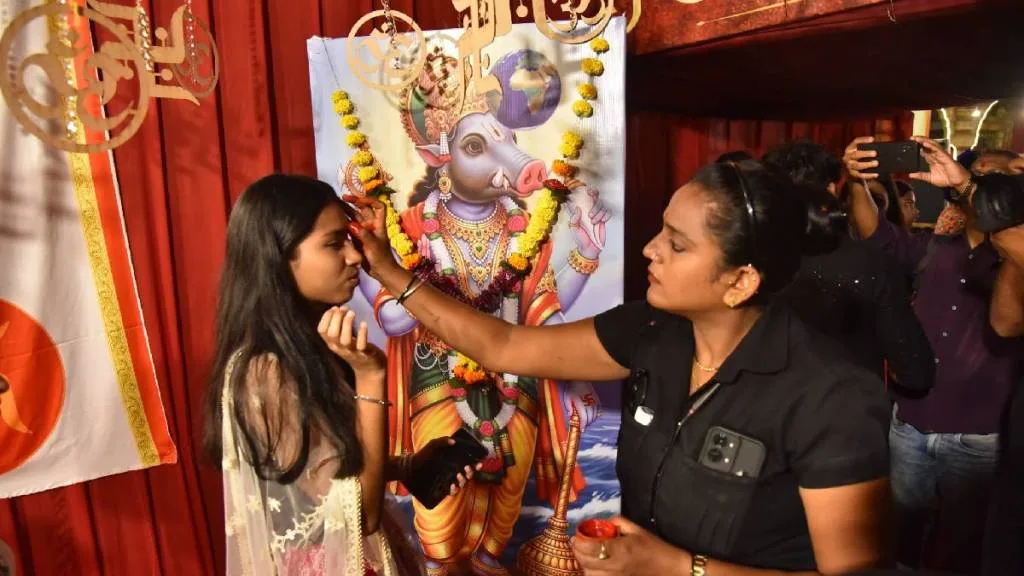
Several Garba pandals in Maharashtra have introduced posters, entry rituals, and verification rules this Navratri, sparking debate over devotion, cultural identity, and inclusivity. Supported by the Vishwa Hindu Parishad (VHP) and Durga Vahini, the measures aim to remind participants that Garba is not merely music and dance but a sacred form of worship dedicated to Maa Durga.
Outside several pandals, large posters carry powerful cultural messages. One urges women to “Become Durga, become Kali, but never lose your identity,” while another echoes the words of Chhatrapati Shivaji Maharaj: “If you do not take up arms, you will lose the nation.” A particularly striking visual is that of Bhagwan Vishnu’s Varaha avatar, revered as the divine protector who rescues the world from chaos, symbolising both safety and order.
Organisers explained that these visuals were chosen to inspire vigilance and pride in Hindu traditions while reinforcing the sacredness of Navratri rituals.
In addition to the posters, many pandals have introduced specific entry requirements. Participants are asked to apply a tilak before entering, wear a kalava on the wrist, show valid ID cards for verification, and, in some cases, pay respect to the Varaha image at the entrance. According to VHP representatives, invoking Varaha’s protective symbolism helps establish the Garba venue as a spiritual and secure space, rather than a casual entertainment area.
Organisers defended the move, citing past disturbances at Garba events and safety concerns, particularly for women. A VHP functionary said, “Garba is a form of devotion, a spiritual journey, not merely entertainment. These measures ensure participants respect the sanctity of the festival while also feeling safe.” They emphasised that the initiative is protective, not exclusionary, ensuring the environment remains peaceful and aligned with the festival’s devotional roots.
The decision, however, has drawn criticism. Congress leader Vijay Wadettiwar alleged that the rules were politically motivated, designed to create divisions in society. Supporters countered that such criticism overlooks the safety rationale, pointing out that similar scrutiny is rarely applied to protective measures at festivals of other faiths.
The introduction of Varaha symbolism and ritualised entry conditions reflects a larger debate around public religious festivals: how to preserve tradition and sanctity in a modernising society, ensure safety for women and participants without appearing exclusionary, and manage the way festivals sometimes become political flashpoints where devotion and identity intersect with broader ideological battles.










Comments