





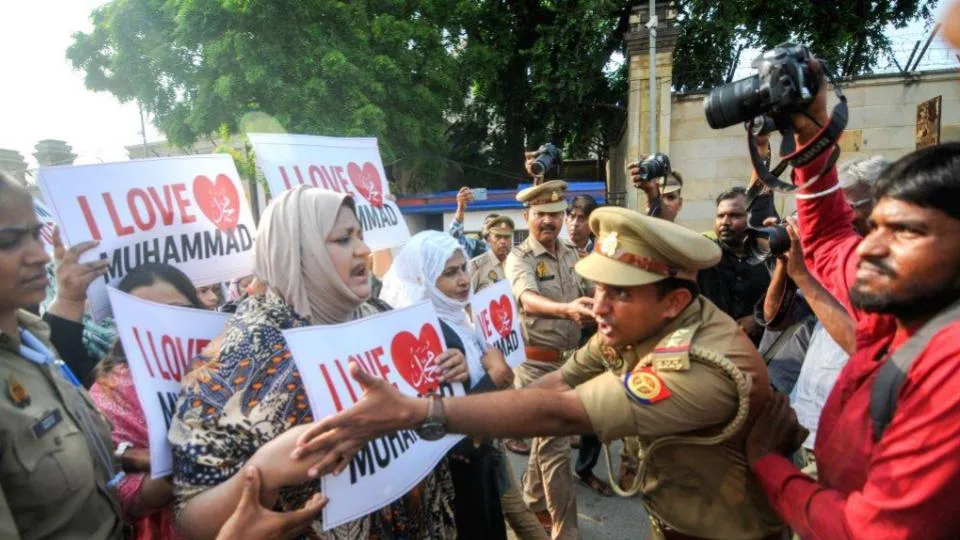
In recent weeks, Indian social media platforms have been flooded with lakhs of posts, viral videos, and hashtags declaring “I Love Muhammad.” On the streets, loud chants, provocative slogans such as “Sar Tan Se Juda,” and rallies waving these posters transformed what initially appeared to be a religious expression into a national-level communal, political, and social controversy.
The critical question remains: was this truly an organic outpouring of Muslim community sentiment, or a carefully orchestrated toolkit amplified by political actors? Evidence from police FIRs, eyewitness accounts, and the chain of events suggests that the campaign was far from spontaneous.
How it all began: Kanpur, September 4, 2025
The first sparks of controversy were lit on September 4, 2025, in Rawatpur, Kanpur, during the Eid-e-Milad-un-Nabi (Prophet Muhammad’s birthday) celebrations. A new tradition emerged, the installation of an illuminated board reading “I Love Muhammad” in front of Zafar Wali Gali, Syed Nagar.
Simultaneously, a Hindu religious procession passed through the same street. Reports confirm that Muslim youths from the crowd allegedly tore Hindu posters with sticks, sparking clashes. Police intervened, removed the board, and temporarily diffused the situation.
However, as the FIR obtained revealed, this was not just about displaying a poster. It was about the destruction of Hindu posters and deliberate provocation.
The September 5 clash and CCTV evidence
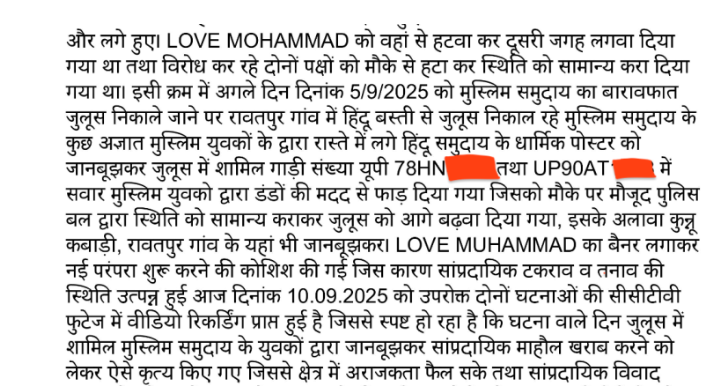
The tension flared again on September 5, 2025, during the Barawafat procession. According to the FIR, “unidentified Muslim youths in a vehicle deliberately used sticks to destroy Hindu religious posters along the road in Rawatpur village.”
On September 10, 2025, authorities obtained CCTV footage confirming these allegations. The recording showed Muslim youths intentionally damaging Hindu posters “with the aim of disturbing communal harmony and inciting chaos.”
Station House Officer (SHO) Krishna Mishra of Rawatpur was quoted in media saying: “The FIR was not filed against the display of the ‘I Love Muhammad’ poster. It was lodged because certain accused individuals deliberately destroyed Hindu posters, creating communal disharmony.”
This police clarification directly contradicts the narrative of “victimisation of Muslims for saying ‘I Love Muhammad’” that spread on social media.
From Kanpur to nationwide protests
What could have remained a localised law-and-order issue soon ballooned into a state-wide and then national campaign.
Uttar Pradesh towns such as Bahraich, Bareilly, Lucknow, Amethi, Unnao, Kaushambi, and Maharajganj saw protests. #ILoveMuhammad trended widely on Facebook, Instagram, and Twitter.
In Madhya Pradesh, mobs pelted stones at a Kali idol.
In Gujarat’s Godhra, agitators surrounded a police station.
In Uttarakhand’s Kashipur, a rally without police permission led to stone-pelting, vandalism, and assaults on police personnel.
The campaign had clearly gone beyond expressions of faith, morphing into orchestrated demonstrations, some turning violent.
Kashipur violence: September 2025
The Kashipur incident in Udham Singh Nagar, Uttarakhand, was among the most violent episodes. Reports confirmed that no permission had been granted for the rally, yet it moved through Ali Khan area, where stone-pelting, vandalism, and assaults on police ensued.
SP (City) Abhay Singh led the police crackdown, later stating: “The atmosphere deteriorated during the unauthorized procession, but due to prompt police action, the situation was brought under control. No casualties or industrial damage occurred.”
Singh also alleged the involvement of Samajwadi Party leader Nadeem Akhtar in orchestrating the violence. He warned: “Uttarakhand is a state of law and order. No one will be allowed to indulge in goonda raj or unrest.”
Political amplification: Congress, SP, AIMIM step in
The campaign’s national momentum surged once political leaders began endorsing it:
On September 20, 2025, the Congress Minority Department announced support for those booked in FIRs. Congress spokesperson Shama Mohammed publicly defended the slogan.
Samajwadi Party leader Abu Azmi declared he was willing to go to jail for saying “I Love Muhammad.” SP spokesperson Amik Jamai equated it with “I Love Shri Ram,” framing it as freedom of expression.
AIMIM chief Asaduddin Owaisi escalated rhetoric, saying: “If saying ‘I Love Muhammad’ is a crime, then we are ready for every punishment.”
Following this, violence intensified in Bareilly. AIMIM’s Waris Pathan alleged that lakhs of Muslims were being unfairly booked.
Nagina MP Chandrashekhar Azad used the slogan to openly challenge the police.
This political endorsement gave the campaign legitimacy, pushing it far beyond its original context.
Women at the forefront: A Shaheen Bagh redux
A notable feature of these protests was the prominent role of women. In Lucknow, SP spokesperson Sumaiyya Rana, daughter of controversial poet Munawwar Rana, led protests alongside other women.
This strategy echoed the Shaheen Bagh protests during the CAA-NRC movement, where women were projected as peaceful symbols of dissent to soften the image of a politically charged agitation.
The hidden truth: Victimhood narrative vs reality
Mainstream discourse largely framed Muslims as victims being persecuted for declaring love for the Prophet Muhammad. Yet the FIRs, CCTV evidence, and police statements prove otherwise.
1. The FIRs were filed not against the slogan, but against those who destroyed Hindu posters and incited communal clashes.
2. The real victims were Hindus whose religious symbols were desecrated.
3. The narrative was flipped deliberately to portray Muslims as persecuted, while the provocation they initiated was obscured.
Congress’s double standards and historical parallels
The Congress party’s involvement in fueling the “I Love Muhammad” campaign is not an isolated episode but part of a broader pattern of selective politics and opportunistic positioning. Time and again, the party has chosen to side with disruptive forces under the guise of defending minority rights, even when evidence clearly points to violence, vandalism, and lawlessness.
This is the same Congress that once coined and propagated the term “Hindu terror”, a narrative that not only vilified Hindu organisations but also equated them with international terror groups. Reports later revealed that Rahul Gandhi, in private conversations with US diplomats, suggested that Hindu groups posed a greater threat than Islamist extremists, a remark that shocked many and exposed the party’s willingness to malign an entire community for political gain.
In more recent times, the party has wrapped itself in the rhetoric of “Mohabbat ki Dukaan”, claiming to spread harmony and inclusiveness. Yet on the ground, its leaders have openly supported movements that have led to attacks on police personnel in Kashipur, stone-pelting in Bareilly, and unrest in Gujarat’s Godhra.
The contradiction is glaring. While Congress leaders speak of love and brotherhood in their public campaigns, they have repeatedly chosen to back protests that thrive on half-truths and selective victimhood narratives. From their silence on Shaheen Bagh’s blockade politics to their support for the violent agitations against the Citizenship Amendment Act (CAA), the party has often endorsed mobilisations that challenge state authority and disrupt public order, so long as they fit its political calculus.
The “I Love Muhammad” controversy follows the same script: facts about Hindu poster vandalism and communal provocation are buried, while Congress and its allies amplify the emotional slogan to project Muslims as victims of religious persecution. By doing so, the party not only deepens communal divides but also undermines faith in institutions meant to uphold law and order.
A toolkit in the garb of religion
The “I Love Muhammad” campaign was not a spontaneous eruption of faith. It was a calibrated toolkit:
1. Rooted in a local vandalism incident in Kanpur,
2. Amplified on social media,
3. Endorsed by political leaders,
4. And designed to create victimhood narratives for electoral mileage.
What began as a small altercation was deliberately magnified into a national controversy by political forces that suppressed facts, erased Hindu suffering, and ignited communal divisions.
The pressing question is: for how long will India’s democracy be jeopardised by leaders who trade truth and harmony for electoral expediency?











Comments