





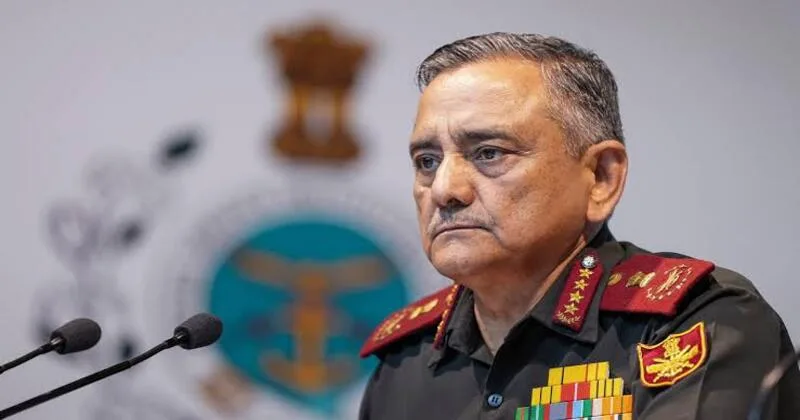
Chief of Defence Staff (CDS) General Anil Chauhan stated on September 24 that the use of the Indian Air Force could have significantly slowed down the Chinese advance during the 1962 war. At the time, air power was seen as an escalatory measure, a perception that, according to the CDS, no longer holds true. He cited Operation Sindoor as a clear example of how this mindset has changed.
General Chauhan made these remarks in a video message played during the unveiling of the revised and expanded edition of From Reveille to Retreat, the autobiography of the late Lieutenant General S.P.P. Thorat, Kirti Chakra. The event was attended by Southern Army Commander Lt Gen Dhiraj Seth, Central Army Commander Lt Gen Anindya Sengupta, military historian Shiv Kunal Verma, and several senior serving and retired officers from all three branches of the armed forces.
CDS Gen Anil Chauhan-
"Indian Air Force was not allowed to participate in 1962 War. Air Force use would've slowed Chinese offensive." pic.twitter.com/V1wlwGHrHS
— News Arena India (@NewsArenaIndia) September 25, 2025
In his address, General Anil Chauhan said, “I was asked to speak about the forward policy and the decision not to use the Air Force during the 1962 war. Assessing the adequacy or inadequacy of the forward policy today is challenging, as our perspectives are influenced by many factors, geography has changed, geopolitics has evolved, the security environment is different, force levels have increased, and even the nature of warfare itself has transformed.”
He continued, “What I can say is that the forward policy should not have been applied uniformly to both Ladakh and NEFA. These two regions had vastly different historical disputes, distinct security contexts, and entirely different terrain. In Ladakh, China had already occupied significant portions of Indian territory, while in NEFA, India’s territorial claims held stronger legitimacy. Treating both situations the same and adopting identical policies, in my view, was somewhat flawed.”
The Chief of Defence Staff further remarked, “I believe General Thorat had envisioned the use of the Air Force during the 1962 conflict, but the government did not authorise it. Air power could have provided a significant advantage at the time, thanks to shorter turnaround times, favourable geography, and the capacity to deliver maximum payloads with precision against the enemy. Its use might not only have slowed the Chinese offensive considerably but potentially halted it altogether, giving the Army much-needed time to prepare.”
He added, “Back then, the use of the Air Force was seen as escalatory. That perception, however, no longer holds true. Operation Sindoor is a fitting example of how our approach has evolved.”
Concluding his address, General Chauhan said, From Reveille to Retreat is more than just an autobiography. “It is a reflection on leadership, strategy, and service. It offers a candid critique of key decisions and draws lessons that remain highly relevant even today.”
Lieutenant General Shankarrao Pandurang Patil Thorat (1906–1992) was a highly respected commander in the Indian Army, renowned for both his combat leadership and strategic foresight. In 1924, he was selected as one of only five Indians to attend the prestigious Royal Military College, Sandhurst, where he graduated with a rating of “Exemplary Character.” He completed his initial attachment with the 2nd Battalion, Middlesex Regiment, before being commissioned into the 1/14th Punjab Regiment and deployed to the North-West Frontier.
As General Officer Commanding-in-Chief of the Eastern Army, Gen Thorat confronted both the growing Naga insurgency and increasing Chinese assertiveness in the North-East Frontier Agency (NEFA). He pioneered counterinsurgency tactics that integrated local military operations with community engagement, an approach that anticipated many aspects of modern civil-military cooperation.
In 1959, Gen Thorat submitted a forward-looking report outlining China’s likely military intentions and probable invasion routes, assessments that proved accurate during the 1962 war. He strongly opposed Defence Minister Krishna Menon’s Forward Policy, warning that it would result in “certain defeat and death” for ill-equipped and poorly supported Indian troops positioned along the frontier.











Comments