





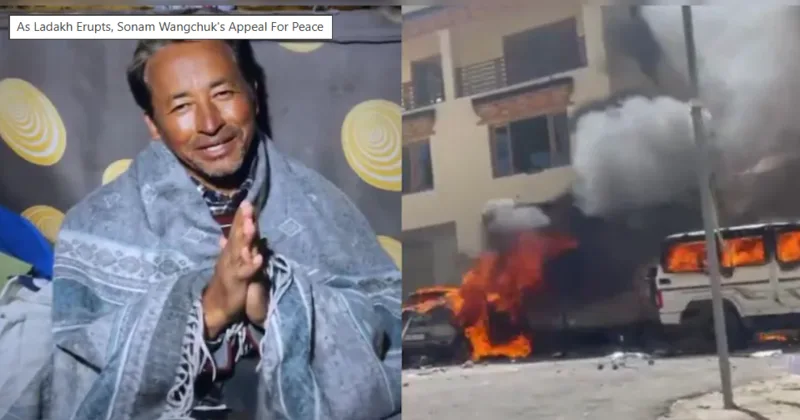
Ladakh, long regarded as a land of peace and harmony, today finds itself engulfed in flames of violence and unrest. The outbreak of violence has shocked the entire nation. Four lives lost; more than eighty injured; over thirty security personnel wounded; and Leh under curfew- this is the grim picture of a movement that began with demands for statehood and constitutional safeguards but quickly descended into chaos. The question is: who bears responsibility for this tragedy?
The Union Government has directly placed social activist Sonam Wangchuk in the dock. The Ministry of Home Affairs states that Wangchuk delivered inflammatory speeches; invoked the Arab Spring and Nepal’s “Gen-Z” movement to mislead the youth; and steered the crowd toward violence. The very demands for which Wangchuk began his hunger strike on September 10 were already under consideration by a high-powered committee. Several issues- such as increased reservations; job recruitments; and recognition of languages- were being addressed through dialogue, and others were in the process of resolution; yet the protestors refused to wait.
Wangchuk had initiated his fast on these demands, drawing national attention to Ladakh by remaining on hunger strike for fifteen days. But what happened next? On the very day violence broke out, he abruptly ended his fast and returned to his village in an ambulance instead of helping calm the crowd. It was clear he made no effort to manage the situation; on the contrary, he further fueled the anger of the youth. The outcome is deeply tragic: Leh is now under curfew, and Section 163 of the Bharatiya Nagarik Suraksha Sanhita has been imposed. In truth, this is not merely a law-and-order crisis; it is a grave challenge to Ladakh’s politics and India’s federal framework.
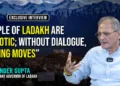
The Congress, too, faces allegations of inciting violence for political gain. Lieutenant Governor of Leh, Kavinder Gupta, has suggested that the movement reeks of conspiracy; outside elements may even be involved. These events remind us once again that chaos and violence never serve anyone’s interest. No matter how justified the demands may be; if pursued through violent means, they lead only to bloodshed. The Congress and Wangchuk, accused of encouraging the unrest, must realize that simply displaying Gandhi’s image is not enough; what he preached must be practiced.
Had Gandhi’s principles been followed, Ladakh would not be reeling in violent disorder today. As he said: “Means and ends must both be pure.” If the people’s demands in Ladakh are genuine, they must be pursued through peaceful and constitutional channels; violence only harms tourism, employment, and social harmony, while giving opportunities to enemies within and across the borders.
Here, the central government cannot be faulted; it appears committed to providing Ladakh with constitutional safeguards. From creating new districts to taking steps on reservations, language, and jobs, it has acted on several fronts. It is also true that discussions are underway on the key demands of statehood and inclusion under the Sixth Schedule. The next high-level committee meeting is scheduled in Delhi on October 6; but after the violence of September 24, will an atmosphere for dialogue even survive? This violence has undoubtedly dealt a severe blow to state- center relations. Four families have lost their loved ones; no political gain or slogan can compensate for that loss. The government may blame the mob; the protestors may accuse the government of negligence; but the truth is that both sides failed in their responsibilities. Movement leaders inflamed emotions rather than calming them.
What Ladakh needs now is a return to trust and peace. The fire of violence in Ladakh has shaken the entire country. Leaders like Wangchuk may feel proud that they shook those in power; but such pride can never be justified when it comes at the cost of four innocent lives. Violence has undermined the moral standing of the movement. Its purpose was to secure rights; the result has been anarchy and death- something no responsible citizen can accept. The foremost need now is accountability; the guilty must be punished.
We must resolve never to support any person or organization that weakens the country and drives society toward violence. Anarchy benefits only enemies; never the people. India’s true strength lies in its diversity; democracy; and peaceful coexistence. If we abandon these values, neither Ladakh nor the nation will remain secure. With the situation now deteriorated, both the central and Ladakh leadership must introspect. The government must accelerate dialogue; rebuild trust; and address people’s concerns through constitutional means.
On the other side, protest leaders must accept that neither statehood nor Sixth Schedule benefits will come through violence; they will only leave behind blood and ashes. Dissent is natural in a democracy; but if dissent turns violent, democracy itself is weakened. This must be understood by all. The crisis in Ladakh is not confined to one region; it is a warning for the entire nation.
Today, we must resolve that no matter the disagreement; no matter how great the demand; it will only be pursued through peaceful and constitutional means. That alone is the true strength of democracy.












Comments