





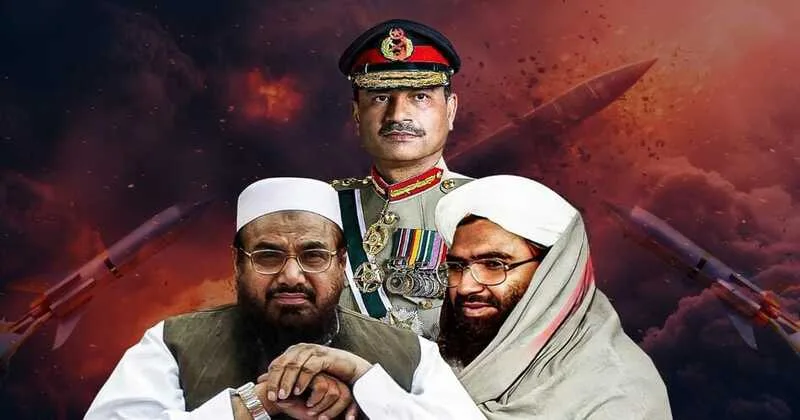
Pakistan’s banned terrorist organization Jaish-e-Mohammed (JeM), which recently suffered a major setback in India’s Operation Sindoor, is preparing to rebrand itself in an attempt to revive its network and expand activities. According to media report, the group is set to adopt a new name, ‘Al-Murabitun ’, which translates to ‘defenders of Islam’ in Arabic, to evade global scrutiny and access new funding channels.
The name change is a strategic move aimed at overcoming the international stigma attached to the JeM brand, which has long been associated with high-profile terrorist attacks in India and beyond. Jaish has historically been a key proxy of Pakistan’s army and government, operating at the forefront of cross-border terrorism. The rebranding has been described by security experts as “new wine in old bottles”, an old terror outfit trying to disguise itself under a fresh identity to continue its militant agenda.
Announcement at Yousuf Azhar memorial, FATF flags digital terror funding network
The formal unveiling of the new name is expected next week during a memorial ceremony for Yousuf Azhar, brother of JeM founder Masood Azhar. Yousuf Azhar was killed during India’s Operation Sindoor, a targeted counter-terror offensive that crippled several JeM networks. Reports indicate that the rebranding is likely to apply primarily to operations inside Pakistan, while the core leadership and agenda of the group remain unchanged.
This move comes at a time when JeM is grappling with financial constraints due to global sanctions and heightened scrutiny from the Financial Action Task Force (FATF), the Paris-based watchdog on terror financing. The group reportedly believes that a new name and renewed organizational identity will help it bypass restrictions and attract funds under the guise of religious and social projects.
A recent FATF report has highlighted that Masood Azhar and his network are actively seeking funds to rebuild terror infrastructure destroyed by Indian forces. The report states that Azhar has been raising money through digital wallets to avoid detection by global monitoring agencies. The funds, often collected in the name of building mosques and religious Markazes, are aimed at reviving JeM’s training camps and operational hubs.
According to the FATF, Masood Azhar has set a target of raising ₹390 crore to finance the establishment of 313 new camps, with significant backing from Pakistan’s intelligence agency, the ISI. Fundraising campaigns are reportedly taking place during Friday prayers across Pakistan, often under the pretext of humanitarian aid for Gaza, exploiting public sentiment to funnel money into terror activities.
Investigators have already identified at least five digital wallets being used by JeM to channel these funds. Platforms such as EasyPaisa and SadaPay, popular Pakistani mobile payment systems, are reportedly being exploited to evade international oversight. The group’s shift to digital transactions reflects a calculated attempt to sidestep banking restrictions and global counter-terror financing frameworks.
Terror recruitment drive under state protection as India maintains strict vigil
As part of its rebuilding efforts, JeM has launched an aggressive recruitment drive. One such campaign was recently held on September 14 in the town of Garhi Habibullah in Mansehra district. Shockingly, reports suggest the event was conducted under the protection of the Pakistan Army and local police. The recruitment session, led by senior JeM commander Masood Ilyas Kashmiri, took place just hours before the India-Pakistan cricket match in Dubai, a timing seen as an attempt to tap into heightened nationalist sentiment.
India continues to closely monitor the activities of JeM and its rebranded entity. The group has been responsible for some of the deadliest terror attacks on Indian soil, including the 2001 Parliament attack, the 26/11 Mumbai attacks, and the deadly strikes on the Uri and Pulwama army camps in Jammu and Kashmir.
Security agencies warn that despite financial strain and global isolation, JeM’s latest maneuver to rebrand as ‘Al-Murabitun’ signals an attempt to regroup and regain operational strength. Indian intelligence remains on high alert to track its funding channels, recruitment networks, and future plans.















Comments