





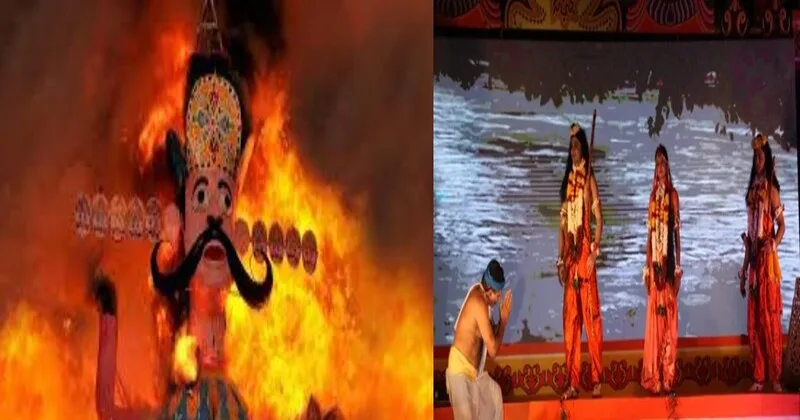
India’s festive calendar is filled with events that blend spirituality, culture, and community bonding, and among them Navratri and Dussehra 2025 hold a very special place. Both festivals are not only marked by prayers and rituals but also by vibrant cultural expressions, the most prominent being Ramlila, the theatrical enactment of the Ramayana. Every year during Navratri, stages are set up in villages, towns, and cities across the country where actors, often drawn from local communities, bring alive the story of Bhagwan Ram, his exile, the abduction of Sita, the battles he fought, and finally, his victory over Ravana. The performance does not remain limited to drama; it becomes a form of collective worship and a celebration of values such as truth, duty, and righteousness.
The origins of Ramlila go back several centuries, with most historians linking it to the 16th century when Goswami Tulsidas composed the Ramcharitmanas in Awadhi. His retelling of the Ramayan in a language accessible to the common people made the story relatable, and dramatized performances became a popular way to spread its message. Over time, Ramlila evolved into a devotional tradition rather than a mere cultural activity, performed not only in temple courtyards or royal courts but in open spaces where everyone could participate. This accessibility allowed the story of Lord Rama to become a shared heritage for generations, cutting across social barriers.
Ramlila and Navratri 2025: The Connection
The connection between Ramlila and Navratri is deeply symbolic. While Navratri is dedicated to worshipping Devi ma and celebrating her victory over the demon Mahishasura, Ramlila runs parallel as a dramatised reminder of Lord Rama’s journey and his battle against evil. Each day of Navratri carries the audience through a different episode of the Ramayan; his birth, marriage, exile, Sita’s abduction, the building of alliances, and finally, the great war. Just as devotees fast and perform rituals for nine nights to invoke strength and devotion, communities gather each evening to witness the play, reinforcing moral lessons in an engaging way. Navratri thus builds the spiritual foundation while Ramlila provides the narrative arc that culminates in Dussehra, when the ultimate victory of good over evil is celebrated.
The tenth day, Vijayadashami or Dussehra, is the grand finale of Ramlila. It is the moment when Bhagwan Ram defeats Ravana and rescues Sita, symbolising the downfall of arrogance, pride, and falsehood. Across India, massive effigies of Ravana, Meghnad, and Kumbhkaran are set ablaze before cheering crowds, turning the scene into more than just fireworks, it becomes a reminder that however powerful evil may appear, it ultimately yields to truth and righteousness. This connection gives the festivities deeper meaning: Navratri 2025 builds inner strength, Ramlila teaches the essence of duty, and Dussehra 2025 celebrates the final victory of those values.
Beyond its religious role, Ramlila has immense cultural importance. It is one of the most powerful examples of India’s living traditions constantly evolving yet rooted in the same epic story. Its participatory nature ensures that it involves not just actors but also artisans, carpenters, musicians, and volunteers, making it a collective endeavor. For children, watching Ramlila is often their first introduction to the Ramayana, serving as a cultural classroom that teaches lessons of courage, sacrifice, and discipline. At the same time, large-scale Ramlilas like those staged in Varanasi’s Ramnagar or in Delhi attract thousands of tourists, boosting local economies and supporting artisans, performers, and vendors.
The importance of Ramlila has also been recognized internationally. In 2008, UNESCO inscribed it on its Representative List of the Intangible Cultural Heritage of Humanity, acknowledging it as more than just a performance but as a living cultural practice that binds communities together. Interestingly, Ramlila is not uniform across India. While Ramnagar hosts a month-long, grand-scale performance where the entire town becomes the stage, urban centers like Delhi use modern lighting, sound systems, and elaborate sets to present the play to large audiences. Rural Ramlilas, on the other hand, are more rustic, with simple costumes and makeshift stages, focusing more on storytelling than spectacle. In different regions, folk songs, dances, or even elements of classical art are woven into the performances, showing how adaptable and inclusive the tradition is.
At its heart, Ramlila is more than just theatre. It is a ritual of reflection, reminding people of the importance of dharma, truth, loyalty, and compassion. It creates a space where people from all walks of life sit together, watch the same story, and share the same emotions, breaking down social barriers and strengthening the sense of community.
Even today, in the age of digital entertainment, Ramlila holds relevance. While modern versions incorporate LED screens, live telecasts, and special effects to attract younger audiences, smaller towns and villages still preserve the charm of traditional performances. The challenge for organizers now is to strike a balance between modernization and authenticity so that the essence of devotion and storytelling is not lost.
The role of Ramlila during Navratri and its culmination in Dussehra is thus a complete cultural journey. It begins with spiritual devotion, unfolds into a narrative of struggle and sacrifice, and ends with the resounding message of the triumph of good over evil. Navratri nurtures faith and discipline, Ramlila translates those values into a story where the community lives together, and Dussehra gives the festival its final celebration through symbolism and spectacle. In today’s changing times, this tradition continues to inspire, reminding us that ancient stories, when performed collectively, still have the power to guide society and uphold timeless values.













Comments