





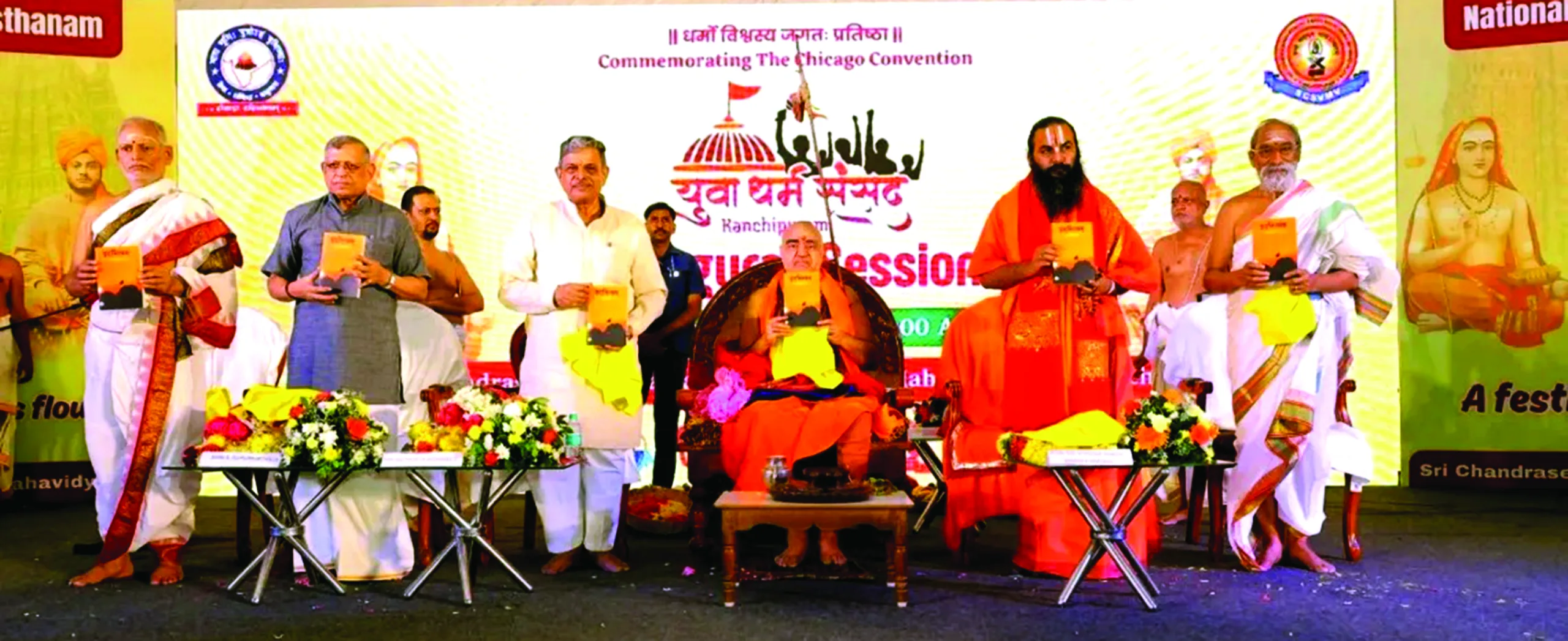
“It is not correct to consider ‘Religion’ as ‘Dharma’. Religion can be a part of Dharma, but in its true essence, Dharma is duty, rule, law, Dharma is character. In short, Dharma is a treasure of virtues. Dharma is not just about rituals and worship. Bharat is a Dharmabhoomi. Bharat has developed the concept of Dharma that exists in the world in an extraordinary way through ages,” said Rashtriya Swayamsevak Sangh (RSS) Sarkaryavah Dattatreya Hosabale at the 5th ‘Yuva Dharma Sansad’ of National Initiative of Sevagya Sansthanam at Kanchi Vishva Vidyalaya, Kanchipuram, Tamil Nadu on September 12.
Dattatreya Hosabale said that human birth is rare, the presence of humanity, and the desire for liberation (Moksha) within oneself is also rare. Within man, there is a conflict, a duality of sin and virtue, of pleasure and Dharma, of what to do and what not to do. Because of this, man is trapped in the tension between indulgence and character-building. When the whole humanity is experiencing conflicts and crises, Bharat, as a civilisation, culture, and nation, stands before the world capable of giving an answer.
“Today, in the prevailing global situation of conflict between nature and between nations, Bharat can provide morality because Bharatiya society has the power to harmonise philosophy, democracy, and religion”
Referring to Maharshi Aurobindo’s vision of Bharat rising as a beacon of light, Dattatreya Hosabale said, “Bharat will rise, but not to crush others, not to enslave others through oppression, but to dispel the darkness of the world, to rise as a lighthouse”.
“Life cannot run without Artha and work, but it is Dharma that puts limits on both. Therefore, the role of Dharma is to establish balance. Dharma nurtures the world, creation, and the universe. Dharma raises up a declining life and restores it. Dharma is most needed when the world stands confused about what ought to be done. Bharat has the civilisation with a continuous practice of living life on the basis of Dharma. The challenge of preparing Bharat to nourish and balance the world lies before the youth of Bharat. We have the knowledge, the civilisation, culture, and tradition, yet we are not in a position to carry it. This is because, in the past 75 years, efforts have been made to keep Dharma away from our lives through education system. In public life, Dharma was shown as a stigma. We have committed this injustice against Dharma in independent Bharat. To build a Dharma-based society, ‘Yuva Dharma Sansad’ is moving ahead with the goal of man-making on the foundation of Dharma,” he said.
He also referred to Bal Gangadhar Tilak and said, Tilak was a great writer, an intellectual thought leader. He taught at a Belgium university for 30 years. Afterwards, he began studying Bharat’s spirituality, and Dharmik scriptures. In a programme at Bangalore University campus, he said that for 30 years he considered leftist thought, secularism, and communist ideology as the only truth, but when he came in contact with the knowledge of Bharat, and tried to understand the Vedas and Upanishads, he realised that Bharat can make a huge contribution to the world. The concept of Dharma in Bharat is supreme.
Narrating an anecdote, he said that Jean Pierre once said—The concept of Dharma is the greatest contribution to humanity from Bharat. “Today, in the prevailing global situation of conflict between nature and between nations, Bharat can provide morality because Bharatiya society has the power to harmonise philosophy, democracy, and religion,” he said.
The Chinese ambassador to America, Hu-Si, once said, “Without sending a single soldier, Bharat established its spiritual supremacy in the minds of the Chinese people for 2,000 years. Bharat’s past is extraordinary. Bharat’s history is inspiring. We are heirs of the knowledge that has come from this land.”
“Speaking grandly about the nation does not make the nation great. For it, one must set an example, one must study, and work hard. In the desire for success and achievement, we must not lose our way. Today, Bharat has to be made Dharma-based. This is the need of the hour, and we must prepare for it. A Dharma-based society is capable and competent to give answers to every question of life. Therefore, amid all the crises, challenges, and conflicts of the world, we must resolve to establish a lighthouse of Dharma on the foundation of spirituality,” he said.
On day two, a session on ‘Vedic Tradition & the Ecological Vision of Mother Earth’ highlighted how Vedic wisdom teaches us to revere, not exploit, nature. From Bhagwan Krishna’s message of Gau raksha to deities symbolising forests, rivers, and creatures as divine companions, Sanatan values guide us towards true environmental harmony. The session also highlighted that Bharat, despite centuries of invasions, preserved its spiritual core, and that the youth must carry forward this legacy as torchbearers of a sustainable and Dharmic future.
Another session on ‘Mutual Harmony, Commitment & Familial Social Ethics’ reflected that true strength lies in preserving relationships through sacrifice, patience, and unity — values that shape both family and nation.
The Yuva Dharma Sansad witnessed the august presence of Pujya Shankaracharya Swami Vijayendra Saraswati of Kanchipuram, Mahant Acharya Mithileshanandini Sharan Maharaj of Shri Hanumat Nivas Ayodhya, Prof V Kutumba Shastri (former Vice-Chancellor of Central Sanskrit University Delhi and Sampurnanand Sanskrit University Varanasi), eminent thinker and economist S Gurumurthy, and renowned poet Dr Kumar Vishwas, along with 1,400 youth delegates from 18 states of Bharat.










Comments