





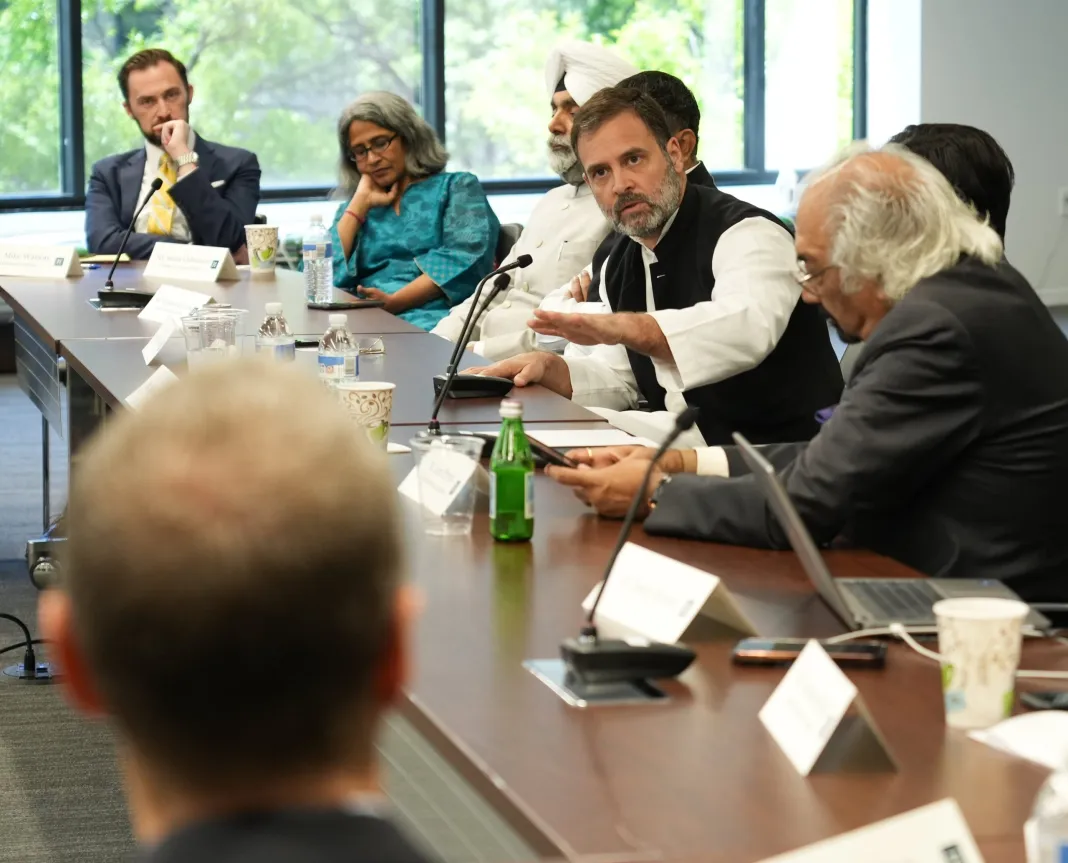
In the ever-fluid world of political optics and international diplomacy, even seemingly casual encounters can pull back the curtain on larger games being played. The latest revelation about Congress leader Rahul Gandhi’s 2023 U.S. tour has reignited debate over foreign influence in Indian politics. A video clip featuring Indian-American scholar Prof. Muqtedar Khan and Pakistani commentator Dr Qamar Cheema has revealed that none other than Qatar’s ambassador to the U.S. had arranged Gandhi’s closed-door seminar at Washington’s Hudson Institute, an event already dogged by controversial associations and foreign-backed activism.
The revelation that sparked the storm
The controversy began with what seemed like an offhand recollection. Professor Muqtedar Khan, in a discussion with Pakistani analyst Dr. Qamar Cheema, recounted how he was denied entry to the Hudson Institute in Washington during Rahul Gandhi’s visit in 2023. The institute was shut to outsiders for a private seminar featuring the Congress leader.
While waiting, Khan encountered another man trying to gain entry. That man turned out to be Sheikh Meshaal bin Hamad Al-Thani, Qatar’s ambassador to the United States. According to Khan, the diplomat openly stated that he had personally organised Gandhi’s event at Hudson.
For observers of Indian politics, this detail was explosive. Why was a senior Qatari envoy, representing a Gulf monarchy long accused of sheltering Islamist outfits and backing extremist movements, facilitating a platform for India’s top opposition figure?
The Hudson Event: Gathering of controversial voices
Photographs from the Hudson Institute seminar showed Rahul Gandhi seated alongside Sunita Viswanath, co-founder of the Washington-based outfit Hindus for Human Rights (HfHR). Far from being a neutral civil society voice, HfHR has been repeatedly linked to George Soros’s Open Society Foundations and to Islamist advocacy networks such as the Indian American Muslim Council (IAMC).
Viswanath herself has courted controversy with her commentary. In a Janmashtami article for The Wire, she likened the plight of Palestinians in Gaza to Hindu epics, even comparing Israel to Kansa, a statement widely condemned as a distortion of Hindu texts to justify Islamist violence. HfHR has endorsed the infamous “Dismantling Global Hindutva” conference, hosted events equating Hindu identity with “supremacy,” and campaigned aggressively against India’s CAA and NRC laws.
That Rahul Gandhi shared a platform with Viswanath was no accident. His own speeches at Hudson closely mirrored the rhetoric of HfHR and IAMC: sharp criticism of the Modi government, a deliberate attempt to separate “Hindutva” from “Hinduism,” and a portrayal of the BJP as authoritarian and divisive.
The Soros connection
These overlaps point to a carefully coordinated strategy. Soros-backed organisations have long supported groups like HfHR and IAMC, both of which echo narratives hostile to India’s nationalist politics. During Gandhi’s Hudson appearance, his talking points, from demonising Hindutva to raising alarms on the CAA, matched those of Soros-funded advocacy platforms.
The irony is striking. Soros has publicly declared his intent to “weaken nationalist governments,” and his foundations have been accused of bankrolling activism targeting India’s internal policies. For Rahul Gandhi, a leader of a national party, to be aligned with such actors raises troubling questions about intent and allegiance.
Qatar’s troubling role
The revelation of Qatari involvement deepens the unease. Qatar, while a U.S. ally, has been repeatedly accused of funding Islamist groups, including Hamas, which many countries designate as a terrorist organisation. Hosting Rahul Gandhi at Hudson Institute wasn’t a routine act of diplomacy; it was an overt move by a controversial Gulf power to provide a stage for India’s opposition leader.
Gandhi’s U.S. visit was not merely about engaging with the diaspora but was underpinned by a coordinated push involving foreign funding networks, Islamist lobbies, and diplomatic players with agendas that could undermine India’s interests.
The secret White House visit
Adding further intrigue, journalist Seema Sirohi reported in The Economic Times that Gandhi quietly visited the White House during his 2023 trip, a meeting absent from official briefings by the Indian side. The lack of transparency about who Gandhi met and what was discussed has fueled speculation about backchannel lobbying and political manoeuvring.
Why would India’s opposition leader, without any official mandate, hold undisclosed meetings at the White House? For a politician already accused of seeking foreign validation, this revelation was damning.
Familiar patterns of seeking foreign validation
The 2023 Hudson episode fits into a larger pattern in Rahul Gandhi’s political career. In Cambridge, he claimed Indian democracy was “under threat” and urged Western nations to intervene. At Harvard, he openly asked U.S. officials to speak up on Indian affairs. In 2018, his secret meetings with Chinese officials during a Kailash Mansarovar trip triggered diplomatic alarm.
Time and again, Gandhi has looked outward for validation, an approach many argue undermines India’s sovereignty.
The shadow of Khalistani and Islamist lobbies
Gandhi’s 2023 tour was also marked by the presence of Khalistani, Kashmiri separatist, and Pakistani-linked lobbyists at his events. Indian diaspora leaders flagged concerns that such associations not only harm India’s global image but may also feed into electoral meddling back home.
This is not paranoia. Groups like IAMC have repeatedly lobbied against India at international forums such as the USCIRF, while Khalistani outfits continue to spread propaganda about “Hindutva fascism” to delegitimise India’s democracy. Gandhi’s alignment with these voices, whether intentional or not, lent them credibility.
A coordinated strategy at play?
Put together, the pieces suggest something larger than just a speaking tour. Qatar’s ambassador arranging closed-door seminars, Soros-linked activists shaping the stage, and Gandhi parroting their talking points point toward a coordinated campaign.
The objective? To reframe India’s image globally ahead of elections, weaken its nationalist leadership, and seed narratives of authoritarianism and communalism. For the Congress party, desperate to reclaim relevance, this strategy may have seemed appealing. But for India, it raises alarms about foreign interference in domestic politics.
Why it matters for India’s democracy
Supporters of Gandhi may dismiss these concerns as political noise. But the stakes are higher. When opposition leaders align with foreign lobbies, sit alongside activists known for anti-Hindu propaganda, and rely on diplomats from controversial states to arrange platforms, questions of accountability arise.
In a rising India, one asserting itself on the world stage, the credibility of its leaders matters. Every move abroad carries consequences. By entangling with Soros-backed activists and Islamist-linked groups, Rahul Gandhi may have not only undermined his own credibility but also risked India’s sovereignty in pursuit of political mileage.
Transparency or more shadows?
The viral Khan-Cheema video has peeled back yet another layer of Rahul Gandhi’s controversial 2023 U.S. trip. Far from being a routine engagement, the tour appears to have been choreographed with the help of foreign players with agendas at odds with India’s interests.
Until Congress and Gandhi himself offer clarity, doubts will linger: Was this simply diaspora outreach, or a larger, more insidious attempt to outsource opposition politics to foreign hands?
In politics, optics matter. In this case, the optics point not toward statesmanship but toward susceptibility to foreign manipulation, a dangerous precedent for India’s democracy.











Comments