





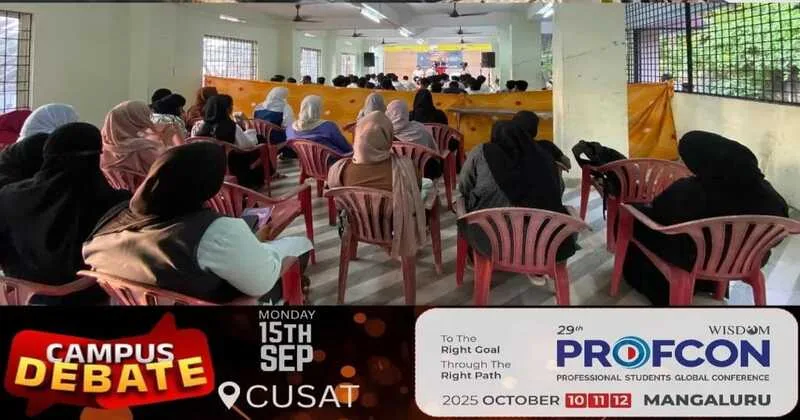
A program organised by a Muslim fundamentalist group at the Cochin University of Science and Technology (CUSAT) has triggered controversy in Kerala, a state long celebrated for its progressive credentials and near-total literacy. The event, held under the banner of the ‘Wisdom Islamic Organization’, affiliated with the Islamic fundamentalist ‘Mujahid movement’, has come under sharp criticism after photographs emerged showing strict gender segregation resembling Taliban-style restrictions.
The program was presented as a campus debate on the theme ‘Religion, Science and Morality.’ However, pictures from the venue reveal a striking arrangement, boys were seated in the front rows facing the stage, while girls were made to sit behind them, obscured by a curtain. This arrangement prevented male and female students from seeing each other during the discussion.
The symbolism goes beyond a simple debate setup. It evokes the restrictive codes enforced by the Taliban in Afghanistan, where women are denied public visibility and segregated from men under rigid religious edicts. Since returning to power in 2021, the Taliban has imposed sweeping curbs on women’s rights, banning them from schools beyond sixth grade, prohibiting higher education, shutting them out of most workplaces, and enforcing full-body coverings in public. Even cultural and recreational spaces such as parks, gyms, and beauty salons have been closed to women. The pictures from (CUSAT) mirror this climate of invisibilisation, raising concerns about creeping fundamentalism in a state that prides itself on social progress.
CUSAT again in controversy as alumni honours Pakistan cricketer Afridi
This is not the first time that the Cochin University of Science and Technology has come under the spotlight for radical activities. On May 25, 2025, the Cochin University BTech Alumni Association, UAE (CUBAA-UAE) organised its cultural programme Ormachivadukal Season 2 at the Pakistan Association Hall (PAD), Dubai. The event, meant as an inter-collegiate dance competition, drew controversy when former Pakistan cricketers Shahid Afridi and Umar Gul appeared on stage, with Afridi receiving a grand welcome from the crowd chanting “Boom Boom.” Afridi, notorious for his repeated anti-India remarks including on Kashmir, was honoured at the programme, sparking outrage because the event was held shortly after the Pahalgam terror attack of April 11 and India’s military response under Operation Sindoor on May 7. CUBAA-UAE later issued a clarification claiming Afridi’s presence was “unannounced and unsolicited” and not part of the official schedule, though records show the venue had been booked earlier on April 5. The matter escalated further when the ABVP filed complaints, including with the NIA, demanding a probe into the organisers and seeking strict action such as the cancellation of passports of CUBAA-UAE office-bearers.
Kerala has historically projected itself as a model of literacy, social equality, and gender advancement. Yet, the incident has sparked alarm over how Islamic extremist practices can find space within state-run educational institutions. Allowing such events under official approval normalizes regressive ideas that undermine democratic values and women’s rights. Campuses in Kerala are increasingly coming under the grip of Islamic fundamentalist groups, often with tacit tolerance from the ruling CPI(M) government led by Chief Minister Pinarayi Vijayan, SFI and opposition congress. The Left, which traditionally projected itself as the guardian of secular and progressive politics, is now being accused of turning a blind eye to Islamist organisations that exploit student spaces to spread regressive ideas. The cover of debates and moral discussions, these groups are embedding radical worldviews that undermine Kerala’s democratic ethos.
Meanwhile, the Akhil Bharatiya Vidyarthi Parishad (ABVP) has filed a formal complaint with the CUSAT Vice Chancellor. The student organization demanded a probe into how permission was granted for the event and urged immediate action against those responsible. “It is dangerous for such programs that inject communal venom into students to be held inside government campuses. If action is delayed, we will move forward with strong protests,” said ABVP State Joint Secretary R. Aswathy.
















Comments