





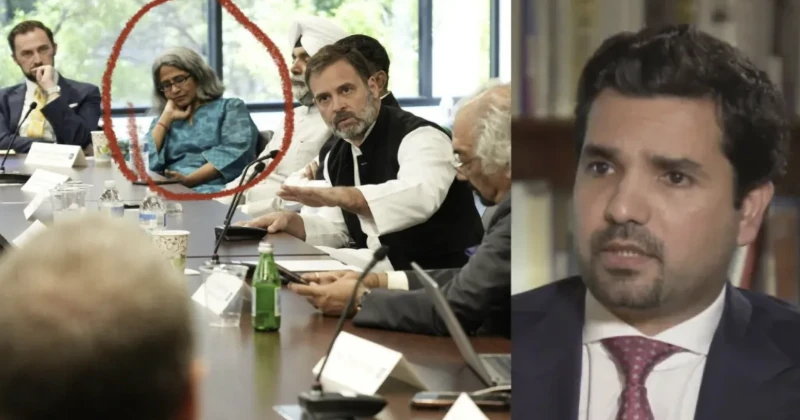
A recent conversation between Indian-American academic Professor Muqtedar Khan and Pakistani commentator Dr Qamar Cheema has ignited debate in India, exposing a critical layer of Rahul Gandhi’s 2023 United States tour. The disclosure is staggering: the Hudson Institute event where Gandhi spoke was not a neutral intellectual forum but was facilitated by Sheikh Meshaal bin Hamad Al-Thani, Ambassador of Qatar to the US.
Professor Khan, narrating his experience, said he was denied entry at the Hudson Institute gates until he was escorted inside alongside another individual. That individual introduced himself as Sheikh Meshaal bin Hamad Al-Thani, Qatar’s envoy in Washington. More striking than the encounter was Al-Thani’s casual admission that he had arranged Rahul Gandhi’s seminar at the think tank.
This revelation transforms the Hudson event from an academic discussion into a politically loaded exercise. For an opposition leader of India to participate in a closed-door seminar facilitated by a foreign ambassador from a state repeatedly accused of funding Islamist causes raises serious questions of influence, loyalty, and intent.
Photographs from the Hudson Institute event revealed Rahul Gandhi sharing the stage with Sunita Viswanath, co-founder of Hindus for Human Rights (HfHR). This organisation, formed in 2019 with the support of Indian American Muslim Council (IAMC) and OFMI, operates at the intersection of Soros-backed foundations and Islamist advocacy groups. Its public record demonstrates a consistent pattern of attacking Hindu identity while aligning with radical Islamist narratives.
Sunita Viswanath’s activities underline this agenda. She penned a controversial article on Janmashtami where she distorted Hindu epics to justify sympathy for Hamas, comparing the conflict in Gaza to the trials of the Pandavas and portraying Israel as Kansa. Her organisation HfHR co-hosted an event at Berkeley titled “Zionism and Hindu Supremacy: Partners Against Pluralism,” equating Hindu identity with supremacy and pairing it with anti-Israel rhetoric. HfHR supported the “Dismantling Global Hindutva” conference, promoted disinformation about CAA and NRC during the Delhi riots of 2020, and even released a “toolkit” to malign India during PM Modi’s 2023 visit to the US.
Social media platform X has already restricted HfHR’s account in India for violating national law with anti-Hindu propaganda. For Rahul Gandhi to sit alongside Viswanath and echo her divisive talking points was not coincidence. It reflected a coordinated alignment of interests against India’s civilisational and democratic ethos.
The Indian American Muslim Council has long operated as a lobbying arm against India, working with platforms like the US Commission on International Religious Freedom to portray India as a violator of minority rights. Its links to Jamaat-e-Islami, an organisation with a violent past in South Asia, deepen the suspicion. Reports by OSINT group DisinfoLab traced the creation of HfHR to IAMC and OFMI, both tied to Islamist influence networks.
Qatar’s involvement raises the stakes further. Qatar hosts the political office of Hamas, provides ideological and financial support to Muslim Brotherhood-linked movements, and uses media platforms like Al Jazeera for global influence operations. For the Qatari envoy to host India’s opposition leader at a premier American think tank underscores not just hospitality but strategic intent. Qatar’s move must be read against the backdrop of its geopolitical tussle with India’s Gulf partners like Saudi Arabia and UAE, both of whom share closer ties with New Delhi.
Adding to the controversy was Rahul Gandhi’s covert visit to the White House during the same tour, as reported by journalist Seema Sirohi in The Economic Times. The visit was not announced, nor coordinated through India’s Ministry of External Affairs. The secrecy triggered speculation: who did Gandhi meet, and what subjects were discussed? For an opposition leader to hold undisclosed meetings with officials of a foreign government without transparency sets off alarms about backroom assurances and foreign policy interference.
Diaspora commentators like Sunanda Vashisht highlighted the absence of clarity, while groups such as HinduACTion pointed to the involvement of Pakistan-backed proxies, Khalistani organisations, and Kashmiri Islamist networks in amplifying the tour. For entrepreneurs and activists in the diaspora, the event evoked fears of foreign meddling in India’s 2024 elections.
Rahul Gandhi’s history demonstrates a troubling consistency. At Cambridge in 2023, he urged Western nations to intervene in India’s internal matters to “restore democracy.” In a Harvard Kennedy School interaction in 2021, he pressed Nicholas Burns, now US Ambassador to China, for American commentary on Indian domestic politics. After the Doklam standoff, he admitted to secret meetings with Chinese ministers. During Bharat Jodo Yatra in 2022, his march welcomed Salil Shetty, former secretary-general of Amnesty International and an associate of Soros’s Open Society Foundations.
Each of these incidents adds weight to the concern that Gandhi does not hesitate to court foreign players to challenge India’s elected government, even at the cost of national sovereignty.
The Hudson Institute episode must therefore be seen as part of a larger pattern. Qatar offered diplomatic facilitation. Soros-funded networks like Open Society provided financial and ideological cover. Islamist advocacy outfits amplified the anti-India message. The convergence of these forces around Gandhi in Washington DC was not accidental but orchestrated.
Their agendas intersect at critical points: delegitimising Hindutva, opposing Indian security laws like CAA and NRC, undermining India’s economic institutions such as the Adani Group, and weakening India’s global diplomatic standing. In aligning with these actors, Gandhi effectively provided the face of India’s opposition to forces hostile to Indian sovereignty.
India, rising as a global counterweight to China and a key partner for the US and Gulf states, cannot afford ambiguity on such matters. A foreign state like Qatar using its diplomatic office to host a leader of India’s opposition party is more than unusual—it is a breach of norms that borders on interference. When combined with Soros-backed lobbies and Islamist outfits, the incident transforms into a potential threat to India’s democratic integrity.














Comments