





In less than half a year since it received formal approval, Dhar in Madhya Pradesh has raced ahead of other states to become the frontrunner among India’s seven PM Mega Integrated Textile Region and Apparel (PM MITRA) Parks. The project, backed by an outlay of Rs 2,100 crore, is being executed at an unprecedented pace by the Mohan Yadav-led Bharatiya Janata Party (BJP) government, which launched a new textile policy in February 2025 and began extensive outreach to global and domestic investors almost immediately.
Chief Minister Mohan Yadav personally spearheaded this mission. He traveled abroad to the United Arab Emirates, Spain, and Japan, while also touring India’s major textile hubs such as Ludhiana, Surat, and Bhopal. The result was a steady flow of investment commitments even before the physical groundwork of the project began.
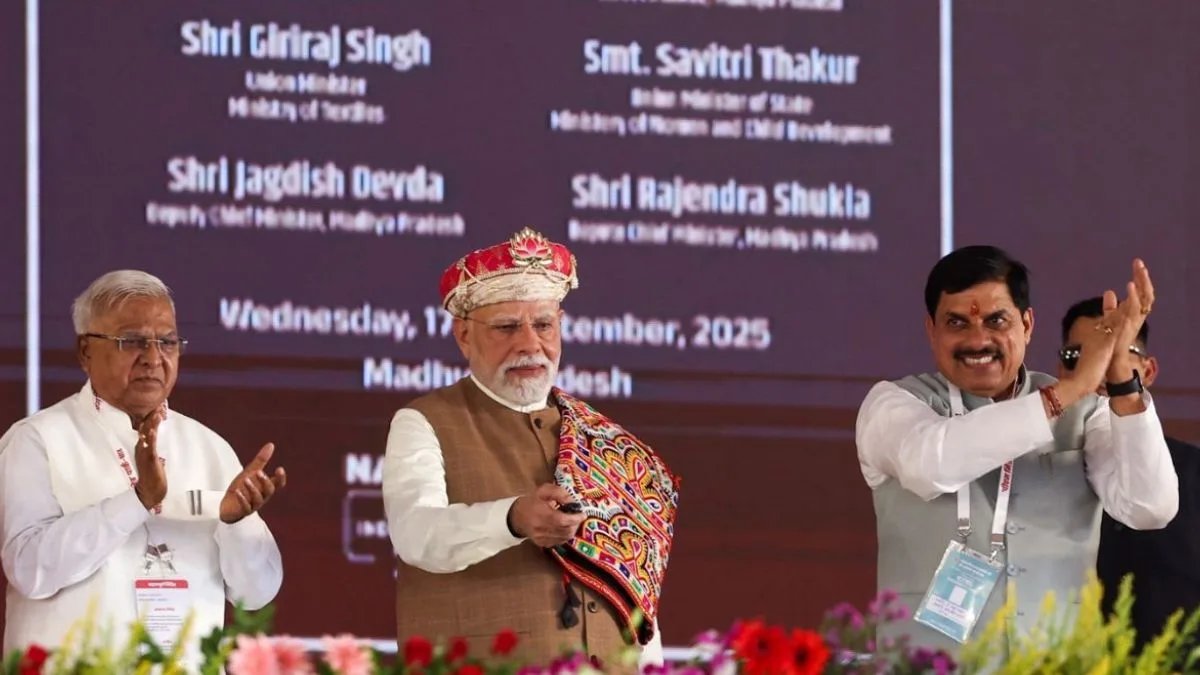
An official closely associated with the project was quoted in a media report saying that “CM Yadav is personally driving its fast-track execution, determined to ensure that India’s largest PM MITRA Park also becomes its finest, an international benchmark for integrated excellence in textiles.” This proactive leadership has placed Dhar ahead of all other PM MITRA projects across the country. The park became the first among the seven approved sites to reach the foundation stage, with Prime Minister Narendra Modi himself laying the foundation stone on September 17, 2025, coinciding with his birthday.
Understanding the PM MITRA Park scheme
The PM MITRA Park scheme was launched by the Union Government in 2021 with a budgetary allocation of Rs 4,445 crore spread over seven years until 2027-28. Its objective was to create globally competitive, integrated hubs that would bring together every aspect of the textile and apparel value chain.
The concept stemmed from the recognition that India’s textile sector, though rich in raw material and manpower, was losing ground to competing economies that had already developed large-scale industrial clusters. By clustering spinning, weaving, processing, garmenting, and exports within one location, the scheme seeks to cut logistics costs, achieve economies of scale, and attract high-value investments.
Each park is envisioned to generate one lakh direct jobs and two lakh indirect jobs, while attracting a minimum investment of Rs 10,000 crore. Dhar has already outstripped this expectation, with proposals worth Rs 14,600 crore on the table within months of approval.
A senior official explained in a media interaction that unlike traditional industrial estates that provide only basic land parcels and utilities, PM MITRA parks are designed as self-sufficient industrial ecosystems. They not only cluster the entire textile chain but also provide township-like facilities with residential complexes, hostels for working women, medical care, and child-care centers. This integrated approach, the official stressed, would reduce costs, improve productivity, and provide a model for global investors.
Why Dhar was chosen
When the Union Government invited state proposals, Madhya Pradesh pitched four sites: Ratlam, Dewas, Dhar, and Katni. Out of these, Dhar was selected because of its strategic location and resource advantages.
Dhar is located at the confluence of the Indore Metropolitan Region, which is already an industrial and logistics hub, and the Malwa cotton belt, which is among the most fertile cotton-growing areas of the country. A consultant involved with the project was quoted in a media report as saying that “Dhar offers both the supply of raw material and seamless integration with advanced industrial ecosystems, making it the ideal choice.”
The state’s cotton output also played a decisive role. Madhya Pradesh produces around 31,700 metric tons of cotton annually, and the region accounts for 43 percent of India’s organic cotton and nearly 24 percent of the global supply. Districts like Khargone, Barwani, Khandwa, Burhanpur, and Dhar form the backbone of this production. Alongside cotton, the state also produces about 200 metric tons of silk, including mulberry silk, further strengthening its textile potential.
Dhar also distinguished itself in terms of size. The proposed park spans 2,158 acres in Bhainsola village of Badnawar tehsil, which is more than twice the required minimum. Its proximity to Indore (110 km), the Pithampur industrial hub (85 km), and the Delhi-Mumbai Expressway (50 km) adds to its logistical edge. The nearest port, Hazira in Gujarat, is just 452 km away, ensuring export-friendly connectivity.
World-class offerings and cost advantage
The Dhar PM MITRA Park promises to deliver some of the most advanced infrastructure facilities ever seen in the Indian textile sector. It will host more than 200 industrial plots supported by world-class trunk infrastructure. The park will feature 81 plug-and-play factory units, a 60-metre-wide approach road, underground cabling, logistics and warehousing hubs, and IoT-enabled monitoring systems.
It will also house a Common Effluent Treatment Plant (CETP) for sustainable waste management, a solar power plant, and centralised utilities such as boilers and steam systems. In addition, the park is designed with community facilities like residential towers, hostels, hospitals, and childcare centers to create a complete live-work environment.
What has particularly attracted investors are the highly competitive tariffs finalised by the state government. Land is being offered at just Rs 1 per square metre, development charges have been fixed at Rs 120 per square foot, electricity is priced at Rs 4.50 per unit, and water at Rs 25 per kilolitre. These incentives are being projected as among the most cost-effective anywhere in the country.
Groundwork and implementation
The Dhar PM MITRA Park is being developed through a Special Purpose Vehicle (SPV), with the Madhya Pradesh Industrial Development Corporation (MPIDC) acting as the nodal agency.
On the ground, construction has already begun with site levelling, the building of a grand park gate, and the development of a six-lane approach road from State Highway 18. A 220 KV power transmission line and a dedicated 20 MLD water supply scheme are also under execution.
Officials associated with the project have said that the first signs of industrial activity should be visible by 2026, while the full-scale township and industrial ecosystem will take about two to three years to be operational. Industries are expected to begin plant construction in parallel with site development, potentially shortening the turnaround time.
The policy push
The groundwork for this speed was laid by the state’s New Textile Policy 2025, announced even before the Union Government’s approval for Dhar. The policy includes financial incentives such as Investment Promotion Assistance ranging from 10 to 40 percent on machinery, interest subsidies of 5 to 7 percent on loans for five years, and up to Rs 1 crore support for infrastructure development.
It also has provisions for green industrialisation, offering up to Rs 1 crore for waste management systems, a 100 percent refund of patent fees up to Rs 5 lakh, and financial support of up to Rs 50 lakh for apparel training institutes.
Praising the policy, Madhya Pradesh’s Principal Secretary of Revenue, Vivek Porwal, said in a media interaction that “MP is the first state in the country where the return on investment in the textile sector is the highest.”
Global and domestic investor outreach
CM Yadav’s proactive outreach has been one of the biggest drivers of Dhar’s success. In January 2025, during his visit to Japan, he met the Chairman of Uniqlo, Japan’s largest apparel brand, to discuss cotton farming and textile production opportunities in India.
The following month, at the Global Investors Summit in Indore, the textile and apparel sector was given a prominent place. Companies such as Arvind Group, Aditya Birla Fashion, and OBT Pvt Ltd participated actively in discussions.
In subsequent months, Yadav visited Surat and Ludhiana to engage with Vardhman Textiles and Trident Group, met TEXMAS officials in Dubai, and held talks with the Inditex leadership team in Spain, the parent company of global fashion giant Zara. In Barcelona, he also chaired a roundtable with European textile machinery manufacturers.
His domestic push culminated in a Roundtable Meet in Bhopal, attended by sourcing heads of 15 global textile brands. Several MoUs were signed at the event. Later, an interactive session in New Delhi fetched investment proposals worth Rs 12,508 crore from 15 companies, including Trident (Rs 4,500 crore), A B Cotspin (Rs 1,300 crore), Arvind Mills (Rs 1,024 crore), Sanathan Textiles (Rs 1,000 crore), Best Corporation Tirupur (Rs 832 crore), Sharmanji Yarns (Rs 800 crore), RSVPM (LNJ Bhilwara) (Rs 700 crore), and R R Jain Industries (Rs 550 crore).
Yadav assured that these projects would generate more than 18,000 jobs, giving a major employment boost to the region.
What it means for Madhya Pradesh
Madhya Pradesh currently contributes only 4 percent to India’s textile exports. Officials believe that with Dhar’s PM MITRA Park, this figure could rise significantly. The state government is working with associations like the Indian Cotton Federation, Tirupur Exporters Association, TEXMAS in Dubai, and FIEO to integrate MP more deeply into the global textile supply chain.
An official explained in a media report that “By bringing spinning, weaving, processing, garmenting, and technical textiles to one location, the park will slash logistics costs and make Madhya Pradesh’s textile products far more competitive in global markets.”
Comparing progress with other states
The Dhar park has become the benchmark for other PM MITRA projects. While some progress has been reported in Navsari, Gujarat and Amravati, Maharashtra, most other parks remain in the preliminary or planning stage. Gujarat has received investment proposals worth Rs 2,845 crore, while Maharashtra has awarded tenders worth Rs 229 crore for infrastructure.
The Lucknow-Hardoi park in Uttar Pradesh is still preparing its detailed project report, having received just Rs 700 crore in investment commitments. The Kalaburagi park in Karnataka is awaiting environmental clearance. The Warangal park in Telangana, being a brownfield site, has moved relatively faster, attracting proposals worth Rs 3,862 crore. Tamil Nadu’s Virudhunagar park was only recently approved and is yet to begin groundwork.
Although still at an early stage, Dhar’s rapid progress has set it apart as the flagship PM MITRA Park of India. With strong political backing, aggressive investor outreach, and a clear policy framework, Madhya Pradesh has positioned itself to move from being a major cotton producer to a global textile manufacturing hub.










Comments