





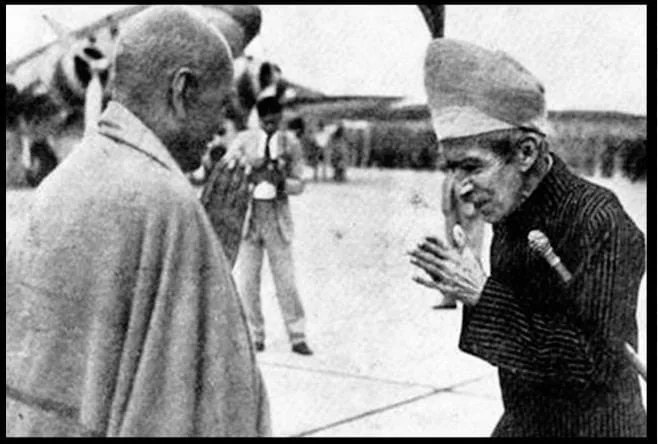
In the tumultuous years following India’s independence in 1947, the challenge of unifying more than 500 princely states into one nation loomed large. While most states signed the Instrument of Accession and merged peacefully into the Union, one state stood out as the most stubborn, complex, and dangerous obstacle, Hyderabad. Situated in the heart of peninsular India, larger than several European nations and nearly as expansive as Australia, Hyderabad was ruled by the fabulously wealthy Nizam Osman Ali Khan.
But behind the glitter of the Nizam’s court lay a grim reality. As he resisted joining the Indian Union, his rule became increasingly dependent on the Razakars, a fanatical Islamist militia. These forces unleashed a reign of terror upon Hyderabad’s Hindu majority, looting villages, enforcing conversions, abducting women, and silencing anyone who showed sympathy towards India. Contemporary reports described how entire communities lived in fear of nightly raids, with Hindus forced to either flee their homes or face brutal reprisals. What the Nizam projected as sovereignty was, in fact, propped up by this organised campaign of intimidation and violence.
The Nizam’s refusal to accede, coupled with the escalating Islamist violence, created a crisis that tested the nerves of India’s leadership. It was Sardar Vallabhbhai Patel, the Iron Man of India, whose resolve and foresight turned the tide. Operation Polo, a five-day military action in September 1948, not only crushed the Razakars’ terror but also secured Hyderabad and safeguarded the unity and stability of a fragile new nation.
The princely states dilemma
When the British left India, they granted princely states the option to accede to India, accede to Pakistan, or remain independent. Sardar Patel, then Deputy Prime Minister and Home Minister, with V.P. Menon as his key aide, launched an intensive diplomatic mission to integrate these states. Through persuasion, tact, and at times pressure, Patel succeeded in bringing over 500 states into the fold. Yet, Hyderabad, because of its geography and its ruler’s ambitions, was unlike any other.
The Nizam of Hyderabad, a Muslim ruler presiding over a Hindu-majority population, dreamed of remaining independent, if not aligning with Pakistan. He styled himself as a sovereign monarch, issuing his own currency and maintaining a private army. For India, this was unacceptable. Hyderabad sat in the Deccan plateau, cutting across the Indian landmass. If left independent, it would have created a dangerous hole in the map, encouraging separatism and jeopardising national unity.
Patel bluntly referred to Hyderabad as an “ulcer in the heart of India” that had to be surgically removed before it poisoned the body politic of the young republic.
The rise of the Razakars
The political dispute soon turned bloody. The Nizam, unwilling to compromise, placed his hopes on the Razakars, a private militia led by Qasim Rizvi, a hardline Islamist who openly declared that Hyderabad’s destiny was either independence under Islamic rule or merger with Pakistan. What began as a political standoff quickly turned into a campaign of terror. The Razakars, swelling in numbers to nearly two lakh men at their peak, armed themselves with modern weapons smuggled in through sympathetic networks and unleashed their fury on the Hindu-majority population that dared to assert loyalty to India.
Their slogan, “Hans ke liya hai Pakistan, lad ke lenge Hindustan”, summed up their ambition. They did not merely enforce loyalty to the Nizam, they sought to create an Islamic state within the heart of India, using fear as their primary weapon. Contemporary reports and eyewitness testimonies speak of entire villages being raided: Hindu men were tortured or killed, women abducted, and families coerced into converting under threat of violence. Shops and homes were looted in broad daylight, temples desecrated, and crops set ablaze to starve dissenting communities into submission.
The Razakars also targeted those who advocated integration with India, branding them as “traitors” and subjecting them to public humiliation, floggings, or executions. In districts like Osmanabad, Gulbarga, and Nanded, atrocities became routine, with villagers forced to pay “taxes” to Razakar bands just to live in their own homes. Their growing fanaticism and impunity created not just lawlessness but a humanitarian crisis of staggering proportions, drawing concern even from foreign observers.
For India, this was not merely a question of sovereignty but of saving millions of its citizens from relentless Islamist terror. Each passing week of Razakar violence reinforced the urgency for decisive intervention.
Patel’s patience runs out
Sardar Patel was not a man to rush into conflict. Initially, he tried the diplomatic route. Negotiations were held with the Nizam, mediated even by Lord Mountbatten, India’s last Viceroy, who had stayed on as the first Governor-General. The Indian government offered the Nizam autonomy within the Indian Union, assurances of cultural freedom, and respect for his titles. Yet, the Nizam vacillated, signing standstill agreements while secretly arming his forces and encouraging Razakar militancy.
Meanwhile, Prime Minister Jawaharlal Nehru was cautious, fearing that military action might provoke international criticism and invite intervention from Pakistan or the United Nations. Patel, however, was convinced that delay would only embolden the Nizam and deepen the Razakars’ grip. “A day’s delay,” Patel reportedly remarked, “will mean another thousand deaths of innocent people in Hyderabad.”
By mid-1948, Patel concluded that the time for diplomacy was over. He managed to get Nehru and the Cabinet to authorise military action. The operation was code-named Operation Polo, after Hyderabad’s famous polo grounds.
The lightning campaign
On September 13, 1948, the Indian Army launched its offensive. Commanded by Major General J.N. Chaudhary, Indian troops advanced rapidly from multiple directions, entering Hyderabad from the west, south, and east. The campaign was swift and well-coordinated.
The Razakars, despite their ferocity, were no match for a professional army. Within days, Indian troops captured key towns, including Bidar and Gulbarga. Secunderabad, the Nizam’s military stronghold, also fell quickly. The Hyderabad State Army, poorly equipped and lacking morale, crumbled under pressure.
By September 17, just five days after the operation began, the Nizam realised resistance was futile. He announced a ceasefire and broadcast a message accepting accession to India. Hyderabad’s fate was sealed. The Nizam was retained as a ceremonial Rajpramukh (governor) for a few years, but political power now lay firmly with the Indian Union.
Patel’s defining triumph
Operation Polo was not just a military victory, it was Patel’s political and strategic triumph. He demonstrated a rare combination of firmness, pragmatism, and foresight. Where Nehru hesitated, Patel acted decisively. He understood that the survival of India as one nation depended on closing the chapter of Hyderabad’s independence swiftly.
History shows that his action prevented a civil war-like situation in the Deccan. The Razakars’ atrocities would likely have escalated, destabilising the region further. Patel’s steely leadership ensured that India remained one cohesive entity, free from the danger of fragmentation.
Aftermath and controversy
In the aftermath of Operation Polo, there were reports of communal violence and reprisals. The “Sunderlal Committee Report,” commissioned by Nehru, documented excesses committed during and after the operation, particularly against sections of Hyderabad’s Muslim population. These remain a matter of historical debate. While acknowledging such episodes, many historians also stress that the violence must be seen in the context of Razakar aggression and the chaos of partition-era politics.
What remains undisputed is that Patel’s intervention ended the Razakars’ terror and secured Hyderabad’s integration, laying the foundation for modern Telangana, Marathwada, and parts of Karnataka to grow within a democratic India.
Turning point in nation-building
Operation Polo was one of the last major state integrations under Patel’s watch. Earlier, he had successfully convinced Junagadh, Travancore, and other reluctant rulers to merge with India. His achievement in bringing 565 princely states into the Union remains unparalleled in world history. No other leader of independent India displayed such a combination of firmness and clarity on the question of national unity.
Hyderabad’s integration also carried symbolic weight. The Nizam was one of the richest men in the world, his fortune legendary. Yet his political power collapsed in less than a week under the determination of a united Indian government. It sent a clear message to the world, that India would not tolerate secession, nor allow religious militias to dictate its destiny.
Remembering Patel’s legacy
September 17, 2025, marks the 77th anniversary of Operation Polo. To commemorate the occasion, the Union Ministry of Culture has announced the unveiling of a life-size AI-powered holobox of Sardar Vallabhbhai Patel at the Prime Minister’s Museum in Delhi. This hyper-realistic 3D avatar will allow visitors to interact with Patel’s likeness and revisit his contributions to nation-building.
This gesture is more than technological innovation; it is an acknowledgement that Patel’s vision continues to inspire. In today’s era, when questions of national unity, federalism, and regionalism often dominate public discourse, Patel’s resolve during the Hyderabad crisis stands as a reminder of what determined leadership can achieve.
Operation Polo was not merely a five-day “police action.” It was the culmination of months of tension, diplomacy, and political manoeuvring. Had Hyderabad remained independent or fallen into Pakistan’s orbit, the map of India today might have looked very different.
Sardar Vallabhbhai Patel, through his determination, foresight, and sheer grit, ensured that this did not happen. The Nizam bowed in five days, but Patel’s triumph endures forever. Operation Polo secured not just Hyderabad, it secured India’s unity.










Comments