





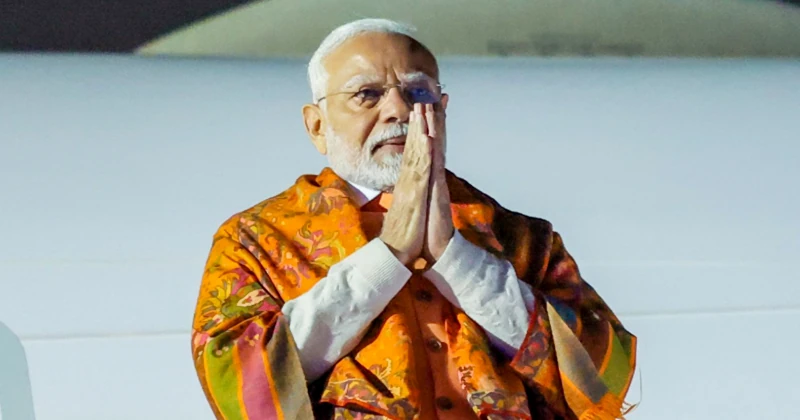
On September 17, Prime Minister Narendra Damodardas Modi will turn 75. For many, it is a moment of reflection not merely on the life of one individual but on the remarkable journey of a nation that has been reshaped under his leadership. From a humble childhood in Gujarat’s Vadnagar to three consecutive terms as Prime Minister of Bharat, PM Modi’s story is one of sacrifice, unshakable discipline, spiritual conviction, and an unyielding belief in the greatness of Bharat Mata.
Today, as he stands as one of the world’s most influential leaders, PM Modi continues to outpace his critics and adversaries with a work ethic and stamina that rivals leaders half his age. His life represents the fusion of spiritual grounding, nationalist philosophy, and pragmatic governance a combination that has catapulted Bharat into a new era of self-confidence and global prominence.
Born into a modest family, Narendra Modi’s early years were marked by hardship but also by aspiration. Vadnagar, his birthplace, was not just an ordinary town. Centuries earlier, it had thrived as a center of Buddhist learning and spiritual scholarship, where monks carried the message of Dharma across Asia. Growing up in this historic environment, PM Modi absorbed the values of discipline, service, and community.
Unlike most children his age, PM Modi’s interests leaned toward Swami Vivekananda’s writings rather than games. Vivekananda’s vision of Bharat as a Jagat Guru a nation leading the world in moral and spiritual wisdom inspired the young boy to see beyond the limitations of poverty and envision himself in the service of the nation.
This spiritual foundation would remain with him throughout his life, giving him the resilience to face criticism, hostility, and political storms without losing sight of his mission.
PM Modi’s initiation into the Rashtriya Swayamsevak Sangh (RSS) came through ‘Vakil Saheb’, who introduced him to an organization dedicated to Bharat’s cultural and social regeneration. Even though he never met M.S. Golwalkar (Guruji), staying in Guruji’s room at Hedgewar Bhawan profoundly impacted him.
At 17 years old, PM Modi made a radical choice he left home to travel across Bharat. For two years, he wandered the country, from the Himalayas to the southern tip, immersing himself in diverse cultures. The experience sharpened his understanding of Bharat’s unity in diversity and deepened his conviction that service to the motherland must be his life’s purpose.
Upon returning, he became a Pracharak in Ahmedabad in 1972, living a life of austerity and discipline. His daily routine waking at 4:30 a.m., attending shakhas, organizing cadres, and engaging in community work instilled in him an unyielding work ethic.
During the Emergency (1975–77), PM Modi worked underground to resist authoritarian rule and defend democracy. Later, under the mentorship of leaders like Balasaheb Deoras, Eknath Ranade, Rajju Bhaiya, Anantrao Kale, and K.K. Shastri, PM Modi imbibed values of consensus-building, karmayoga, and disciplined service.
From Shastri, he learned the art of working 18 hours a day without expectation of reward; from Ranade, he learned the importance of combining spirituality with nation-building; from Deendayal Upadhyaya, he drew the philosophy of Integral Humanism, which continues to guide his policies today.
Unlike many political leaders, PM Modi’s journey was not a pursuit of power but a renunciation of personal life. He chose to live as a Pracharak single, selfless, and dedicated solely to Bharat Mata. Known for his punctuality, meticulous reading habits, and ability to connect with people in their own language, PM Modi became a natural orator who could stir the masses.
His principle was clear: Pal Pal, Kan Kan for the nation. Every moment and every breath belonged to Bharat. This sense of mission over self became the cornerstone of his leadership.
By the late 1980s, PM Modi’s organizational skills caught the attention of the BJP leadership. As General Secretary of Gujarat BJP in 1987, he spearheaded the party’s first victory in Ahmedabad Municipal Corporation elections. In the 1990 Assembly elections, BJP emerged as a serious challenger to Congress under his strategy, and by 1995, the party swept Gujarat with 121 seats.
Appointed Chief Minister of Gujarat in 2001, PM Modi transformed the state into an economic powerhouse. His flagship initiative, Vibrant Gujarat, turned the state into an investment hub, showcasing his ability to merge governance with growth. Even in the face of severe criticism and challenges, PM Modi’s resilience and administrative acumen helped Gujarat emerge as a model of development.
When Modi became Prime Minister in 2014, he inherited a nation grappling with corruption scandals, economic slowdown, and waning global influence. His slogan of “Minimum Government, Maximum Governance” became the touchstone of his administration.
Over the next decade, PM Modi’s leadership would reshape Bharat:
- Poverty Alleviation: According to NITI Aayog, over 25 crore people have exited multidimensional poverty in just ten years under his policies.
- Healthcare Revolution: The Ayushman Bharat Yojana created the world’s largest government-funded healthcare program, covering 50 crore citizens.
- Women’s Empowerment: Initiatives like Ujjwala Yojana, Beti Bachao Beti Padhao, and Lakhpati Didi Yojana gave women financial, social, and cultural empowerment.
- National Integration: The abrogation of Article 370 ended J&K’s special status, integrating the region more closely with the Union.
- Global Recognition: PM Modi emerged as one of the most influential world leaders, ensuring Bharat’s voice resonated at global forums, from the G20 to the UN.
Equally significant has been his ability to withstand the “deep state forces” and entrenched lobbies that sought to destabilize his government. Despite hostile propaganda, PM Modi has consolidated power for three consecutive terms an achievement unmatched in recent Bharatiya political history.
Ten flagship campaigns that redefined Bharat
- Swachh Bharat Mission (2014) – Eliminated open defecation, built over 10 crore toilets.
- Pradhan Mantri Jan Dhan Yojana (2014) – Opened crores of bank accounts, ensured financial inclusion.
- Beti Bachao, Beti Padhao (2015) – Promoted education and dignity for the girl child.
- Namami Gange (2014) – Restored the Ganga, linked with sanitation and environmental sustainability.
- Pradhan Mantri Awas Yojana (2015) – Provided affordable housing, with priority to women and marginalized groups.
- Ayushman Bharat (2018) – Health cover up to Rs 5 lakh for crores of families.
- Pradhan Mantri Ujjwala Yojana (2016) – Over 9 crore LPG connections to poor households.
- Lakhpati Didi Yojana (2023) – Empowering rural women to earn Rs 1 lakh annually.
- Pradhan Mantri Matru Vandana Yojana – Direct support to pregnant and lactating mothers.
- Sukanya Samriddhi Yojana (2015) – Secure savings for girl children with tax benefits.
Each of these schemes reflects PM Modi’s philosophy targeted empowerment, mass participation, and holistic nation-building.
As Narendra Modi turns 75, he remains a karmayogi in action sleeping barely four hours a night, maintaining strict discipline, reading extensively, and engaging tirelessly with citizens. His life, built on sacrifice and determination, is a message to the youth: great nations are not built overnight, but by leaders who place duty above self.










Comments