





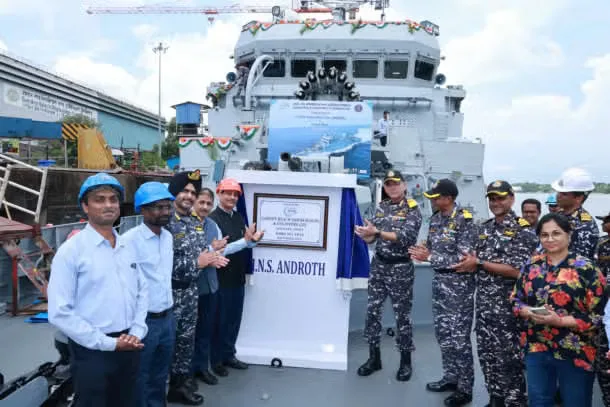
On September 13, the Indian Navy formally received ‘Androth,’ the second Anti-Submarine Warfare Shallow Water Craft built by GRSE in Kolkata. According to the Ministry of Defence, the vessel is part of a planned fleet of eight ships designed to boost the Navy’s capability in littoral warfare.
Built entirely in India and adhering to the Indian Register of Shipping’s (IRS) classification rules, the Androth showcases the success of indigenous naval design and construction. With over 80 per cent indigenous content, the vessel stands as a testament to India’s Atmanirbhar Bharat push in defence manufacturing.
Measuring about 77 metres in length, the ASW SWC class ships are the largest Indian naval warships to be powered by a Diesel Engine-Waterjet propulsion system. This enables high manoeuvrability and efficiency in shallow waters.
The Androth has been named after Androth Island in Lakshadweep, highlighting its role in securing India’s maritime boundaries. The vessel is designed for multi-role operations, including:
Anti-submarine warfare
Coastal surveillance
Mine-laying operations in littoral water.
The Androth is equipped with modern warfare technologies, including:
Lightweight indigenous torpedoes
Advanced anti-submarine rockets
Shallow water SONAR systems
These systems significantly strengthen the Navy’s ability to detect, track, and neutralise enemy submarines operating close to India’s coastlines.
With its induction, Androth is expected to enhance the Indian Navy’s operational readiness and provide a robust strategic deterrent in the Indian Ocean Region (IOR). Officials noted that such vessels will play a crucial role in countering undersea threats in the era of heightened regional maritime competition.
The delivery also underlines the Navy’s emphasis on self-reliance and reduced import dependence, as India steadily expands its domestic warship-building capabilities.










Comments