





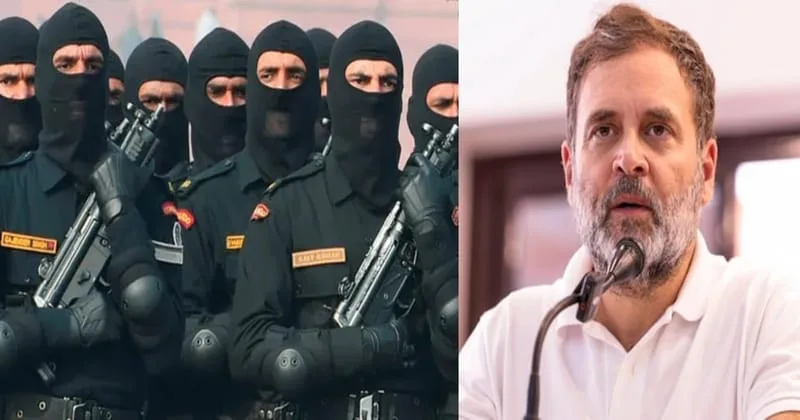
India’s internal security framework is built on layered protocols, with the highest being Z+ security, a level of protection reserved for individuals under the gravest threat. It is a privilege extended to only a handful of political leaders, high-profile figures, and individuals facing credible and ongoing risks from terrorism or other hostile actors. However, when those under such protection fail to comply with established guidelines, it doesn’t just compromise their own safety, it raises serious national security concerns.
🚨 What is Z+ Security Protocol, How it is being violated? Read in detail
Thread 🧵
Did you know that Z+ security is one of the highest levels of protection in India? It involves 55 personnel, including 10+ NSG "black cat commandos," CRPF personnel, and police officers. This… pic.twitter.com/BoXX9bytUg— GD Pai (@GD_Pai_blr) September 11, 2025
Recent developments have brought this issue into sharp focus, with Congress leader Rahul Gandhi reportedly violating multiple Z+ security protocols during international travel. These breaches have triggered serious warnings from the Central Reserve Police Force (CRPF), the nodal agency responsible for his VVIP protection. A letter dated September 10, 2025, from the CRPF’s top VVIP security officer to Congress President Mallikarjun Kharge and Rahul Gandhi himself has made the gravity of the situation abundantly clear.
Understanding Z+ Security: More than just a perk
Z+ security is not merely a status symbol—it is a comprehensive, high-level protective apparatus. It involves a security detail of around 55 personnel, including elite NSG commandos (Black Cats), CRPF personnel, intelligence officers, and local police units. The commandos are trained in close-quarter combat, counter-terrorism tactics, and emergency evacuation protocols. Their job is to shield the protectee from any threat, overt or covert, at all times.
Z+ security comes with strict procedures governed by the Yellow Book, an internal classified manual that outlines movement protocols, route planning, communication security, coordination with local agencies, and Advance Security Liaison (ASL) – a key layer where a team scouts locations before the VIP arrives to preempt threats. All movements, especially international travel, must be communicated in advance to security agencies to allow for proper coordination and risk assessment.
The Breaches: What went wrong?
Despite being the beneficiary of this elite level of protection, Rahul Gandhi has reportedly sidestepped critical security procedures on multiple occasions. The CRPF has flagged unauthorised foreign visits to countries including Italy, Vietnam, Dubai, Qatar, London, and Malaysia, without prior intimation to security authorities or the Ministry of Home Affairs.
These are not isolated incidents. The letter from the CRPF points out a “pattern of repeated violations”, where Gandhi allegedly undertook travel without allowing the Advance Security Liaison teams to conduct reconnaissance, nor did he share full travel itineraries, hotel details, or contact information, making it nearly impossible for his security team to provide full protection.
The CRPF has expressed “grave concern” over this conduct, stating that it not only endangers Gandhi’s personal safety but also undermines the effectiveness of the entire security operation. Without prior notice, security personnel are left scrambling, often unaware of the travel route, exposure points, or vulnerabilities in foreign jurisdictions, particularly troubling in today’s world of transnational terror networks and targeted cyber-espionage.
National Implications: It’s not just personal safety
The issue here goes beyond the personal safety of one political leader. When someone with access to sensitive information and national strategic interests violates security protocols, it can become a national security liability. The lack of transparency in Gandhi’s travel, coupled with the absence of ASL and intelligence vetting, raises uncomfortable questions:
Who is he meeting overseas without a vetted security presence?
What if he is unknowingly targeted or compromised by hostile actors?
What happens if there’s a coordinated attack or kidnapping in a region where India has limited operational reach?
The CRPF’s concerns have deeper implications. The agency is implicitly suggesting that political stature cannot override national security norms. Z+ protection is funded by the Indian taxpayer. It requires immense coordination across intelligence agencies, local police, foreign embassies, and sometimes even international security outfits. When this system is bypassed, it’s not just irresponsible—it’s potentially dangerous.
The Yellow Book: Ignored at risk
The Yellow Book lays out specific steps to ensure foolproof protection. From air travel to hotel bookings, route plans, emergency exits, and even who is allowed near the protectee, all must go through layers of clearance. Any deviation is flagged as a serious breach.
Rahul Gandhi’s failure to adhere to these guidelines weakens this chain. For example, ASL teams are supposed to visit every venue days in advance. They inspect for vulnerabilities like weak surveillance points, risk of IEDs, crowd control failures, or cyber vulnerabilities in communication systems. If these inspections aren’t carried out, it leaves the protectee and, by extension, the nation, vulnerable.
Furthermore, intelligence teams use such advanced planning to scan for possible threats from extremist groups, stalkers, or even foreign intelligence agencies. Without foreknowledge, the agencies are blind.
Political fallout and need for accountability
While the CRPF’s letter is addressed to internal Congress leadership, the issue has wider political ramifications. In an increasingly polarised political climate, every breach or deviation is subject to intense scrutiny. However, this isn’t about political blame games, it’s about accountability and responsibility.
If the protocols are not being followed, then either the protectee must be made to comply, or the nature of the security cover should be reassessed. A security detail is only as effective as the cooperation it receives from the individual it is protecting. There is also a moral and ethical dimension. When the public is paying for elite security, there is a duty of responsibility on the protectee to uphold the integrity of that system. Regularly undermining it shows disregard for not just the lives of the security personnel involved, but for national security as a whole.
(This news article is based on a tweet)








Comments