





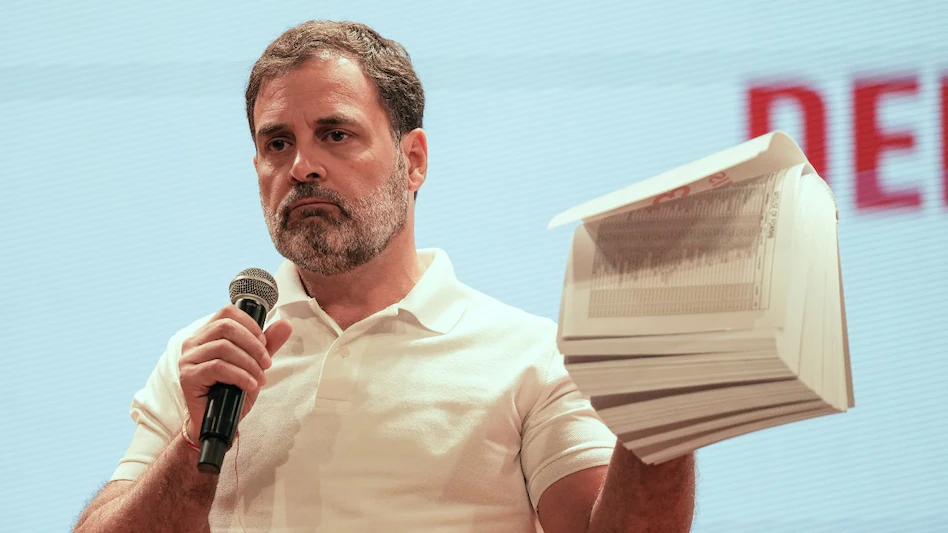
Congress leader Rahul Gandhi, long accused by rivals of undermining the credibility of the Election Commission of India (ECI) through his persistent “vote chori” conspiracy, has now found himself at the centre of a new controversy. On September 10, an influential X (formerly Twitter) account, ‘khurpenchh’, alleged that the controversial document Gandhi showcased during his press conference on August 7 this year was not prepared in India, but in Myanmar.
The revelations were not speculative. They came with hard technical data, metadata embedded in the very files Gandhi himself had uploaded on his official website. Within hours, the expose had gone viral, sparking political tremors in Delhi and triggering a robust counter-offensive from the Congress party.
The metadata trail and Myanmar standard time
At the heart of this controversy lies the metadata, a layer of information hidden within digital files that records details such as the author, creation date, software used, and most crucially, the system time zone of the device on which the file was created.
‘Khurpenchh’, in a detailed seven-tweet thread, analysed the PDFs that Gandhi had uploaded under a Google Drive folder titled “Rahul Gandhi’s Presentation”. The folder contained three versions of the so-called “Vote Chori Proof” document: English, Hindi, and Kannada. Upon examination, each file revealed that it was created using Adobe Illustrator and that the time zone embedded in the metadata matched Myanmar Standard Time (MMT), which is UTC + 6:30.
🚨खुरपेंची ख़ुलासा:
7 अगस्त,2025 को विपक्ष के नेता माननीय राहुल गांधी जी द्वारा वोट चोरी पर एक प्रेस कॉन्फ्रेस की गई,
जो कि पूरे देश में चर्चा का विषय बनी, जिसमे देश के बड़े बड़े सोशल मीडिया इन्फ़्लुएंसर्स ने बढ़चढ़कर हिस्सा लिया।लेकिन जब खुरपेंच टीम ने इसकी तहक़ीक़ात की तो… pic.twitter.com/J3w4JicLkz
— खुरपेंच (@khurpenchh) September 10, 2025
This raised a critical question: why would a document allegedly prepared by Gandhi’s team in India, where the time zone is UTC + 5:30 (IST), carry a signature of being authored in Myanmar’s time zone?
The account clarified further: “VPNs do not alter a system clock. Metadata extracted from Adobe Illustrator reflects the actual machine environment. The Myanmar time zone proves the file was created outside India.”
For tech-savvy users, the revelation was self-explanatory. For the broader political audience, it was a bombshell that cast doubts on the authenticity and origin of Gandhi’s central piece of evidence against India’s electoral system.
Congress rushes to defend, calling it a “bug”
The expose forced the Congress into immediate damage-control mode. On September 11, party spokesperson Supriya Shrinate took to X to downplay the revelations. She claimed the one-hour discrepancy was the result of a software glitch in Adobe products, not evidence of foreign involvement.
“This one-hour discrepancy is not evidence of relocation. It’s a common artefact. Adobe products often exhibit timestamp oddness where offsets mismatch, especially in metadata fields,” Shrinate argued in a defensive tweet.
She even went so far as to cite ChatGPT, suggesting that the metadata controversy was being misinterpreted by political opponents and “two-rupee trolls.”
➡️ Since the 2 rupee trolls and the dumb IT cell are spreading lies about the “Vote Chori” presentation made by Rahul Gandhi on August 7th – it’s important to counter their misinformation and expose how truly dumb they are!
▪️The document, based on the EXIF data for the English…
— Supriya Shrinate (@SupriyaShrinate) September 11, 2025
But her defence drew sharp rebuttals. Many pointed out that the bug Shrinate cited had been associated with Adobe Lightroom and Bridge, not Adobe Illustrator, which was clearly listed as the software used to create Gandhi’s documents. Furthermore, the Lightroom bug she referenced was a 14-year-old issue, patched in 2011, and had no bearing on Illustrator.
“Khurpenchh” immediately highlighted these discrepancies, asking Shrinate and other Congress defenders to cite the specific Illustrator bug that could alter an IST file into MMT metadata. None could provide an answer.
Congress IT cell in counterattack mode
As the debate intensified, Congress’s social media machinery kicked into overdrive. Troll armies, influencers sympathetic to the party, and anonymous handles flooded X with counter-narratives, memes, and dismissals of the Myanmar link. The strategy seemed clear: drown out the technical evidence with noise and ridicule.
Yet, despite the efforts, the metadata analysis proved difficult to dislodge. Independent tech analysts on X sided with “khurpenchh,” emphasising that VPN use or file transfers through Google Drive could not change metadata time zone information.
The more Congress tried to brush it off as a bug, the more it appeared that the party was scrambling without a coherent explanation.
A pattern of foreign shadows around Rahul Gandhi
For political observers, the controversy fits into a broader pattern surrounding Rahul Gandhi’s career, a pattern of alleged foreign influence and unexplained connections.
Some of the most frequently cited episodes include:
1. MoU with the Chinese Communist Party (2008): The Congress party, under Sonia Gandhi’s leadership, signed a memorandum of understanding with the CCP, details of which remain murky to this day. Opponents have long questioned whether this agreement shaped Congress’s softer stance on China.
2. Mysterious foreign trips: Rahul Gandhi has often been accused of leaving the country without public explanation or disclosure in Parliament, raising questions about who he meets abroad.
3. Secret meetings: Reports have emerged of Gandhi holding discussions with foreign diplomats and officials without following the protocol required of an opposition leader.
4. Foreign-backed social media campaigns: Studies and online monitoring groups have alleged that bot farms from Kazakhstan, Russia, and Indonesia amplify Congress narratives online, boosting Gandhi’s visibility in ways that raise eyebrows.
5. Congress office in Turkey: The party’s decision to expand its organisational presence in Turkey, a country frequently hostile to India in international forums, further added to suspicions.
When viewed against this backdrop, the Myanmar metadata trail appears less like an isolated oddity and more like another entry in a worrying pattern of unexplained foreign linkages.
Why the metadata matters
While detractors of the expose may argue that metadata is too technical for public debate, its significance cannot be overstated. Metadata acts like a digital fingerprint. It reveals not just what is being said, but where and how it was prepared.
For a document intended to question the credibility of India’s election process, being authored in a foreign country, even inadvertently, undermines its very foundation. If Congress wanted to build a narrative of “vote chori,” relying on a document apparently created outside India only strengthens accusations of external interference.
Unanswered questions
As of now, Rahul Gandhi has remained conspicuously silent. His party’s defence, hinging on a vague Adobe bug explanation, has convinced few outside the Congress echo chamber.
The Myanmar link, if proven beyond doubt, would represent more than a mere embarrassment; it would strike at the heart of Congress’s credibility and raise questions of whether foreign actors play a role in shaping opposition narratives in India.
With suspicions already surrounding Rahul Gandhi’s foreign engagements, the metadata revelation has deepened scepticism. Until Rahul Gandhi or the Congress leadership provides a transparent and verifiable explanation, the shadow of Myanmar will continue to loom large over the “vote chori” controversy.












Comments