





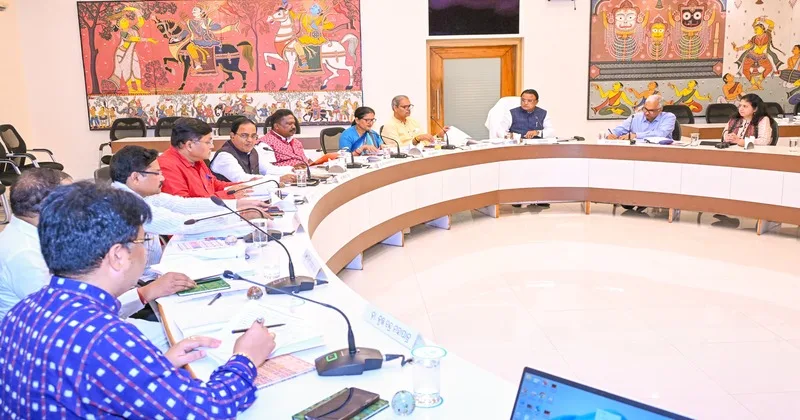
Bhubaneswar: In a major policy decision, the Odisha Cabinet, chaired by Chief Minister Mohan Charan Majhi, has approved the ambitious ‘New City Development’ scheme for Bhubaneswar. The decision was taken at the 26th meeting of the Cabinet held at Lok Seva Bhawan, signalling the state government’s commitment to building a modern, inclusive, and sustainable urban hub in the capital region.
Chief Secretary Manoj Ahuja, briefing the media after the meeting, said the proposed new city will be developed over nearly 800 acres within the Bhubaneswar Development Plan Area (BDPA), covering Gothapatna, Malipada, and Daspur mouzas. The project is envisioned as a multi-economic growth zone aligned with the long-term vision “Viksit Odisha 2036.”
A Transit-Oriented, Inclusive Township
According to officials, the New City will adopt a transit-oriented development model, placing strong emphasis on efficient public transport, reduced travel distances, and seamless connectivity. The design also integrates the state’s commitment to “Housing for All” by ensuring affordable and diverse residential options for every income group. The township will be inclusive in nature, designed to meet the aspirations of both the economically weaker sections and the middle- and high-income populations.
World-Class Infrastructure and Community Spaces
The project promises to deliver state-of-the-art infrastructure. It will include facilities for Meetings, Incentives, Conferences, and Exhibitions (MICE) to attract global business events, innovation-driven plug-and-play hubs, and modern data management centres. Alongside, the city will emphasise “creative placemaking” by incorporating central forest parks, gateway plazas, and expansive open spaces that will serve as vibrant hubs of community engagement and recreation. These features are expected to enhance the social and cultural vibrancy of the capital region.
Green and Smart Solutions for Sustainable Growth
Officials highlighted that the project is being designed with a strong focus on climate resilience and environmental sustainability. Smart and green infrastructure solutions will be integrated into the township to ensure sustainable urban living, better resource efficiency, and improved quality of life. The approach aims to make Bhubaneswar a model for next-generation city development in India.
Global Partnership for Master Planning
A significant milestone in this initiative was achieved on January 17, 2025, when the Bhubaneswar Development Authority (BDA) signed a Memorandum of Understanding (MoU) with Surbana Jurong Infrastructure Pvt. Ltd. (SJI), Singapore, in the presence of the President of Singapore and the Chief Minister of Odisha. Under this partnership, SJI will provide consultancy services for preparing the master plan and advisory support for urban infrastructure development in the Greenfield Township.
Investment and Funding Framework
The BDA has projected a total investment of Rs 8,179 crore for the complete execution of the project over the next 15 years. Funding will be sourced from both public and private avenues to ensure sustainability and scale. For the first phase of implementation, covering 2025-26 to 2029-30, the state government has proposed an allocation of Rs 1,342 crore from the state budget. These funds will be utilised for land acquisition, road construction, core utility services, public amenities, and administrative contingencies.
Cabinet Decision on Panchayati Raj Financial Powers
Apart from the approval of the New City scheme, the Cabinet also cleared significant amendments to the Odisha Panchayat Samiti Accounting Procedure Rules, 2002, thereby enhancing the financial powers of government officers in Panchayati Raj institutions.
The financial authority of Block Development Officers (BDOs) has been increased fivefold—from ₹2 lakh to ₹10 lakh—for passing bills of Panchayat Samiti works without requiring counter-signatures from Samiti chairpersons. Similarly, administrative approval and technical sanction powers have been delegated to engineers and Chief Development Officers (CDOs)-cum-executive officers of Zilla Parishads.
Officials clarified that these reforms will streamline the approval process, eliminate delays caused by multiple counter-signatures, and ensure the faster execution of developmental schemes at the grassroots level.
Ahead of the meeting, the CM released a compilation of key decisions from the last 25 cabinet sessions, highlighting 149 resolutions across 34 departments.















Comments