





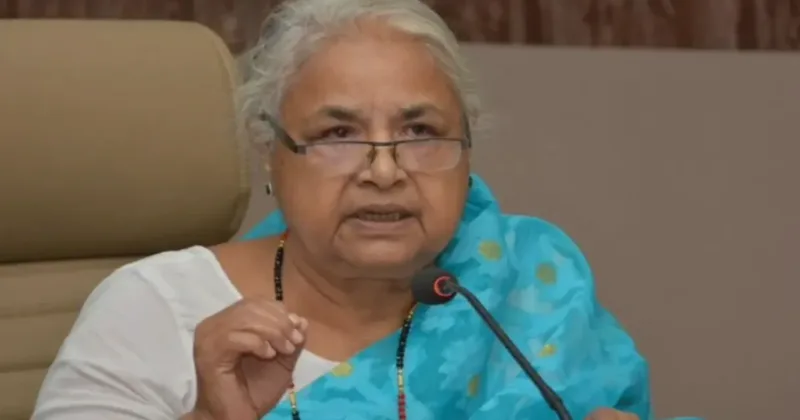
Kathmandu: Former Chief Justice of Nepal, Sushila Karki, who is set to lead the country’s interim government following the resignation of Prime Minister KP Sharma Oli, has spoken warmly of her deep ties with India and admiration for Prime Minister Narendra Modi.
The 71-year-old jurist, chosen by Nepal’s Gen-Z protesters to head the transitional administration, credited her years at Banaras Hindu University (BHU) in Varanasi during the 1970s for shaping her worldview. “I studied in BHU… I have many friends in India. I still remember my teachers in BHU. The relationship with India is very good and it goes back many years,” Karki told CNN-News18.
https://x.com/Indian_Analyzer/status/1965781295965122752
Expressing gratitude towards India’s support for Nepal over the decades, Karki described herself as “a friend of India.” She said, “I am very much impressed with Indian leaders. Indians treat me as a sister. Main Modi ji ko namaskar karti hoon. I have a good impression of Modi ji.”
Karki emphasised that she felt humbled by the faith of Nepal’s young generation who reposed trust in her leadership during a turbulent political transition. “The Gen-Z group trusted me to lead the government for a short period. I am ready to work in the national interest,” she said.
From Jurist to Premier: Know all about first former woman Chief Justice Sushila Karki
In a significant development aimed at resolving the political turmoil that has gripped Nepal over the past two days, former Chief Justice Sushila Karki has agreed to serve as the country’s interim Prime Minister. A distinguished jurist and the first woman to hold Nepal’s highest judicial office, Ms. Karki’s name was proposed by a surprising new voice in the country’s political landscape: “Gen Z.”
The appointment follows a virtual consensus meeting in which Ms. Karki received the support of 3,543 of the 5,000 participants. Her selection is seen as an effort to restore stability by appointing a non-partisan figure with a strong public reputation.
Born on June 7, 1952, in Biratnagar, Sushila Karki is a respected figure in Nepal’s legal community. She made history in 2016 when she became the first female Chief Justice of Nepal’s Supreme Court. Her tenure, however, was marked by a dramatic episode in 2017 when an impeachment motion was filed against her by the Maoist Centre and Nepali Congress. The move, widely seen as an attempt to undermine the judiciary, was met with public outcry and was ultimately withdrawn following an interim order from the Supreme Court itself.
A former student of Banaras Hindu University (BHU) in India, Karki holds a master’s degree in Political Science from the institution, which she completed in 1975. She later earned a Bachelor of Law from Tribhuvan University in Nepal in 1978. She began her legal career in 1979 in Biratnagar and was appointed a Supreme Court justice in 2009, becoming a permanent justice in 2010.
Her tenure, however, was not without turbulence. On April 30, 2017, an impeachment motion was filed against her in Parliament by the Maoist Centre and Nepali Congress, a move widely seen as an attempt to weaken judicial independence. Massive public backlash and an interim order from the Supreme Court forced the withdrawal of the motion, further elevating her stature as a defender of democratic values.
Throughout her career, Ms. Karki was known for her landmark judgments in high-profile cases, including the Sudan peace mission corruption case, the Nepal Trust Office vs. Prerana Rajya Lakshmi Rana property dispute, and a case involving corruption in the printing of polymer banknotes. Her notable rulings on the Kathmandu-Nijgadh Fast Track project and surrogacy have also left a significant mark on the country’s legal precedents.
In addition to her legal and now political roles, Ms. Karki is also an author. She has published two books: an autobiographical work titled “Nyaya” (Justice), and a novel titled “Kara,” which is set in the Biratnagar jail where she herself was held during the Panchayat regime.
















Comments