





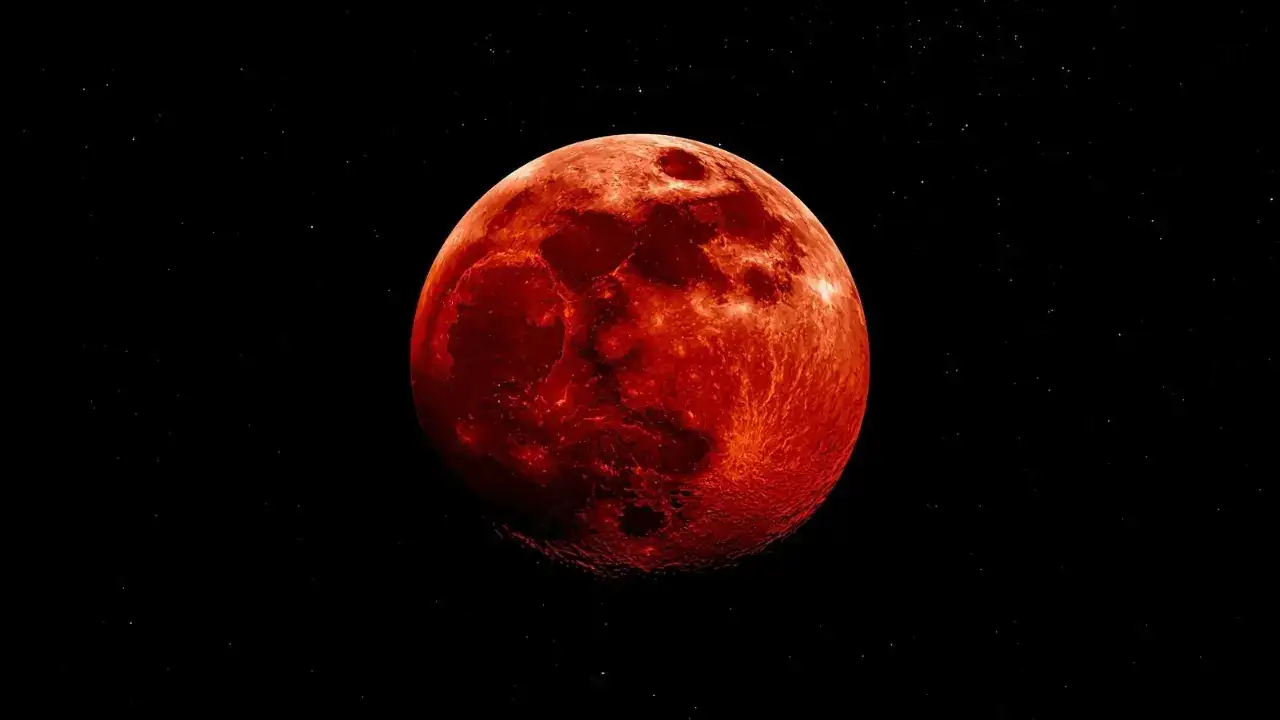
A rare celestial event is set to dazzle sky-watchers as a total lunar eclipse (Chandra Grahan), popularly known as a Blood Moon, will be visible across India on the night of September 7 and the early hours of September 8, 2025. This marks the second lunar eclipse of the year and will unfold over several hours, treating astronomy enthusiasts to the mesmerising sight of the Moon gradually transforming into a deep reddish hue.
The event, often called a “Blood Moon,” occurs when Earth comes directly between the Sun and the Moon, casting its shadow across the lunar surface. Unlike solar eclipses, lunar eclipses are safe to view with the naked eye, making it an accessible event for millions across the globe.
During the eclipse, sunlight passes through the edges of Earth’s atmosphere, scattering shorter blue and green wavelengths while bending longer red wavelengths onto the lunar surface. This phenomenon transforms the Moon into a glowing copper-red orb.
The total phase will last for 82 minutes, during which the Moon will appear vividly red. Including the penumbral and partial phases, the entire celestial event will span several hours. The eclipse will start at 09:58 pm on September 7, and end at 1:26 am on September 8, according to Drik Panchang.
According to astronomical calculations by Drik Panchang, the lunar eclipse in New Delhi will take place in the following stages:
First contact with penumbra: 8:59 PM
First contact with umbra: 9:58 PM
Total eclipse begins: 11:01 PM
Maximum eclipse: 11:42 PM
Total eclipse ends: 12:22 AM (Sept 8)
Last contact with umbra: 1:26 AM (Sept 8)
Last contact with penumbra: 2:24 AM (Sept 8)
Duration:
Penumbral phase: 5 hours 24 minutes
Partial phase: 3 hours 28 minutes
Total phase: 1 hour 21 minutes
In Hindu tradition, a lunar eclipse (Chandra Grahan) is considered significant only when the umbral phase is visible to the naked eye. Since this eclipse will be clearly visible in India, Sutak rituals and precautions will be observed.
Sutak begins: 12:19 PM (Sept 7)
Sutak ends: 1:26 AM (Sept 8)
For children, the elderly, and the sick, Sutak starts later at 6:36 PM on Sept 7 and ends with the eclipse at 1:26 AM on Sept 8.
During Sutak, religious activities are generally avoided, and many households abstain from consuming food until the eclipse concludes.
Astronomers confirm that the entire eclipse will be visible across India, from moonrise until well past midnight. Major cities including Delhi, Mumbai, Bengaluru, Chennai, and Kolkata are expected to get a clear view, weather permitting.
Globally, the eclipse will be visible to nearly seven million people across continents, with prime viewing in Yangon, Shanghai, Johannesburg, Lagos, Cairo, Bangkok, Jakarta, Berlin, Moscow, Seoul, Rome, Dhaka, Manila, Athens, Singapore, Melbourne, Sydney, Tokyo, Beijing, Brussels, Paris, London, and Madrid.
Such long-duration total lunar eclipses are rare, and the Moon turning red for over an hour is an awe-inspiring reminder of Earth’s cosmic position. For students, sky lovers, and photographers, it is both a learning opportunity and a visual delight.










Comments