





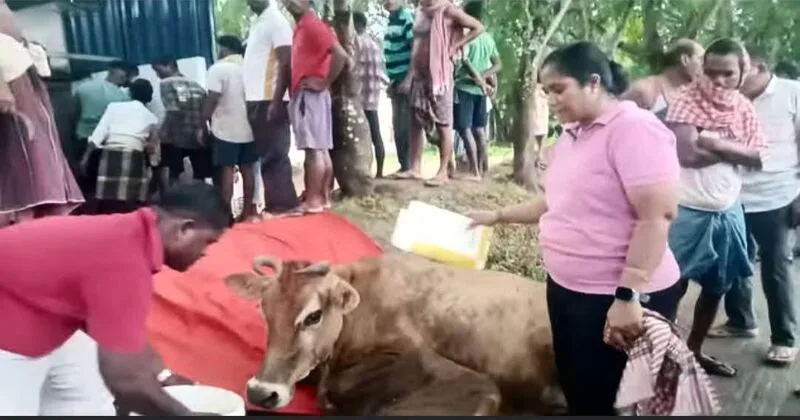
Bhubaneswar: Jajpur district of Odisha is gradually turning into a major hub for cow smuggling. Despite stringent laws in place, repeated incidents of illegal transportation of cattle have raised serious questions about the role of the administration and law enforcement agencies. In the latest case, police in Badachana police station limits, intercepted a container truck loaded with dozens of cows in inhumane conditions. Out of the 48 cows rescued, 28 had already died due to suffocation and ill-treatment.
The incident has triggered widespread outrage and sparked fresh debate over the growing menace of cattle trafficking in the district. Locals and activists have accused authorities of failing to implement laws effectively and turning a blind eye towards the illegal trade.
Container seized, 28 cows dead
According to police, the cows were being transported in a Uttar Pradesh-registered container truck from Balichandrapur area of Jajpur district and were headed towards Kolkata. On receiving a tip-off, Badachana police inspector-in-charge Madhusmita Behera led a team to intercept the truck near Kundal Benapur bridge close to Chandikhole.
As the police approached, the driver and helper abandoned the vehicle and fled. Upon inspection, the container revealed a shocking sightcows tied with ropes, packed in large numbers without food, water, or ventilation. Many were already struggling to breathe. By the time police managed to unload them, 28 cows had died of suffocation.
The surviving animals were shifted to a goshala (cow shelter) in Choudwar, while the carcasses were buried in nearby forests with the help of local villagers. Police have launched a manhunt for the absconding driver and helper.
Cattle-Laden auto seized in Brahmabarada
In another incident the same week, police in Brahmabarada area under Rasulpur block seized an auto-rickshaw (OD 05 AZ 9752) carrying three bulls. Acting on a tip-off from locals who noticed the animals crammed inside the vehicle, police rescued the bulls and detained the driver for questioning.
Preliminary investigation revealed that the animals were being transported towards Istamapadia area of Dharmasala block. However, no formal FIR was registered in this case. Locals expressed dissatisfaction over the casual handling of such cases, questioning why strict charges were not framed against the offenders.
A growing nexus of cow smuggling
The seizure of the container carrying 48 cows is not an isolated incident. In fact, Badachana police alone have intercepted over 11 cattle-laden vehicles in the past four months, rescuing more than 400 cows. Yet, activists argue that such action is limited to only one or two police stations, while others remain inactive.
Smugglers reportedly transport cattle from various parts of Odisha, including Jajpur, Kendrapara, Dhenkanal, and Cuttack, using both small vehicles and large container trucks. These vehicles often pass through national highways without being stopped, raising suspicion of a deeper nexus and possible protection enjoyed by traffickers.
Locals and cow protection activists claim that Sahapur Hat in Panikoili police station limits has now become a major transit point for cattle trafficking. Large numbers of cattle are allegedly gathered here, tied cruelly with ropes, and loaded into trucks late at night. From there, they are transported out of the state, mainly towards West Bengal and beyond.
Administration under fire
Activists have sharply criticized the administration, pointing out that Odisha has strict laws prohibiting cow slaughter, sale, and transportation. Yet, smuggling thrives openly, often in plain sight on highways and near checkpoints. They allege that police conduct occasional raids to show formality, but most consignments pass without any obstruction.
“The fact that hundreds of cattle can be packed into trucks and moved across districts every day without being stopped clearly indicates either negligence or collusion,” said a local activist. “When only one police station like Badachana takes consistent action while others remain silent, it raises serious doubts about police integrity.”
Villagers in Jajpur, too, have expressed anger over the inaction of authorities. Many have demanded stricter monitoring, more frequent highway checks, and accountability from officials who allow such illegal consignments to pass.
Disturbing conditions of transportation
The recent Badachana case also highlights the inhumane conditions in which cows are transported. Instead of following basic animal welfare guidelines, traffickers allegedly tie the legs and necks of cattle with ropes and force them into tightly packed containers without ventilation.
Wider network across Odisha
Jajpur is not the only district facing the cattle smuggling menace. Reports indicate that traffickers also operate from Kendrapara, Dhenkanal, and Cuttack, using forest routes and national highways to transport animals towards West Bengal. Despite the presence of forest check-posts and multiple police stations, most consignments escape scrutiny.
Local people argue that this would not be possible without systemic loopholes or deliberate negligence. “Every day, trucks and autos carrying cattle pass through our villages and highways. Everyone sees it, yet no authority intervenes. If the administration is truly serious, they can stop it in a week by strict monitoring,” said a villager from Jajpur.
Demands for stronger action
Cow protection activists and local villagers have demanded urgent steps to curb the growing trade. They insist that all police stations must work in coordination, monitor highways round-the-clock, and subject every suspicious vehicle to strict checking.
“There needs to be accountability. If one police station can seize 11 trucks in four months, why are others not doing anything?” asked a cow protection leader. “Unless higher authorities intervene and order joint operations, smugglers will continue to operate with impunity.”
Activists also want the state government to set up more shelters for rescued cattle, introduce harsher penalties for smugglers, and ensure that repeat offenders face stricter legal consequences.
The back-to-back incidents in Badachana and Brahmabarada have once again exposed the alarming rise of cow smuggling in Jajpur district. With traffickers adopting new methods and exploiting loopholes, the district is fast emerging as a critical hub for the illegal trade.
While sporadic police action has resulted in significant rescues, inconsistent enforcement, administrative silence and alleged complicity have emboldened smugglers. Unless urgent and coordinated measures are taken, Jajpur risks cementing its reputation as Odisha’s cattle smuggling capital.
















Comments