





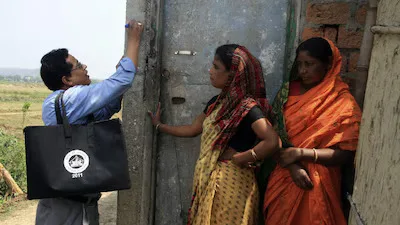
India is preparing to undertake one of the most ambitious data-collection exercises in its history. The Census 2027 will not only enumerate the country’s vast population but also introduce a technological leap by geo-tagging every single building across the nation.
This first-of-its-kind initiative marks a watershed moment in India’s approach to governance, promising precision, transparency, and a data-driven foundation for policymaking. It is a historic departure from traditional methods that relied heavily on manual entries and hand-drawn sketches, which often lacked accuracy and uniformity.
For decades, census workers across India prepared hand-drawn notional sketches to represent villages, towns, and city wards. While these sketches served their purpose in earlier times, they were prone to errors, duplication, and inconsistencies, particularly in fast-urbanising areas where the pace of development often outstripped official records.
By 2027, this entire system will be replaced with Digital Layout Mapping (DLM). Using Geographic Information System (GIS) technology, every building will be assigned precise latitude and longitude coordinates, automatically generating accurate digital layout maps. This means that every structure, from a remote hut in the Himalayas to a skyscraper in Mumbai, will be digitally recorded and geo-referenced.
Officials emphasise that such a system will virtually eliminate duplication, reduce errors, and provide a transparent record of the housing stock in both rural and urban India.
The new methodology will also change what gets counted and how it is classified. The census will categorise structures into residential, non-residential, partly residential, and landmark buildings. Within each building, details will be collected on the number of census houses and the households occupying them.
As per the 2011 definition, a household is a group of people living together and sharing meals from a common kitchen. In 2011, India recorded 33.08 crore houses, of which 30.61 crore were occupied and 2.46 crore vacant. Of these, 22.07 crore were rural and 11.01 crore urban. With urbanisation accelerating over the past decade, census authorities expect both the total numbers and the share of urban houses to increase significantly in 2027. This shift will provide policymakers with vital insights into how India’s settlement patterns are changing and what this means for infrastructure, urban planning, and welfare delivery.
The 2027 Census will be carried out in two phases. The first, called the Houselisting Operations (HLO), is scheduled between April and September 2026. During this phase, enumerators will record details about housing conditions, amenities, property ownership, and geo-tag buildings. The second phase, the Population Enumeration, will be conducted in February 2027 across most of India.
However, in states like Jammu & Kashmir, Ladakh, Himachal Pradesh, and Uttarakhand, where harsh winters make February impractical, the enumeration will take place earlier, in September 2026. This staggered approach ensures that weather extremes do not disrupt the massive field operations required.
Perhaps the most significant departure from the past is that the entire census will be fully digital. Dedicated mobile applications have been designed for field enumerators, replacing the bulky paper registers of previous censuses. Citizens, too, will have the option of self-enumeration through secure digital portals. This will not only save time and resources but also make participation more convenient for tech-savvy urban households.
For the first time, caste data will also be collected electronically, enabling sharper analysis of social structures and more targeted welfare interventions.
The backbone of this digital transformation will be the Census Monitoring & Management System (CMMS), developed under the Office of the Registrar General and Census Commissioner of India (RGI). CMMS will integrate administrative boundaries, satellite imagery, data on built-up areas, and geo-tagged household information into a single platform.
Authorities at the central and state levels will be able to monitor census progress in real time, track enumerator performance, and resolve technical issues instantly. In previous censuses, problems often went unnoticed until much later, delaying corrective action. The CMMS ensures that this will no longer be the case.
India is not entirely new to geo-tagging exercises. Similar technology has already been deployed in government programmes like the Pradhan Mantri Awas Yojana (PMAY), where housing beneficiaries properties were geo-tagged to ensure transparency and prevent fraud.
The lessons learned from these smaller exercises will now be scaled up to the national level. However, the sheer scale of Census 2027 is unprecedented: it involves tracking more than 140 crore people spread over more than 3 crore square kilometres of territory.
The benefits of geo-tagging extend far beyond statistical accuracy. Policy experts note that such precision will enable improved targeting of welfare schemes like PMAY, Jal Jeevan Mission, and rural electrification programmes. For urban development, accurate data on peri-urban growth and semi-urban sprawl will allow planners to redraw India’s urban map, aligning infrastructure development with actual population trends. In disaster-prone areas, geo-tagged maps can serve as vital tools for evacuation planning, relief distribution, and reconstruction efforts.
Moreover, digital workload management will ensure that enumerators’ assignments are more balanced, preventing under-coverage or duplication. As one census official observed, “The geo-tagging exercise will help in accurately estimating the number of census houses and households requiring enumeration, thus improving workload management across field functionaries.”
However, this leap into the digital future has not come without concerns. Privacy advocates and opposition voices have raised questions about data security and surveillance risks. The fear is that geo-tagging every household, when combined with demographic details, could expose citizens to misuse if data falls into the wrong hands. Government officials, however, have sought to allay such fears, assuring that strict encryption protocols and multi-layered security frameworks are being built into both the CMMS and the census mobile applications. They also underline that no personally identifiable information will be released into the public domain, and sensitive data will remain confidential as mandated by the Census Act.
For India, Census 2027 will be more than just a headcount. It will serve as a digital mirror of the nation, reflecting not just population numbers, but the lived reality of its homes, its people, and its aspirations. In a country as vast and diverse as India, where rapid migration and urbanisation often outpace official records, the importance of such a digital shift cannot be overstated. From enabling more effective welfare distribution to building resilience against disasters, the ripple effects of this census will likely be felt for decades to come.
As India prepares for this monumental task, it is clear that the census is no longer just a statistical exercise. It is becoming the backbone of governance in a digital era. Census 2027 will not only mark the first time every building in India is geo-tagged but will also symbolise the country’s determination to embrace technological solutions for complex governance challenges. It is a step that will define how India records, understands, and plans for its future, a future where data is not merely collected, but transformed into a tool for nation-building.










Comments